

Pakistan power minister warns solar net-metering may raise national costs

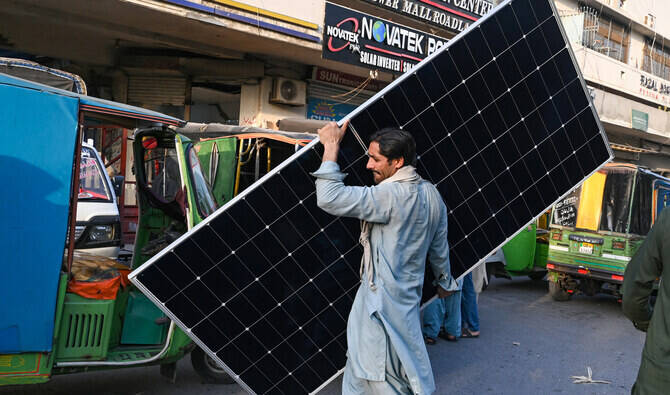
A worker carries a solar panel plate at a market in Lahore, Pakistan, on June 12, 2024. (AFP/File)
Short Url
Updated 30 August 2025
Follow

Pakistan power minister warns solar net-metering may raise national costs

  • Net metering lets users generate solar power, sell excess to the grid for credit or cash
  • PM Shehbaz Sharif has directed further cuts in power tariffs, Sardar Awais Leghari says

ISLAMABAD: Pakistan’s Power Minister Sardar Awais Leghari on Friday warned that the use of solar net-metering facility could add an extra burden of Rs3-4 per unit on consumers, if allowed to continue unchanged.

Solar net-metering is a policy that allows homeowners and businesses to generate power using solar panels and export excess energy to the national grid. In Pakistan, it is a billing system through which consumers receive credits or monetary compensation for the surplus power they sell to the grid.

Approved in 2017 to promote solar energy, Pakistan’s net-metering policy pays Rs21 per unit for surplus solar power, including a Rs1.90 subsidy. In April last year, the energy ministry said the subsidy burden falls on the government and other consumers to benefit affluent households with solar panels.

Around 0.6 percent of total electricity consumers in Pakistan are net-metering users out of which 80 percent belonged to affluent areas of major cities while the remaining 99.4 percent of electricity consumers bear the burden of the net-metering costs, the energy ministry said in January this year.

“As for the matter of net metering, if it is allowed to continue in the same manner, then 200,000 to 300,000 people will benefit from it while placing an additional burden of Rs3-4 on the entire nation,” Leghari said at a press conference in Lahore.

Around 18 million consumers are already receiving electricity at a 70 percent discount, which was up from nearly six million consumers in recent years, according to the minister. Prime Minister Shehbaz Sharif has directed further cuts in electricity prices and officials at the energy ministry are “exploring different options” to achieve this.

Leghari had called for revising Pakistan’s existing net-metering system in January this year, saying that it was becoming unfeasible for the government.

“Solar net-metering has to change,” Leghari said while addressing a conference in Islamabad. “It is impossible for us to sustain the same cost of buying power from distributors the way we are.”

Pakistan has ideal climatic conditions for solar power generation, with most parts of the country receiving over nine hours of sunlight daily. According to the World Bank, utilizing just 0.071 percent of the country’s land area for solar photovoltaic (solar PV) power generation could meet Pakistan’s electricity demand.

The South Asian country, home to 241 million people, aims to transition to 60 percent renewable energy by 2030 and reduce projected emissions by 50 percent. However, despite a recent surge in solar power adoption, it remains far behind in achieving this goal.


China’s mediation eases fighting between Pakistan, Afghanistan — sources

Updated 4 sec ago
Follow

China’s mediation eases fighting between Pakistan, Afghanistan — sources

  • China’s envoy shuttles between Pakistan and Afghanistan to mediate in conflict
  • Gulf countries that mediated in the past embroiled in Middle East conflict

ISLAMABAD/BEIJING: Chinese mediation efforts, including a message from ​President Xi Jinping, have helped ease the worst fighting between Pakistan and Afghanistan since the Taliban returned to power in 2021, three Pakistani government officials said.

The officials said a meeting between the Chinese ambassador to Pakistan, Jiang Zaidong, and Prime Minister Shehbaz Sharif late last month included a message from Xi to cease hostilities.

Neither side has reported any Pakistani air strikes on Afghanistan in recent days and ground fighting along the 2,600-km (1,600-mile) border has tapered off, although daily clashes continue to be reported.

China has said it is ‌in contact ‌with both countries about ending hostilities but Mosharraf Zaidi, a ​spokesman ‌for ⁠Sharif who ​has previously ⁠said there would not be any talks with the Taliban, did not respond to questions about Beijing’s efforts.

Pakistani security officials have said the military campaign will continue until desired goals were achieved, which was to prevent militant attacks in Pakistan launched from Afghan soil.

Pakistan’s foreign ministry and military did not respond to Reuters requests for comment.

Islamabad launched air strikes on Afghanistan on February 26, saying the Taliban were providing a safe haven to ⁠militants carrying out attacks in Pakistan. Kabul denies the charge ‌and says militancy in Pakistan is an internal problem.

The ‌Chinese efforts came as Qatar, Saudi Arabia and ​Turkiye, who hosted talks between Pakistan and ‌Afghanistan during previous clashes in October, have been embroiled in the war in the Middle ‌East following the US and Israeli strikes on Iran.

“China’s Special Envoy for Afghanistan Affairs is currently shuttling between the two countries to mediate, while Chinese embassies in both nations maintain close communication with the respective parties,” the Chinese foreign ministry told Reuters in an email.

“The most urgent task ‌is to prevent the fighting from expanding and for the two countries to return to the negotiating table as soon as possible.”

The ⁠foreign ministry added ⁠that Foreign Minister Wang Yi held telephone talks with Pakistan’s Deputy Prime Minister and Foreign Minister Ishaq Dar on Tuesday to discuss the conflict.

China’s ambassador to Kabul, Zhao Xing, and the special envoy Yue Xiaoyong met Afghanistan’s acting Foreign Minister Amir Khan Muttaqi this week, the Afghan foreign ministry said in a statement.

Afghanistan and Pakistan have said they inflicted heavy damage on the other in the conflict and killed hundreds of opposition troops, without providing evidence. Reuters has not been able to verify the reports.

Beijing, a longtime Pakistani ally, has invested heavily in mines and minerals in both nations.

The investments include over $65 billion in road, rail and other development projects in Pakistan, part ​of Beijing’s Belt and Road Initiative to ​expand land and sea trade routes to Europe and Africa.