

Pakistan power minister warns solar net-metering may raise national costs

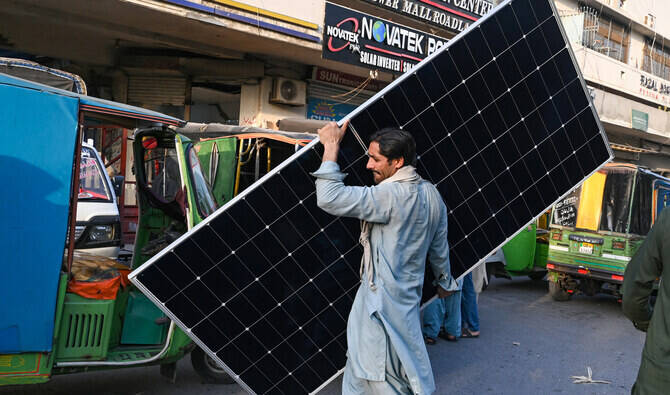
A worker carries a solar panel plate at a market in Lahore, Pakistan, on June 12, 2024. (AFP/File)
Short Url
Updated 30 August 2025
Follow

Pakistan power minister warns solar net-metering may raise national costs

  • Net metering lets users generate solar power, sell excess to the grid for credit or cash
  • PM Shehbaz Sharif has directed further cuts in power tariffs, Sardar Awais Leghari says

ISLAMABAD: Pakistan’s Power Minister Sardar Awais Leghari on Friday warned that the use of solar net-metering facility could add an extra burden of Rs3-4 per unit on consumers, if allowed to continue unchanged.

Solar net-metering is a policy that allows homeowners and businesses to generate power using solar panels and export excess energy to the national grid. In Pakistan, it is a billing system through which consumers receive credits or monetary compensation for the surplus power they sell to the grid.

Approved in 2017 to promote solar energy, Pakistan’s net-metering policy pays Rs21 per unit for surplus solar power, including a Rs1.90 subsidy. In April last year, the energy ministry said the subsidy burden falls on the government and other consumers to benefit affluent households with solar panels.

Around 0.6 percent of total electricity consumers in Pakistan are net-metering users out of which 80 percent belonged to affluent areas of major cities while the remaining 99.4 percent of electricity consumers bear the burden of the net-metering costs, the energy ministry said in January this year.

“As for the matter of net metering, if it is allowed to continue in the same manner, then 200,000 to 300,000 people will benefit from it while placing an additional burden of Rs3-4 on the entire nation,” Leghari said at a press conference in Lahore.

Around 18 million consumers are already receiving electricity at a 70 percent discount, which was up from nearly six million consumers in recent years, according to the minister. Prime Minister Shehbaz Sharif has directed further cuts in electricity prices and officials at the energy ministry are “exploring different options” to achieve this.

Leghari had called for revising Pakistan’s existing net-metering system in January this year, saying that it was becoming unfeasible for the government.

“Solar net-metering has to change,” Leghari said while addressing a conference in Islamabad. “It is impossible for us to sustain the same cost of buying power from distributors the way we are.”

Pakistan has ideal climatic conditions for solar power generation, with most parts of the country receiving over nine hours of sunlight daily. According to the World Bank, utilizing just 0.071 percent of the country’s land area for solar photovoltaic (solar PV) power generation could meet Pakistan’s electricity demand.

The South Asian country, home to 241 million people, aims to transition to 60 percent renewable energy by 2030 and reduce projected emissions by 50 percent. However, despite a recent surge in solar power adoption, it remains far behind in achieving this goal.


Pakistan mulls 'Super App' for public services, document verification in major technology push

Updated 7 sec ago
Follow

Pakistan mulls 'Super App' for public services, document verification in major technology push

  • Pakistan has been urging technology adoption in public, private sectors as it seeks to become a key tech player globally
  • The country this month launched the Indus AI Week to harness technology for productivity, skills development and innovation

KARACHI: Pakistan is planning to launch a “Super App” to deliver public services and enable digital document verification, the country's information technology (IT) minister said on Sunday, amid a major push for technology adoption in public and private sectors.

Pakistan, a country of 240 million people, seeks to become a key participant in the global tech economy, amid growing interest from governments in the Global South to harness advanced technologies for productivity, skills development and innovation.

The country's information and communications technology (ICT) exports hit a record $437 million in Dec. last year, according to IT Minister Shaza Fatima Khawaja. This constituted a 23% increase month on month and a 26% increase year on year.

Pakistan's technology sector is also advancing in artificial intelligence (AI) and cloud computing, marked by the launch of Pakistan’s first sovereign AI cloud in November, designed to keep sensitive data domestic and support growth in the broader digital ecosystem.

“In developed countries, citizens can access all government services from a mobile phone,” Fatima said, announcing plans for the Super App at an event in Karachi where more than 7,000 students had gathered for an AI training entrance test as part of the ‘Indus AI Week.’

“We will strive to provide similar facilities in the coming years.”

Khawaja said the app will reduce the need for in-person visits to government offices such as the National Database and Registration Authority (NADRA) and the Higher Education Commission (HEC).

The Indus AI Week initiative, which ran from Feb. 9 till Feb. 15. was aimed at positioning Pakistan as a key future participant in the global AI revolution, according to the IT minister.

At the opening of the weeklong initiative, Prime Minister Shehbaz Sharif announced that Pakistan would invest $1 billion in AI by 2030 to modernize the South Asian nation’s digital economy.

“These initiatives aim to strengthen national AI infrastructure and make the best use of our human resource,” Khawaja said, urging young Pakistanis to become creators, inventors and innovators rather than just being the consumers of technology.