

Pakistan threatens action against resorts, housing societies on riverbeds

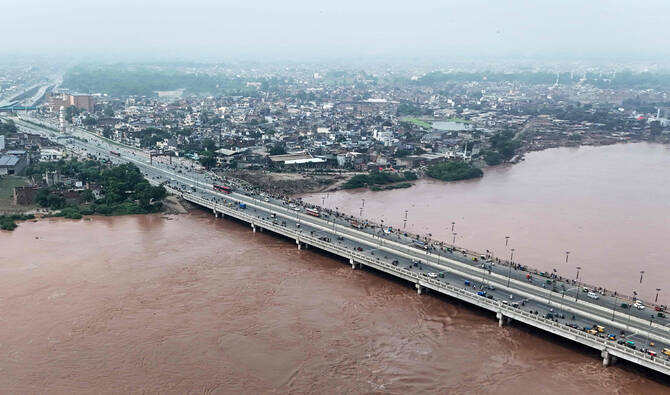
This aerial photograph shows commuters driving on a bridge as floodwaters flow through the Ravi river following a rise in water levels near residential areas in Shahdara, Lahore on August 29, 2025. (AFP)
Short Url
Updated 29 August 2025
Follow

Pakistan threatens action against resorts, housing societies on riverbeds

  • Climate minister vows to assert state authority over wealthy tycoons
  • He says government deploying satellites, drones and AI to track floods

ISLAMABAD: Pakistan’s Climate Change Minister Musadik Malik on Friday warned wealthy business tycoons of action against resorts, hotels and housing societies built on riverbeds after floods inundated the northern and eastern parts of the country.

Swollen rivers in Pakistan’s most populous province, Punjab, have submerged more than 1,600 villages and displaced over 1.1 million people, with about 40 deaths reported in the region since Aug. 15, according to the National Disaster Management Authority (NDMA).

Mass evacuations began after heavier-than-usual monsoon rains and the release of water from overflowing dams in India triggered flash floods in low-lying border areas of Pakistan.

Media footage showed water from the Ravi River entering a lavish private housing society in the eastern city of Lahore last night as police urged residents to evacuate immediately.

“This monsoon is our declaration of war. We will not stop now and will remove every obstacle from the river’s path,” Malik said while addressing a televised news conference in Karachi during his visit.

“The prime minister has said no one is stronger than the state and this year you will see it,” he continued. “Now we will see who is stronger — the state or a handful of tycoons.”

He pleaded with the country’s elite to “have some fear” while building housing colonies along riverbanks.

“These are the very places where we should have been preserving water and where rivers should have been allowed to spread and be stored,” he added.

“Every district should have designated wetland zones and protected areas.”

Malik urged people to grow mangroves, wetlands and forests to absorb carbon dioxide from the air.

He lamented that resorts, hotels and housing societies built along riverbanks by wealthy people had become a source of death for the poor.

“When the mansions and illegal complexes of the wealthy collapse, their concrete and timber turn into missiles,” he said.

“Huge boulders, flying like pebbles, come crashing down with the water hitting poor settlements and destroying everything in their way.”

Calling the settlements on riverbanks an “agent of destruction” for the poor, Malik urged the wealthy elite to reconsider their actions and stop building along riverbanks.

He also disclosed that Pakistan was employing the best technology in the world including satellites, drones and artificial intelligence to monitor and tackle floods.

“Drones are hovering over the mountains, satellites are sending images, AI is mapping every possible route water could take next year.”

Around 842 people have been killed in the monsoon season since June 26, with the northwestern Khyber Pakhtunkhwa province recording the highest number of casualties.

Pakistani officials say the current spell is likely to last until at least Sept. 10 and could rival the 2022 floods, which killed more than 1,700 people and caused over $30 billion in damage.


Pakistan PM invites UAE investment across tech and resource sectors at National Day event

Updated 08 December 2025
Follow

Pakistan PM invites UAE investment across tech and resource sectors at National Day event

  • Shehbaz Sharif says the UAE remains a key economic partner and continues to lend ‘critical support’ to Pakistan
  • UAE envoy says both nations have potential for cooperation in renewable energy, AI and economic diversification

ISLAMABAD: Pakistan is ready to welcome investment from the United Arab Emirates across emerging technologies and resource sectors, Prime Minister Shehbaz Sharif said on Monday, as both countries marked the 54th National Day of the Gulf country in Islamabad.

Speaking at the ceremony attended by senior ministers, diplomats and business leaders, Sharif said the UAE remained a key economic partner for Pakistan and continued to lend “critical support” to the country’s stabilizing economy.

“Pakistan takes great pride in its strategic partnership with the UAE, which continues to deepen across every domain of life,” he said. “With Pakistan’s economy stabilizing, we stand ready to welcome Emirati investment in renewable energy, AI, fintech, agriculture and minerals.”

Sharif praised the UAE’s leadership and recalled his earliest memories of the Gulf nation as “a land that believed in possibilities long before they became realities,” saying the country’s progress under President Sheikh Mohamed bin Zayed Al Nahyan commanded “profound admiration.”

UAE Ambassador Salem Al Bawab Al Zaabi said the Emirates was committed to strengthening ties with Pakistan in areas including the economy, energy and artificial intelligence.

He said the two countries shared a “deep-rooted friendship built on mutual respect, shared values and a common vision for regional peace and development.”

“We see tremendous potential for collaboration in renewable energy, artificial intelligence, sustainability and economic diversification,” the ambassador said, adding that the UAE aimed to broaden the scope of its economic relations with Pakistan.

The UAE hosts around 1.8 million Pakistani expatriates, one of the country’s largest overseas communities, who Sharif said contributed “tirelessly” to the Gulf state’s development.

Sharif and Deputy Prime Minister Ishaq Dar also joined the UAE ambassador in a cake-cutting ceremony to mark the occasion.