

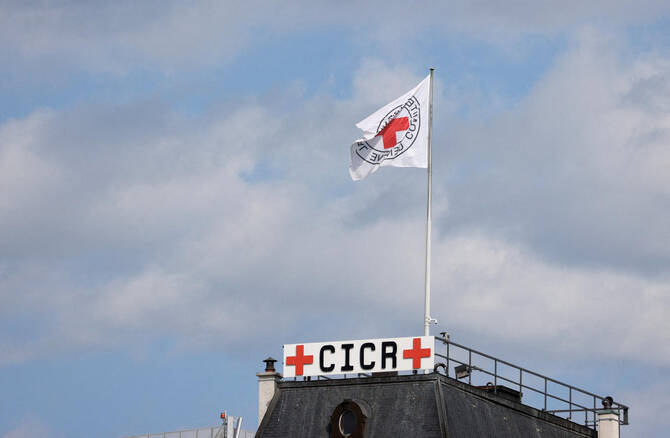
Number of registered missing people surges 70 percent in five years: Red Cross

More than a quarter of a million people are registered as missing by the Red Cross, a figure up nearly 70 percent over five years, the organization said on Friday. (Reuters)
Short Url
Updated 29 August 2025
Follow

Number of registered missing people surges 70 percent in five years: Red Cross

  • The increase is being driven by growing numbers of conflicts, mass migration and fading respect for the rules of war, ICRC said
  • Some 284,400 people were registered as missing by the ICRC’s Family Links Network at the end of 2024

GENEVA: More than a quarter of a million people are registered as missing by the Red Cross, a figure up nearly 70 percent over five years, the organization said on Friday.

The increase is being driven by growing numbers of conflicts, mass migration and fading respect for the rules of war, the International Committee of the Red Cross said in a statement.

“From Sudan to Ukraine, from Syria to Colombia, the trend is clear: the surging number of missing persons provides a stark reminder that conflict parties and those who support them are failing to protect people during war,” said ICRC director-general Pierre Krahenbuhl.

Some 284,400 people were registered as missing by the ICRC’s Family Links Network at the end of 2024, an increase of 68 percent since 2019, according to numbers released on Friday.

But Krahenbuhl cautioned that that figure represents “only the tip of the iceberg.”

“Worldwide, millions of people have been separated from their loved ones — often for years or even decades,” he said.

“The tragedy of the missing is not inevitable. With stronger measures to prevent separation, protect those in detention and properly manage the dead, countless families could be spared a lifetime of anguish.

“Let us remember that behind every number is a mother, father, child or sibling whose absence leaves a wound that statistics cannot capture.”

The ICRC stressed that states and parties to armed conflicts bear the primary responsibility to prevent disappearances, clarify the fate of missing people and provide support to families.

“How states respond to missing persons cases can shape societies long after violence ends, influencing peace-building, reconciliation and the ability of communities to heal,” it said.

It emphasized that when parties respect international humanitarian law, “the risk of people going missing is reduced.”

The rules of war include, for instance, a duty to avoid separating family members during the transfer or evacuation of civilians by an occupying power.

And they stipulate that parties must share information about detainees in a timely manner and enable them to maintain contact with relatives.

“The obligation to account for deceased enemy combatants likewise ensures that their fate is known to the families and they are not registered as missing,” it said.


US bombers join Japanese jets in show of force after China–Russia drills

Updated 8 sec ago
Follow

US bombers join Japanese jets in show of force after China–Russia drills

  • Japan says US B-52 bombers flew with Japanese F-35s and F-15s
  • South Korea and Japan have scrambled jets during Chinese and Russian drills

TOKYO: US nuclear-capable bombers flew over the Sea of Japan alongside Japanese fighter jets on Wednesday, Tokyo said, in a show of force following Chinese and Russian drills in the skies and seas around Japan and South Korea.
Japan and the US “reaffirmed their strong resolve to prevent any unilateral attempt to change the status quo by force and confirmed the readiness posture of both the Self-Defense Forces (SDF) and US forces,” Japan’s defense ministry said in a press release on Thursday.
The flight of two US B-52 strategic bombers with three Japanese F-35 stealth fighters and three F-15 air-superiority jets was the first time the US had asserted its military presence since China began military exercises in the region last week.
The display follows a joint flight of Chinese and Russian strategic bombers in the East China Sea and western Pacific on Tuesday and separate Chinese aircraft carrier drills that prompted Japan to scramble jets that Tokyo said were targeted by radar beams.

A Russian Tu-95 nuclear-capable strategic bomber which flew from the Sea of Japan to the East China Sea to rendezvous with two Chinese H-6 bombers before heading into the Western Pacific on December 9, 2025. (Japan Self Defense Forces/Handout via REUTERS)

The encounter drew criticism from Washington, which said the incident was “not conducive to regional peace and stability” and reaffirmed that its alliance with Japan was “unwavering.”
Both Japan and South Korea host US forces, with Japan home to the biggest concentration of American military power overseas, including an aircraft carrier strike group and a US Marine expeditionary force.
China denied Tokyo’s accusation, saying Japanese jets flying near the carrier had endangered its air operations south of Japan.

South Korea’s military said it also scrambled fighter jets when the Chinese and Russian aircraft entered its air defense identification zone on Tuesday, an area that extends beyond its airspace and is used for early warning.
 

Chinese H6 nuclear-capable strategic bomber flies from the East China Sea over the Miyako Strait into the Western Pacific on December 9, 2025. (Japan Self Defense Forces/Handout via REUTERS)

Regional tensions have risen since Japanese Prime Minister Sanae Takaichi triggered a dispute with Beijing last month with her remarks on how Tokyo might react to a hypothetical Chinese attack on Taiwan.
China claims democratically governed Taiwan and has not ruled out using force to take control of the island, which sits just over 100 km (62 miles) from Japanese territory and is surrounded by sea lanes on which Tokyo relies.