

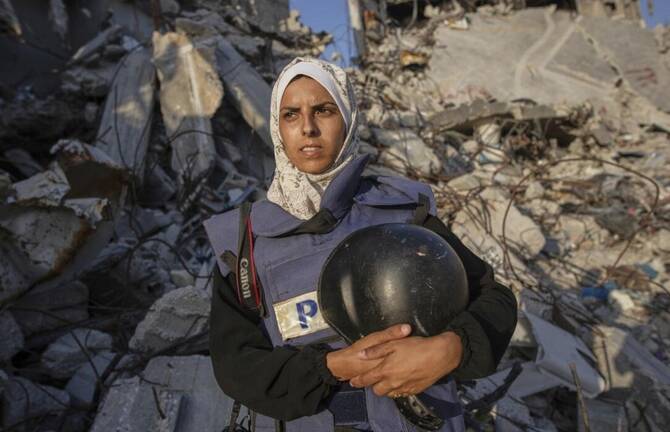
Journalist Mariam Dagga’s final images show where she was killed by an Israeli strike in Gaza

The last photos taken by Mariam Dagga show the damaged stairwell outside a hospital in the Gaza Strip where she would be killed by an Israeli strike moments later. (X/@malonebarry)
Short Url
Updated 29 August 2025
Follow

Journalist Mariam Dagga’s final images show where she was killed by an Israeli strike in Gaza

  • Dagga and other reporters regularly based themselves at Nasser Hospital in Khan Younis during the war
  • She documented the experiences of ordinary Palestinians who had been displaced

GAZA CITY: The last photos taken by Mariam Dagga show the damaged stairwell outside a hospital in the Gaza Strip where she would be killed by an Israeli strike moments later.

Dagga, a visual journalist who freelanced for The Associated Press, was among 22 people, including five reporters, killed Monday when Israeli forces struck Nasser Hospital twice in quick succession, according to health officials.

The photos, retrieved from her camera on Wednesday, show people walking up the staircase after it was damaged in the first strike while others look out the windows of the main health facility in southern Gaza.

The Israeli military said it targeted what it believed was a Hamas surveillance camera, without providing evidence. Witnesses and health officials said the first strike killed a cameraman from the Reuters news agency doing a live television shot and a second person who was not named. A senior Hamas official denied that Hamas was operating a camera at the hospital.

Dagga, 33, and other reporters regularly based themselves at Nasser Hospital in Khan Younis during the war. She documented the experiences of ordinary Palestinians who had been displaced from their homes, and doctors who treated wounded or malnourished children.

Algeria’s ambassador to the United Nations, his voice breaking and on the verge of tears, read a letter Wednesday to the UN Security Council that Dagga wrote days before she was killed.

It was addressed to her 13-year-old son, Ghaith, who left Gaza at the start of the war to live with his father in the United Arab Emirates.

Holding up a photo of Dagga, Amar Bendjama called her “a young and beautiful mother” whose only weapon was a camera.

“Ghaith. You are the heart and soul of your mother,” Bendjama quoted Dagga as writing. “When I die, I want you to pray for me, not to cry for me.”

“I want you never, never to forget me. I did everything to keep you happy and safe and when you grow, when you marry, and when you have a daughter, name her Mariam after me.”


Tunisian police arrest member of parliament who mocked president

Updated 05 February 2026
Follow

Tunisian police arrest member of parliament who mocked president

  • Ahmed Saidani mocked the president in a Facebook post, describing him as the “supreme commander of sewage and rainwater drainage”

TUNIS: Tunisian police arrested lawmaker Ahmed Saidani on Wednesday, two of his colleagues ​said, in what appeared to be part of an escalating crackdown on critics of President Kais Saied.
Saidani has recently become known for his fierce criticism of Saied. On Tuesday, he mocked the president in a Facebook post, describing him as the “supreme commander of sewage and rainwater drainage,” blasting what he said ‌was the absence ‌of any achievements by Saied.
Saidani ‌was ⁠elected ​as ‌a lawmaker at the end of 2022 in a parliamentary election with very low voter turnout, following Saied’s dissolution of the previous parliament and dismissal of the government in 2021.
Saied has since ruled by decree, moves the opposition has described as a coup.
Most opposition leaders, ⁠some journalists and critics of Saied, have been imprisoned since he ‌seized control of most powers in 2021.
Activists ‍and human rights groups ‍say Saied has cemented his one-man rule and ‍turned Tunisia into an “open-air prison” in an effort to suppress his opponents. Saied denies being a dictator, saying he is enforcing the law and seeking to “cleanse” the country.
Once a supporter ​of Saied’s policies against political opponents, Saidani has become a vocal critic in recent months, accusing ⁠the president of seeking to monopolize all decision-making while avoiding responsibility, leaving others to bear the blame for problems.
Last week, Saidani also mocked the president for “taking up the hobby of taking photos with the poor and destitute,” sarcastically adding that Saied not only has solutions for Tunisia but claims to have global approaches capable of saving humanity.
Under Tunisian law, lawmakers enjoy parliamentary immunity and cannot be arrested for carrying out their ‌duties, although detention is allowed if they are caught committing a crime.