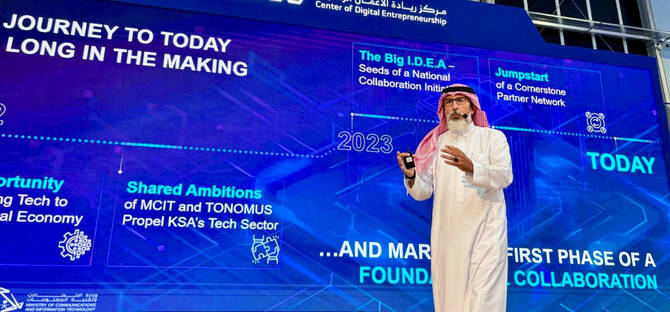

AL-KHOBAR: For many Gulf companies, artificial intelligence solutions are failing to catch on not because of some weakness in the technology, but because corporate leaders are often too afraid to fully adopt these tools.
In boardrooms across the region, executives are pitching fully functional AI prototypes. But, more often than not, boards hesitate. One asks if the system is too risky. Another wonders about audit exposure.
The result? Delays, confusion and abandoned innovation.
Two recent reports echo this challenge. A January 2025 McKinsey study found that while nearly all companies are investing in AI, just 1 percent consider themselves truly AI mature, citing leadership hesitation and a lack of risk readiness as key barriers.
Similarly, research from HFS highlights how firms often get stuck in “pilot purgatory” due to internal innovation blockers and a failure to scale AI beyond proof-of-concept demos.

According to Yousef Khalili, global chief transformation officer at AI solutions company Quant, this has become a familiar occurrence and a major reason why AI transformation remains stuck in “pilot mode.”
“AI isn’t failing because of the tech,” he told Arab News. “It’s failing because boards are scared, teams are confused, and no one agrees on what success looks like.”
Khalili has helped lead digital transformations across the Gulf, with former roles at Cisco, Microsoft and the Saudi National Digitization Strategy Committee. His perspective is shaped by years inside boardrooms.
On the surface, companies point to concerns like data privacy, integration challenges and workforce disruption. But Khalili believes the underlying cause is more complex: organizational culture.
He explains that many senior leaders still view AI as an experimental concept, not a strategic enabler. In rigid corporate hierarchies, admitting knowledge gaps can feel threatening. That discomfort leads to silence, delay or rejection.
“Leaders are afraid of the decisions being taken by machines,” he said. “It is also an existential issue — that AI may reveal inefficiencies or old business models or practices. It’s not just the fear of disruption but also the fear of irrelevance.”
Opinion
This section contains relevant reference points, placed in (Opinion field)
In such environments, even when a tool works, it may never be implemented — not because it failed technically, but because no one in power felt secure enough to champion it.
Khalili urges companies to rethink how they present AI, not as a machine replacement for human judgment, but as a tool that enhances it.
He believes transformation will only succeed if organizations redefine AI’s role within leadership structures. The shift must be driven from the top, not left to IT departments or external consultants.
This is especially urgent in the Gulf, where national ambitions for AI are moving faster than private sector adoption.
“What is needed more is the redefinition of AI as the tool that would provide humans with the means to lead,” Khalili said.
Instead of pitching AI as a cost-cutter or automation shortcut, Khalili recommends tying it to leadership enhancement — providing decision-makers with better insights, faster response and future-readiness.
For internal change to take root, Khalili says CEOs must model a new kind of leadership, one that is open, collaborative, and not afraid to upskill.

True transformation happens when teams feel included, not just informed, in the AI journey, says Yousef Khalili, global chief transformation officer at AI solutions company Quant. (Supplied)
He outlines three essential traits for modern leaders navigating AI transformation: empathy, inclusivity and education.
Too often, the lack of these qualities results in internal pushbacks. Employees fear being replaced. Managers fear becoming obsolete. And without reassurance, resistance builds.
“The internal resistance can be caused by fear of redundancy,” he said. “Leaders should highlight the role of AI as a tool that supplements rather than replaces.”
True transformation, Khalili argues, happens when teams feel included, not just informed, in the AI journey.
While executive teams often lead digital discussions, Khalili says it is the boardroom that ultimately determines whether projects scale.

A photo of a diverse group of modern business owners effectively conducting a meeting in a well-lit conference room. (Supplied)
When boards treat AI as an isolated tech trend rather than a governance issue, efforts remain small and fragmented. Projects never reach maturity. Pilots do not scale. And even worse, companies lose ground to faster, bolder competitors.
“Failure to engage the board may turn efforts into a series of pilots that can’t scale,” Khalili warned. “Boards must mandate AI literacy not only by the tech team but across the organization.”
He says boards should see themselves not just as gatekeepers of compliance, but as stewards of innovation. If they aren’t pushing AI forward, they’re holding the company back.
Many companies hesitate to scale AI because they don’t see immediate return on investment. But Khalili says this mindset is outdated, especially when measuring transformation.
In his view, success should be measured by a broader set of indicators: adoption rates, decision-making speed, employee engagement, accuracy improvement, and time saved.
These “early indicators” are often more useful in determining whether a system is working than short-term financial returns.
“A better view is provided by a balanced scorecard approach,” he said. “The leadership must consider AI as infrastructure that, when prudent investments are made, the returns will be progressive and not immediate.”
Khalili believes these metrics must become part of every boardroom dashboard, not just tucked away in IT updates.
Despite the hesitation in some sectors, Khalili says Saudi Arabia is better positioned than most to break through boardroom fear — and lead globally.

While executive teams often lead digital discussions, it is the boardroom that ultimately determines whether projects scale, says Yousef Khalili. (Supplied)
Thanks to Vision 2030, the country has already made AI a strategic priority. Investments in talent, regulation, and digital infrastructure are giving both public and private sectors a strong foundation.
And unlike in other regions, where policy often lags behind innovation, Khalili sees the opposite happening in the Kingdom.
“Top-down commitment among Saudi Arabia leadership is a unique advantage,” he said. “Vision 2030 and the cultural shift it promotes will help overcome barriers faster than in other regions.”
But for private firms to match government ambition, they will need to align more closely with the mindset of risk-taking, experimentation, and long-term impact.
When asked what is really holding AI back in the Gulf, Khalili does not hesitate. It is not the tools. It is not the infrastructure. It is the culture.
For AI to succeed, organizations must prioritize internal literacy, build inclusive leadership and rethink what success looks like. And above all, they must stop waiting for certainty.
“Think of AI as a fundamental capability, not a peripheral one,” he said. “Without addressing the organizational culture first, no AI pilots can deliver enterprise-wide value for sure.”