

Pakistan to launch major polio vaccination drive as floods heighten disease risk

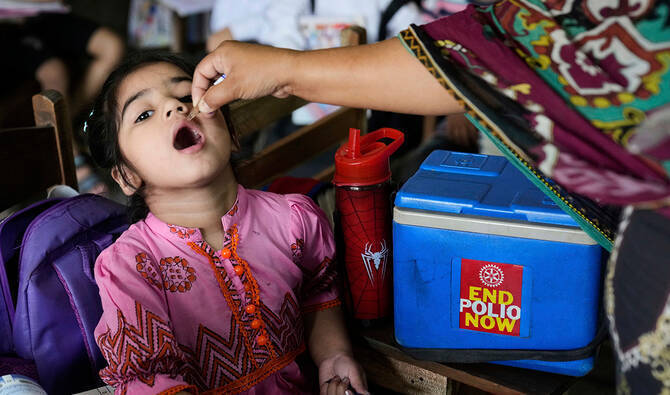
A health worker administers a polio vaccine to a child in a school in Lahore, Pakistan, on April 21, 2025. (AP)
Short Url
Updated 28 August 2025
Follow

Pakistan to launch major polio vaccination drive as floods heighten disease risk

  • Pakistan reports 23 polio cases this year, mostly in Khyber Pakhtunkhwa province
  • New vaccination campaign to protect 28 million children across 97 high-risk districts

KARACHI: Pakistan will launch a new polio vaccination campaign from Sept. 1 to immunize 28 million children under five across 97 high-risk districts, officials said on Thursday, warning that widespread flooding has increased the risk of virus transmission.

The National Emergency Operations Center (NEOC) said the week-long drive, led by the government’s Polio Eradication Programme, will be carried out by more than 240,000 frontline health workers going door-to-door across Balochistan, Sindh, Khyber Pakhtunkhwa, Punjab, Gilgit-Baltistan, Azad Jammu & Kashmir, and Islamabad.

Three major rivers burst their banks this week because of heavy rain and the release of water from overflowing dams in neighboring India, causing floods that have displaced nearly 250,000 people in Pakistan’s Punjab province. Officials say more than 1 million people are affected, with crops and businesses destroyed and many unable to leave their homes.

“This polio campaign comes at a critical time,” the NEOC said in a statement. “Widespread flooding across parts of Pakistan has increased the risk of polio and other vaccine-preventable diseases spreading to previously unaffected areas.”

Officials said floodwaters and crowded conditions in displacement camps have heightened the likelihood of virus transmission, making it even more urgent to vaccinate every child under five.

Pakistan confirmed two new polio cases in its northwestern Khyber Pakhtunkhwa province this week, bringing the total number of children affected by the crippling virus this year to 23. The country and neighboring Afghanistan remain the only two where polio is still endemic.

Pakistan made significant progress in curbing the virus, with annual cases dropping from around 20,000 in the early 1990s to just eight in 2018. It reported six cases in 2023 and only one in 2021, but saw a sharp resurgence in 2024 with 74 cases recorded.

Polio is a highly infectious and incurable disease that can cause lifelong paralysis. The only effective protection is through repeated doses of the Oral Polio Vaccine (OPV) for every child under five during each campaign, alongside timely completion of all routine immunizations.

The NEOC urged parents and caregivers to ensure that “every child must receive two drops of the polio vaccine during every campaign, alongside their routine childhood vaccinations, to stop the virus from spreading further.”

Past efforts to eradicate the virus have been repeatedly undermined by vaccine misinformation and resistance from some religious hard-liners, who claim immunization is a foreign plot to sterilize Muslim children or a cover for Western espionage. 

Militant groups have also frequently targeted polio vaccination teams and the security personnel assigned to protect them, particularly in KP and Balochistan.

Pakistan remains one of just two countries in the world where the polio virus is still endemic, alongside Afghanistan, according to the World Health Organization.


Pakistan constitutional court disposes of murder case of journalist Arshad Sharif

Updated 4 sec ago
Follow

Pakistan constitutional court disposes of murder case of journalist Arshad Sharif

  • Sharif was shot dead by police in Kenya on October 23, 2022, in what was said to be a case of ‘mistaken identity’
  • Court says no need for judicial interference when Pakistan, Kenya taking ‘appropriate action under respective laws’

ISLAMABAD: Pakistan’s Federal Constitutional Court (FCC) on Tuesday disposed of a suo motu case related to the killing of prominent journalist Arshad Sharif in Kenya, ruling that there is no need for judicial oversight when the law and investigation are taking their “due course.”

Sharif, an outspoken critic of Pakistan’s government and its powerful military, was killed when police shot at his car on the outskirts of Kenya’s capital Nairobi on Oct. 23, 2022. Kenyan police later said the killing was a case of mistaken identity.

A five-member Supreme Court bench had initially taken up the suo motu case for an independent and transparent probe of Sharif’s murder in Dec. 2022, which was transferred to the FCC that was formed under the 27th constitutional amendment last year and granted jurisdiction over both constitutional and suo motu cases.

In a 14-page judgment on Tuesday, the constitutional court stressed that a mutual legal assistance (MLA) agreement had been reached between Pakistan and Kenya and that the matter was being handled through diplomatic channels.

“Since the MLA agreement has been signed between the two nations and they are also coordinating at the diplomatic level to implement it, we are of the view that the authorities of both countries are taking appropriate action under their respective laws,” the verdict read.

“Therefore, there is no need for any judicial interference in this regard when the law and investigation is taking its due course. In light of the aforementioned discussion, the instant suo moto action is disposed of. Accordingly, all pending applications are also disposed of.”

Sharif, who hosted a current affairs show on a local television channel, had to leave the country after several cases related to charges of sedition and others were filed against him shortly before his killing. He was believed to have been in the United Arab Emirates since he left Pakistan and had traveled to Kenya where he was killed.

While Kenyan police called his killing a case of mistaken identity, a team of Pakistani investigators, who probed his alleged murder, released a report in December 2022, saying that Sharif’s killing was a “planned, targeted assassination.”

Sharif’s wife, Javeria Siddique, who had demanded a judicial commission last year to probe his killing, said she was “disappointed” by Tuesday’s verdict.

“This case was a test for press freedom in Pakistan and getting justice for a citizen hounded in three countries, brutally killed,” she said on X. “A black day indeed.”