

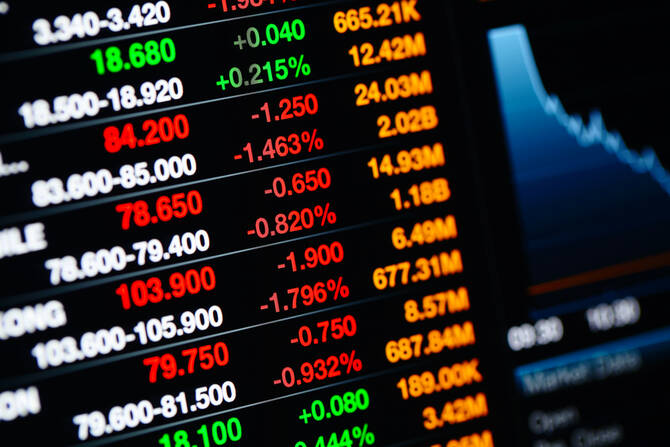
Closing Bell: Saudi stock market ends lower at 10,732

The day’s top performer was Sport Clubs Co., which gained 5.28 percent to close at SR11.76. Shutterstock
Short Url
Updated 28 August 2025
Follow

Closing Bell: Saudi stock market ends lower at 10,732

RIYADH: Saudi Arabia’s Tadawul All Share Index fell on Thursday, dropping 76.14 points, or 0.7 percent, to close at 10,732.31.

Total trading turnover reached SR3.94 billion ($1.05 billion). Of the traded stocks, 59 advanced while 190 declined.

The MSCI Tadawul 30 Index lost 9.06 points, or 0.65 percent, to settle at 1,384.65. 

The parallel market, Nomu, however, ended higher, gaining 122.07 points, or 0.47 percent, to 26,303.65, with 46 gainers and 42 losers.

The day’s top performer was Sport Clubs Co., which gained 5.28 percent to close at SR11.76. 

Other gainers included Arab National Bank, up 4.31 percent to SR23.50; Middle East Paper Co., rising 3.67 percent to SR28.28; and Nice One Beauty Digital Marketing Co., which climbed 3.07 percent to SR25.20.

Leading decliners were Thimar Development Holding Co., down 3.94 percent to SR42.46, followed by Saudi Company for Hardware, which fell 3.39 percent to SR28.50. Riyadh Cables Group Co. dropped 3.23 percent to SR129, while Saudi Kayan Petrochemical Co. declined 3.21 percent to SR5.12.

On the announcements front, Saudi Awwal Bank announced the completion of its $1.25 billion Tier 2 Capital Green Notes issuance, according to a statement published on the Saudi Exchange.

The offering was carried out under the bank’s medium-term note program and was extended to eligible investors in Saudi Arabia and internationally.

The notes, which are denominated in US dollars, carry a fixed annual return of 5.947 percent and will mature in 10 years, with a call option after five years. The issuance included 6,250 notes, each with a par value of $200,000.

Settlement of the notes is scheduled for Sept. 4.

The bank noted that the issuance reflects its ongoing efforts to support environmental sustainability while enhancing its capital base in line with regulatory requirements and long-term strategic objectives.

Saudi Awwal Bank’s share price decreased by 0.53 percent to close at SR30.16.

Alinma Bank also completed the offering of its $500 million US dollar-denominated Sustainable Additional Tier 1 Capital Certificates under its dedicated issuance program, the bank announced on Wednesday via the Saudi Exchange.

The issuance, launched on Aug. 27, was offered to eligible investors both within Saudi Arabia and internationally. Settlement is expected to take place on Sept. 3.

According to the bank, a total of 2,500 certificates were issued, each with a par value of $200,000. The certificates carry a fixed annual return of 6.25 percent and are structured as perpetual instruments, meaning they do not have a fixed maturity date but are callable after five and a half years.

The offering forms part of Alinma Bank’s long-term capital strategy to bolster its capital base and support sustainable growth. The proceeds from the issuance are expected to align with the bank’s broader environmental, social and governance commitments, although specific project allocations have not been disclosed.

The certificates were issued under the bank’s Additional Tier 1 Capital Certificate Issuance Programme, which provides flexibility in redemption terms as outlined in the official offering circular.

Based in Riyadh, Alinma Bank is one of the Kingdom’s leading Shariah-compliant financial institutions, offering a full suite of retail, corporate, investment and treasury services.

Alinma Bank’s share price decreased by 1.10 percent to close at SR25.20.

On a broader perspective, Saudi Exchange approved Merrill Lynch Kingdom of Saudi Arabia to begin market making activities on 18 listed securities across both the Main Market and Nomu – Parallel Market, effective Aug. 28.

The approval, announced on Wednesday, enables the financial institution to support liquidity and trading volumes on a diversified range of securities listed on both platforms. The move is expected to enhance market efficiency and provide investors with tighter spreads and improved access to selected equities.

Among the approved securities in the Main Market are Umm Al Qura for Development and Construction Co., Saudi Aramco Base Oil Co., Miahona Co., Arabian Drilling Co., and Saudi Research and Media Group. In the Nomu – Parallel Market, approved entities include Gas Arabian Services Co., Canadian Medical Center Co., and Edarat Communication and Information Technology Co.

Each security carries specific market making obligations in terms of minimum order presence, order size, spread limits, and minimum value traded requirements, tailored to reflect the trading dynamics and liquidity needs of the individual stocks.

For instance, market making obligations for Umm Al Qura for Development and Construction Co. and Saudi Aramco Base Oil Co. include a minimum presence of orders of 80 percent, a minimum size of $150,000, and a maximum spread of 0.65 percent.

Meanwhile, securities on the parallel market such as AME Company for Medical Supplies and Purity for Information Technology Co. are subject to a minimum order presence of 50 percent, a minimum size of $50,000, and a spread cap of 5 percent.

The announcement reflects Saudi Exchange’s commitment to bolstering secondary market activity and increasing market depth as part of the kingdom’s broader strategy to advance capital market development under Vision 2030.

This approval covers only a portion of the 18 securities and demonstrates the exchange’s ongoing efforts to attract more market participants and create a more robust trading environment.


How mining can transform Saudi Arabia’s economy

Updated 07 March 2026
Follow

How mining can transform Saudi Arabia’s economy

  • Kingdom’s mineral wealth valued at $2.5tn, positioning mining as a third pillar of the national economy

RIYADH: Saudi Arabia is accelerating its push into mining as part of its economic transformation under Vision 2030, amid the growing importance of critical minerals and rare earths.

The Kingdom’s mineral wealth is valued at $2.5 trillion, positioning mining as a third pillar of the national economy alongside hydrocarbons.

The mining industry could give Saudi Arabia an edge in transition minerals and supply chains by expanding extraction, processing and the logistics needed to move materials to market, according to economists and industry specialists.

Saudi Arabia is home to more than 45 identified minerals, including gold, copper and uranium, according to the Vision 2030 strategy.

Momentum has been supported by measures aimed at making mining easier to invest in and faster to scale, including updated regulations, digital licensing platforms, specialized mining services, and new transport and rail links to mining areas.

Vision 2030 aims to raise mining’s contribution to gross domestic product to SR240 billion ($63 billion) by 2030, create 200,000 direct and indirect jobs, and attract $27 billion in new investment, according to published government targets.

Signs of progress are starting to show in the mining sector in terms of exploration activity, licensing and new discoveries.

“The mining strategy shows it’s working very well, evidenced by the rapid rise in exploration and industrial licenses, and major new mineral discoveries,” Talat Hafiz, an economist and financial analyst, told Arab News.

Saudi Arabia is undertaking the world’s largest geological survey, covering about 700,000 sq. km of the Arabian Shield for $1.5 billion, he said. 

The number of mining licenses issued exceeds 2,000, according to official data, and the Kingdom’s mineral wealth is valued at 90 percent higher than it was in 2016 when Vision 2030 was rolled out.

A key milestone highlighted in Vision 2030’s mining strategy was the introduction of a new mining investment law, which reduced the tax rate to 20 percent from 45 percent to spur investment and align the sector with global standards.

The Kingdom’s mining resources position it well to be a critical supplier of raw materials that are integral to energy transition as clean-energy technologies require large volumes of mined materials.

Copper is central to electrification and power networks, while battery supply chains rely on minerals such as nickel and lithium. Phosphate is a key industrial input with wider economic value.

Reliable supplies of metals and minerals used in power grids, batteries and electric vehicles can attract investment and support downstream industry in the Kingdom.

Saudi Arabia’s Jabal Sayid site, northeast of Jeddah, ranks among the world’s top four resources for rare earth elements, Khalid Al-Mudaifer, vice minister of industry and mineral resources for mining affairs, recently told Al Eqtisadiah.

It will help meet Saudi Arabia’s needs for minerals used in magnet manufacturing, EVs and wind energy, while also supporting global supply, including the US market, he said.

Mining can also catalyze investment in the Kingdom, widen supply-chain employment, and boost non-oil exports and private-sector growth, according to economists and policymakers.

Mines, processing plants and the infrastructure around them require large upfront capital spending, creating a pipeline of work across construction, equipment, utilities and logistics. 

The mining industry could give Saudi Arabia an edge in transition minerals and supply chains by expanding extraction, processing and the logistics needed to move materials to market. (Shutterstock)

“When a mining sector scales, the economic footprint extends well beyond extraction,” said Turki Al-Nahari, vice president of global mining at Ecolab, told Arab News. “Growth typically occurs across engineering services, industrial water management, logistics, laboratory testing, equipment reliability, environmental services and digital performance systems.

“That shift creates demand for skilled engineers, technicians, data analysts and operational specialists,” he added.

In 2025, Saudi Arabia’s mining exploration budget increased 600 percent to $146 million from $21 million in 2022.

“This growth is driven by ongoing geological surveys, technological advancements and higher exploitation budgets, all of which signal stability and opportunity, attracting foreign investment,” Manraj Lamba, a mining economics analyst at S&P Global, said in a recent report.

Mining projects are easier to finance when the size and quality of the deposit are clear, costs are competitive, and rules and taxes are stable, Abdullah Al-Harbi, an economist familiar with the industry, told Arab News.

Investors want solid feasibility work, credible timelines and evidence a project can stay profitable through swings in commodity prices, Al-Harbi said.

Saudi Arabia’s pipeline includes 24 exploration-stage projects and 17 more advanced developments, according to S&P Global.

“Its proactive approach to geological surveys and resource assessment has uncovered significant potential across gold, copper, phosphate and bauxite,” Lamba said.

Large projects also tend to generate employment across a wider industrial supply chain, including contractors, maintenance, laboratories, transport and a range of operational services.

To boost employment and support hiring and training, Saudi Arabia has moved to standardize job roles and skills for the mining industry. 

HIGHLIGHT

Vision 2030 aims to raise mining’s contribution to gross domestic product to SR240 billion ($63 billion) by 2030, create 200,000 direct and indirect jobs, and attract $27 billion in new investment.

The Kingdom rolled out a framework related to employment and skills in the mining industry in January at the Global Labor Market Conference.

The framework is “a tool which ensures clear definitions of occupations and their required skills,” the Kingdom’s Minister of Industry and Mineral Resources Bandar Al-Khorayef said. It will cover more than 500 job roles, detail the necessary skills, responsibilities and titles, he added.

Exports from the sector are already rising in tandem with investments to develop the industry and create jobs.

Saudi Arabia exported 5.7 million tonnes of phosphate fertilizer in 2024, up about 6 percent from 2023, according to a GASTAT report.

As the energy transition accelerates, Saudi Arabia’s advantage may be strongest beyond extraction alone.

“Saudi Arabia’s most realistic advantage in the accelerating energy transition lies in combining selective mining with strong processing and refining capabilities, supported by its emerging role as a logistics and supply-chain hub,” Hafiz said.

The Kingdom’s position between Africa, Europe, and Asia favors downstream processing and value-added industries, he added.

“Saudi Arabia is prioritizing minerals that are both financeable and strategically aligned with emerging industries such as electric vehicles and clean energy technologies, where markets are clear, and demand is scalable,” Hafiz said.

Aluminum, phosphate, and similar commodities remain a key focus to support local manufacturing, infrastructure development and downstream industries while strengthening export capacity, he said.

“Once construction concludes, the priority shifts to operational stability and performance optimization,” Al-Nahari said.

“Small efficiency gains, applied consistently across large-scale operations, compound materially over time,” influencing cost as well as uptime and competitiveness over the life of a mine, he added.

As the global race toward electrification and decarbonization accelerates, the Kingdom is effectively positioning itself beyond its oil legacy with its strategic commitment to the minerals sector, which will play a critical role in powering the future.

Its investment in exploration, infrastructure, and downstream processing anchor it as a pivotal supplier in the critical minerals and rare earths value chain in the era of energy transition.