Pakistan says fresh Gates Foundation-WHO initiative to support 465,000 flood victims

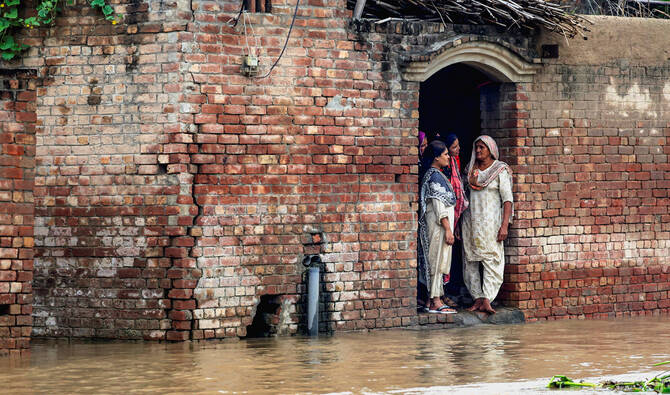
Residents stand at the entrance of a house on a flooded road, caused by monsoon rains and the rising water level of the Sutlej River, in Hakuwala village near the Pakistan-India border in Kasur district of Punjab province, Pakistan on August 24, 2025. (REUTERS)
Short Url
Updated 27 August 2025
Follow

Pakistan says fresh Gates Foundation-WHO initiative to support 465,000 flood victims

  • Gates Foundation announces $1 million donation to WHO to support relief activities in 33 high-risk areas, says state media
  • Unusually heavy monsoon rains have killed over 800 people in Pakistan since Jun. 26, triggered floods in several parts

ISLAMABAD: Pakistan’s state media on Wednesday announced a fresh initiative by the Gates Foundation and the World Health Organization (WHO), saying it would strengthen Islamabad’s response to the ongoing monsoon floods and help support 465,000 people.

As per a report in the state-run Associated Press of Pakistan (APP), a $1 million donation from the Gates Foundation will support the WHO’s partnership with Pakistan in 33 high-risk, flood-affected districts across Khyber Pakhtunkhwa (KP), Sindh, Punjab and Balochistan provinces.

Torrential rains since Jun. 26 have killed over 800 people in Pakistan and injured more than 1,000. Pakistani authorities have ramped up rescue and rehabilitation activities, especially in Punjab, where rising water levels have spiked fears of cataclysmic floods.

“The generous donation from the Gates Foundation – totaling $ 1 million – will serve to support Pakistan’s national and provincial authorities in ensuring the continuity of life-saving health services,” APP reported.

It added that the initiative will strengthen disease surveillance, outbreak response and ensure availability of essential medical supplies in targeted locations, promote health sector coordination, and risk communication.

“The initiative, to be implemented over the next six months, will pay particular attention to pregnant women, children under five, older persons, persons with disabilities, internally displaced persons (IDPs), and the most vulnerable populations in host communities,” the state media said.

Dr. Dapeng Luo, the WHO’s representative in Pakistan, thanked the Gates Foundation for its support to the local population in meeting their health needs, delivering medical supplies and saving lives.

“WHO stands with Pakistan to save lives today and build stronger, more resilient health systems for tomorrow, protecting the future generations,” Dr. Luo was quoted as saying by the APP.

Earlier this week, the United Nations said it has released $600,000 to support Pakistan’s flood response. Officials warn the current monsoon spell could last until at least Sept. 10 and may rival the catastrophic floods of 2022, which killed more than 1,700 people and caused over $30 billion in economic damage.

Despite contributing less than 1 percent of global greenhouse gas emissions, Pakistan is among the world’s most climate-vulnerable nations, facing erratic weather from droughts and heatwaves to record-breaking rains.



Curfew extended in Gilgit-Baltistan, probe ordered after deadly Khamenei protests

Updated 03 March 2026
Follow

Curfew extended in Gilgit-Baltistan, probe ordered after deadly Khamenei protests

  • At least 15 people were killed in clashes with law enforcement agencies over the weekend in Gilgit-Baltistan
  • Government also announces a de-weaponization campaign, crackdown on hate speech and cybercrime in region

ISLAMABAD: The government in Pakistan’s Gilgit-Baltistan (GB) region on Tuesday extended a curfew in Gilgit district and ordered a judicial probe into violent protests over the killing of Iranian Supreme Leader Ali Khamenei in US-Israeli strikes last week, an official said.

At least 15 people were killed in clashes with law enforcement agencies over the weekend in GB, where protesters torched and vandalized several buildings, including United Nations regional offices, an army-run school, software technology park and a local charity building.

The violence prompted regional authorities to impose curfew in Gilgit and Skardu districts on March 2-4 as officials urged people to stay indoors and cooperate with law enforcers, amid widespread anger in Pakistan, particularly among members of the Shiite minority, over Khamenei’s killing.

On Tuesday, the GB government convened to review the situation and announced the extension of curfew in Gilgit among a number of security measures as well as ordered the establishment of a judicial commission to investigate the weekend violence in the region.

“The government has made it clear that the law will strictly take its course against elements involved in vandalism at government institutions, private properties and incidents of vandalism in Gilgit and Skardu and no kind of mischief will be tolerated,” Shabbir Mir, a GB government spokesperson, said in a statement.

“In view of the security situation, curfew will remain in force in Gilgit, while the decision to extend the curfew in Skardu will be taken keeping the ground realities and the changing situation in view.”

The statement did not specify how long the curfew will remain in place in Gilgit.

Besides the formation of the judicial commission to investigate the violent clashes, the government also decided to launch a large-scale de-weaponization campaign in the entire Gilgit district, for which relevant institutions have been directed to immediately complete all necessary arrangements, according to Mir.

In addition, a crackdown has been ordered on hate speech, spread of fake news and cybercrime.

“The aim of these decisions is to ensure the rule of law, protect the lives and property of citizens and crack down on miscreants,” he said. “Approval has also been given to immediately survey the affected infrastructure and start their restoration work on priority basis.”

Demonstrators in Pakistan’s southern port city of Karachi also stormed the US Consulate on Sunday, smashing windows and attempting to burn the building. Police responded with batons, tear gas, and gunfire, leaving 10 people dead and more than 50 injured.

Pakistani authorities have since beefed up security at US diplomatic missions across the country, including around the US consulate building in Peshawar, to avoid any further violence.