



ISLAMABAD: Pakistan’s national disaster authority said on Wednesday 210,000 people had been evacuated from flood-hit areas as the army expanded its rescue and relief operations in Punjab, the country’s most populous province and currently the center of a flood emergency.
Since the monsoon season began on June 26, more than 800 people have been killed across Pakistan. Officials say the worst spell of rains began on Aug. 15 and is still ongoing, with the latest surge of floodwaters in the Sutlej, Chenab and Ravi rivers turning Punjab into the hardest-hit region.
Large swathes of the province are inundated and the government has called for the deployment of army units in multiple districts, including Lahore, Kasur, Sialkot, Faisalabad, Narowal, Okara, Hafizabad and Sargodha, for rescue and relief operations.
Reuters reported on Wednesday India had opened all gates of major dams on rivers in its part of the Kashmir region following heavy rains, and warned neighboring Pakistan of the possibility of downstream flooding.
At a press conference in Islamabad, military spokesperson Maj. Gen. Ahmed Sharif Chaudhry said the armed forces had scaled up their response to the emergency.
“An additional engineering brigade and 30 units have been deployed solely for flood relief,” he said, detailing one engineer brigade, 19 infantry units, seven engineering units and four medical units.
“Nearly 28,000 people have been rescued, and around 225 tons of rations have been distributed.”
Chaudhry said 29 medical camps were treating 7,786 patients, while 2,600 sorties had been flown despite adverse weather.
“So far, two soldiers have been martyred and two injured in the line of duty, which is a great loss. However, vigilance remains at 100 percent despite the severe flood conditions.”
Chaudhry stressed the military’s relief role across provinces:
“Relief efforts are being carried out across Punjab, Khyber Pakhtunkhwa, Gilgit-Baltistan, and AJK.”
In Gujranwala Division, he said, six infantry units and two engineering units had been deployed, evacuating around 6,000 people. In Kasur and Chiniot, more than 9,000 had been rescued.
“In Bahawalpur and Bahawalnagar … so far, 2,000 people have been evacuated from flood-threatened zones.”
The military spokesman noted operations in Kartarpur Sahib, where one of Sikhism’s holiest sites, the Gurdwara Darbar Sahib, was submerged:
“Currently, five engineering boats are engaged in rescue operations with the civil administration.”
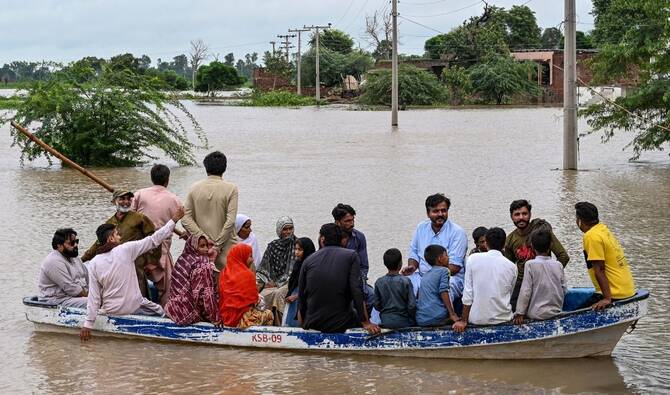
Flood-affected people evacuate on a boat amid rising water levels after heavy rainfall in the Haqu Wala village of Pakistan's Kasur district on August 24, 2025. (AFP)
On security, Chaudhry emphasized that Pakistan’s border defenses had not been affected by the floods.
Punjab shares much of its eastern boundary with India, including the contested Jammu and Kashmir region where the two countries face off along what Pakistan calls the “working boundary.”
“No post has been abandoned or left unmanned,” he said. “Two personnel have lost their lives, and two are injured. All posts remain fully occupied despite the flood situation.”
FLOOD WARNINGS AND PUNJAB BREACH
National Disaster Management Authority chairman Lt. Gen. Inam Haider Malik, who addressed the press conference with Chaudhry, said river flows were rising at multiple barrages.
“At Shahdara, a high-intensity flood is currently flowing at about 78,000 cusecs, and the pressure is being maintained at that level,” he said, warning of an “exceptionally high flood trend” in the Sutlej at Ganda Singh Wala, where 250,000 cusecs were passing through, with downstream pressures recorded at Sulemanki and Islam Headworks.
“So far, approximately 200,000 people have been evacuated from these areas through coordinated efforts … Thankfully, there has been zero [civilian] fatality,” Malik said, adding that tents, medical cover and rations were being provided in relief camps.
The NDMA said in a statement flows at Panjnad could climb to 600,000–700,000 cusecs in the coming days, putting strain on barrages downstream in Sindh. It warned of more rainfall between Aug. 29 and Sept. 9.
The Punjab disaster authority said an “extremely high flood” was recorded at Qadirabad Headworks on the Chenab River, with water flow measured at 935,000 cusecs.
“An emergency breach was carried out on the right marginal embankment to protect the headworks, which will help reduce pressure on the structure,” it said.
Addressing a press conference on Wednesday morning, provincial disaster management chief Irfan Ali Katia said hundreds of thousands of people had been moved to safety overnight after water levels in the Chenab and Ravi rose “to medium and exceptionally high within hours.” He called current flows “historical peaks” not seen since 2014.
About 100–110 relief camps have been set up, providing food, medical care and livestock shelter, Katia said, adding that the government had released Rs900 million ($3.2 million) to districts for emergency supplies.
“For the next 48 hours, this is critical for the Rawi River and downstream Khan in Chenab,” the official said, urging residents in floodplains to evacuate.
Prime Minister Shehbaz Sharif meanwhile chaired an emergency meeting in Islamabad and ordered “more effective” early warnings and immediate dispatch of relief goods. He instructed the federal ministers for energy, communications and planning to travel to Lahore, the provincial capital, to coordinate with Punjab authorities, ensure uninterrupted power and restore roads. He also ordered preparations for possible urban flooding in Gujrat, Sialkot and Lahore, and advance alerts for Sindh

Prime Minister Shehbaz Sharif chairs meeting on update of flood situation in Punjab province, at the PM Office in Islamabad on August 27, 2025. (Handout/PMO)
Sharif will visit Narowal, Sialkot and South Lahore on Thursday, the NDMA said.
The United Nations said it had released $600,000 to support Pakistan’s flood response.
‘INTENSE MONSOON WINDS’
In its latest press release, the NDMA warned that “intense” monsoon winds from the Bay of Bengal and Arabian Sea have entered the upper and central regions of the country, bringing high moisture and the likelihood of widespread rainfall.
“These winds are expected to persist for the next two days, with moderate to heavy rainfall forecast in the River Ravi watershed,” the disaster management authority said.
It said that the water flow level at river Ravi has reached 202,020 cusecs, stressing that it was at an “abnormally high flood level.”
The NDMA named Shahdara, Kot Mahbo, Jia Musa, Aziz Colony, Qaiser Town, Faisal Park, Dheer and Kot Begum as union councils in Lahore that are at high risk from potential floods.
It also identified several union councils in Punjab’s Sheikhupura, Kasur and Khanewal as areas at high risk from potential flooding due to rising water levels.
Officials warn the current monsoon spell could last until at least Sept. 10 and may rival the catastrophic floods of 2022, which killed more than 1,700 people and caused over $30 billion in economic damage.
Annual monsoon rains are vital for Pakistan’s agriculture but increasingly destructive, a trend experts link to climate change.
Despite contributing less than 1 percent of global greenhouse gas emissions, Pakistan is among the world’s most climate-vulnerable nations, facing erratic weather from droughts and heatwaves to record-breaking rains.


