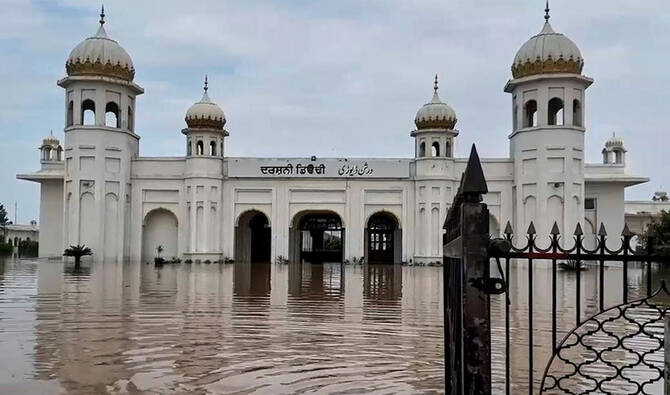
Floods engulf Kartarpur, swamping Sikh holy site Gurdwara Darbar Sahib

The Gurdwara Darbar Sahib, a shrine of Guru Nanak Dev, is submerged after torrential rains, in Kartarpur, in Narowal district, Pakistan, on Aug. 27, 2025. (AP)
Short Url
Updated 28 August 2025
Follow

Floods engulf Kartarpur, swamping Sikh holy site Gurdwara Darbar Sahib

  • Kartarpur is home to Gurdwara Darbar Sahib, where Sikhism’s founder Guru Nanak spent his final years
  • Pakistan inaugurated Kartarpur Corridor in 2019, passage allowing Indian Sikhs to visit shrine without visa

ISLAMABAD: Pakistan Army personnel are evacuating about 300 people stranded in the Kartarpur town of the country’s most populous province of Punjab after the waters of the Ravi River overflowed its banks and flooded the entire area, state media said on Wednesday.

Kartarpur is a town in Punjab’s Narowal district situated on the western bank of the Ravi, about four kilometers from the Indi-Pakistan border. It is home to the Gurdwara Darbar Sahib, one of Sikhism’s holiest sites, where its founder Guru Nanak spent his final years.

Floodwaters in the Sutlej, Chenab and Ravi rivers have forced Pakistani authorities to order mass evacuations of residents from vulnerable areas of Punjab.

“Due to flooding in Kartarpur, around 200 to 300 people are stranded,” state broadcaster Radio Pakistan said.

“In coordination with local administration, army troops are working to evacuate the stranded people.”

Social media footage showed the gurdwara submerged in floodwaters.

Ruling Pakistan Muslim League Nawaz (PML-N) party leader Hina Parvez Butt posted a photo on X showing Sikhs and others being rescued by emergency services personnel on a speedboat.

“People are being shifted to a safe location from Kartarpur,” she said.

Pakistan inaugurated the Kartarpur Corridor in 2019, a passage allowing Indian Sikh pilgrims to visit the shrine of Guru Nanak without a visa. The initiative was hailed as a significant confidence-building measure between the two countries and a major interfaith milestone.

Over 800 people have been killed in the monsoon season since June 26, with the northwestern Khyber Pakhtunkhwa province recording the highest number of casualties.

Pakistani officials say the current spell is likely to last until at least Sept. 10 and could rival the 2022 floods, which killed more than 1,700 people and caused over $30 billion in damage.


Fear, shock grip southwestern Pakistan day after deadly separatist attacks

Updated 5 sec ago
Follow

Fear, shock grip southwestern Pakistan day after deadly separatist attacks

  • Separatist militants carrying assault rifles stormed banks, jails, police stations and military installations, killing 31 civilians and 17 security personnel
  • Mobile Internet, train services remained suspended across Pakistan’s Balochistan on Sunday, with major roads and businesses deserted after attacks

QUETTA: Residents in the southwestern Pakistani city of Quetta were in shock and feared more violence, they said on Sunday, following deadly separatist attacks that killed nearly 200 people, including militants, security personnel and civilians, in the Balochistan province.

Authorities in Balochistan are battling one of the deadliest flare-ups in years as ethnic Baloch separatists step up assaults on security forces, civilians and infrastructure in the resource-rich province bordering Iran and Afghanistan.

Separatist militants carrying assault rifles stormed banks, jails, police stations and military installations in a string of coordinated attacks in several cities of Balochistan, including the provincial capital of Quetta, early Saturday.

Officials said the attacks killed 31 civilians and 17 security personnel, while 145 militants were killed in skirmishes and follow-up operations. The assaults were claimed by the Baloch Liberation Army (BLA) separatist group.

“The fear and anger are palpable in the city’s atmosphere following yesterday’s attacks at various locations in Quetta and other cities of Balochistan,” Zain Ali, a resident of Quetta’s Brewery Road, told Arab News on Sunday.

“We used to think that there is insurgency in Balochistan but Quetta is safe but that perception has been shattered.”

Balochistan has long been the site of a separatist insurgency that has intensified in recent years, with the BLA emerging as the most influential of separatist groups operating in the region.

The separatists, who frequently target security forces, foreigners, government officials and non-local Pakistanis, accuse the central government of stealing the region’s resources to fund development elsewhere in the country. The Pakistani government denies the allegations and says it is working for the uplift of local communities in Balochistan.

Saturday’s pre-dawn attacks by BLA targeted high-security government installations in Balochistan’s Quetta, Gwadar, Dalbandin, Pasni, Nushki, Kalat, Turbat and Mastung cities. 

Ali, who teaches at a private school and stepped out of home to buy groceries on Sunday, said he experiences an “unexplainable fear” of a sudden ambush by armed men on his way to downtown Quetta.

“If the capital is not safe, how would you expect security in rural areas of Balochistan,” Zain said. “The government has to take decisive action against these elements.”

On Sunday, mobile Internet and train services remained suspended across the province, with major roads and businesses deserted after the attacks.

Hafiz Ameer Muhammad, a security guard at a government’s run bank in Quetta’s Hazar Ganji area, recounted the horror when the militants stormed the city’s busiest business market, attacking several bank branches and torching goods and equipment.

“They came here at 10am and fired upon the gate but we didn’t let them in,” he told Arab News. “They broke the window and got inside and threatened us to hand over the weapons or face death.”

Dr. Mansoor Tareen, a dentist at Quetta’s Liaquat Bazar, said he feared more such attacks.

“Unfortunately, the government is limited to media and newspapers,” he said.

Pakistan’s military said the attacks were launched by “Indian-sponsored Fitna al Hindustan,” a reference it uses for Baloch separatist groups. India has denied any involvement.

In a statement on Saturday, the BLA said it had launched “Operation Herof 2.0,” claiming responsibility for attacks at multiple locations across Balochistan. Saturday’s assaults were similar to coordinated attacks carried out by the group in Aug. 2024, which killed dozens of people in various districts of Balochistan.

Balochistan Chief Minister Sarfraz Bugti has vowed his government would not surrender and would fight the militants until they are eliminated.

“We will fight this war for 1,000 years,” he said on Sunday. “This country is ours. This is our motherland. We will fight for it.”