

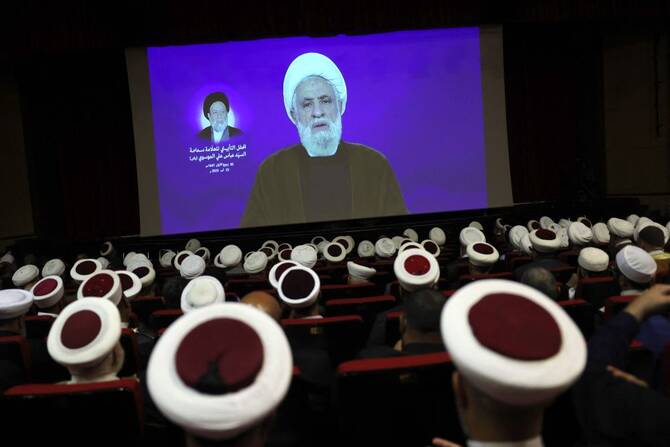

BEIRUT: A group of prominent Lebanese politicians on Wednesday filed a criminal lawsuit against Hezbollah chief Sheikh Naim Qassem, accusing him of inciting war and sedition.
The plaintiffs include current and former MPs as well as senior political figures in the country.
The suit is the first of its kind to target a member of Hezbollah’s senior leadership. It cites inflammatory speeches by Qassem, the party’s secretary-general, and accuses him of “inciting war, sedition and the overthrow of constitutional authority.”
MP Ashraf Rifi told Arab News that the lawsuit, which was accepted by the court, targets “anyone the investigation reveals to be a perpetrator, accomplice or instigator.”
He added: “We are aware that Sheikh Qassem’s address is unknown, making it difficult to serve him the legal notice. While the lawsuit may not deter him from continuing his actions, we assert that he has violated the constitution, and the complaints will continue as long as Hezbollah continues to do so.”
Alongside Rifi, MPs Elias Khoury, Camille Chamoun (head of the National Liberal Party), George Okais, former MP Eddy Abillama and the head of the Change Movement, lawyer Elie Mahfoud, are acting as plaintiffs against Qassem. The lawsuit was submitted before Public Prosecutor Jamal Hajjar at the Palace of Justice in Beirut, amid tight security measures taken by the Lebanese Army.
The plaintiffs said that their personal claim against Qassem followed the Public Prosecution’s “inaction regarding the individual in question.”
They called for “the appointment of the appropriate authority to investigate the complaint, summon Sheikh Naim Qassem for questioning, and take all necessary legal measures against him.”
In the suit, the plaintiffs highlighted comments made by Qassem during a major public address to Hezbollah supporters in mid-August.
Hezbollah represents an “unlicensed organization considered a terrorist organization by a large number of countries around the world,” they said.
During the speech earlier this month, Qassem had repeated Hezbollah’s refusal to surrender its weapons to the state in defiance of a Cabinet decision.
The plaintiffs described Qassem’s speech as “a threat to Lebanon’s internal security and a direct challenge to decisions issued by the Council of Ministers.”
Qassem threatened the Lebanese Army with his comments, and displayed open contempt for the presidency, prime minister and members of the government, they said.
The Hezbollah chief also defied government measures by calling for demonstrations across the country, including outside the US Embassy in Beirut, the plaintiffs added.
“This speech provoked most of the Lebanese who are still living through a bloody war provoked by the military organization headed by the accused person,” the suit said.
The plaintiffs said Qassem’s behavior implicated him in Israel’s occupation of Lebanese regions and the widespread economic damage inflicted on the country as a result of the war.
Qassem’s speech contradicted President Joseph Aoun’s inaugural address to parliament, in which he outlined the general framework of Lebanon’s policy — particularly the principle that only legitimate Lebanese forces may possess arms, the plaintiffs added.
The speech also contradicted a ministerial statement highlighting Lebanon’s commitment to non-involvement in regional or international conflicts, they said.
The secretary-general’s speech was “a clear and explicit admission that the military organization led by Qassem is waging war on behalf of a foreign state and in its defense, a policy that will inevitably lead to devastation and destruction,” the suit said.
Hezbollah’s stance under Qassem contradicts the Lebanese Constitution and the UN Charter that the Lebanese Republic is committed to, the plaintiffs said.
“The Israeli enemy responded to the speech with a direct and public warning to Lebanon against any escalation by the military organization led by Qassem. The speech also triggered a massive wave of reactions, all of which were sectarian in nature; some rejecting and denouncing the statement, while others responded with sectarian counter-comments in support of what the defendant had said,” they added.
The lawsuit highlighted Hezbollah’s call to protest that accompanied the speech, involving the display of threatening banners on public property along the road to Rafic Hariri International Airport in Beirut. Some banners featured images of Iranian Supreme Leader Ali Khamenei and bore the message: “The hand that reaches for our weapons, we will cut it off. At your command, we are ready and advancing toward Jerusalem.”
The MPs accused Qassem of inciting “sedition and internal strife, overthrowing decisions taken by legitimate constitutional authorities, disrupting Lebanon’s relations with the vast majority of world countries that support the Lebanese government’s decisions regarding the restriction of arms to the Lebanese state, and exposing the Lebanese to hostile acts by an enemy state, Israel.”
Rifi described the government’s decision to restrict arms to the state as a pivotal moment in Lebanon’s political history, leading to the flourishing of sovereignty.
The MP told Arab News he is convinced that “surrendering weapons will happen sooner or later. People do not want to live under the rule of a state within a state. Hezbollah’s role is over.”
Hezbollah’s power and influence within Lebanon had grown substantially over the past decade, in part due to support from Damascus and Tehran. But the fall of the Assad regime in Syria in late 2024 and the election of Lebanon’s newest government earlier this year has led to a dramatic shift in the balance of power.
The party’s military wing was significantly weakened during its latest war with Israel. Key officials were killed, including former chief Hassan Nasrallah, and a substantial portion of its arsenal was destroyed.
Rifi said the party and its military wing “has nothing to do with the defense strategy” of Lebanon.
“It is the state’s responsibility; it is not that of those who seek to be part of the strategy placement according to their whims and desires. It is the responsibility of the Lebanese Army officers and leadership,” he added.
The MP accused Hezbollah of trying to model itself on Iraq’s Popular Mobilization Forces in order to “legitimize itself as a partner.”
He added: “This will not happen. Hezbollah’s role is over. The role of Iran in the region is over. Assad has been ousted and could now be subject to accountability.”
Wednesday’s lawsuit was filed amid escalating political tensions in Lebanon. Hezbollah has insisted on maintaining control of its arms, while the Lebanese government has tasked the army with developing a plan to limit weapons to the military and government-affiliated security forces.
The plan must be discussed and adopted by the Council of Ministers on Sept. 2 and implemented by the end of the year.
US envoy Tom Barrack, during a press conference at the Presidential Palace on Tuesday, set a condition that requires Hezbollah to surrender its arms.
Hezbollah supporters reacted by forcing Barrack to cancel his tour of Lebanon’s southern border region the following day. They staged protests, held banners condemning the tour and “biased policies,” and prepared tomato pallets to throw at Barrack’s convoy. The envoy was scheduled to visit the village of Khiam and Tyre.
He had arrived at Francois Al-Hajj Army Barracks in Marjayoun aboard a helicopter. The Lebanese Army deployed a heavy presence in the area, including at the northern entrance of Khiam, to accompany Barrack.
However, residents in Khiam gathered at the town’s entrance holding images of slain family members, along with Hezbollah banners, causing the visit to be canceled.


