US envoy cuts short south Lebanon visit amid protests: state media

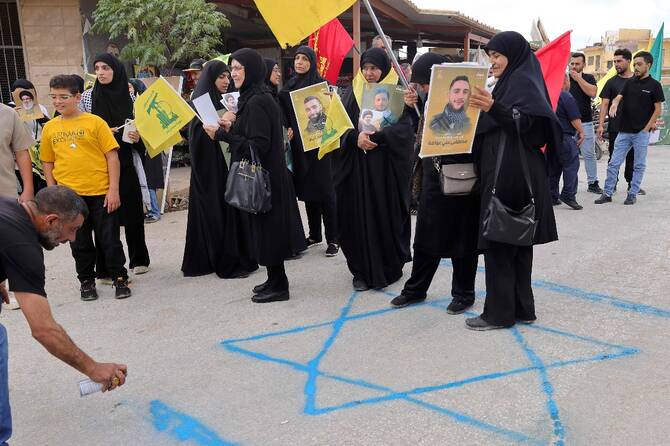
Hezbollah supporters stand above a Star of David graffiti as they demonstrate against the planned visit of US envoy Tom Barrack to south Lebanon. (AFP)
Short Url
Updated 27 August 2025
Follow

US envoy cuts short south Lebanon visit amid protests: state media

EL KHIAM: Lebanese state media said US envoy Tom Barrack cut short a visit to the south on Wednesday amid protests in two planned stops against US pressure to disarm Hezbollah.
The official National News Agency (NNA) reported that Barrack arrived by helicopter at a Lebanese army barracks in Marjayoun near the border, with soldiers deploying in the area.
The news agency later reported that the envoy had canceled planned stops in nearby Khiam, which was pummelled by Israel during its latest hostilities with Hezbollah, and in the coastal city of Tyre.
A spokesperson told AFP the US embassy did not comment on officials’ schedules for security reasons.
An AFP correspondent in Khiam saw a group of residents, some waving Hezbollah flags or holding pictures of fighters killed in the conflict, demonstrating against Barrack.
Some were standing on a Star of David that had been drawn on the road in blue, near the words in Arabic “America is the great Satan,” and “Barak is animal” written in English.
The last was a reference to comments by the US envoy at a Beirut press conference on Tuesday which sparked an outcry in Lebanon.
Barak told journalists to “act civilized,” adding: “The moment that this starts becoming chaotic, like animalistic, we’re gone.”
Bilal Kashmar, an official from the southern municipalities union, said dozens of people had demonstrated in Tyre on Wednesday against Barak’s expected visit and Washington’s “biased policies.”
Under heavy US pressure and amid fears of expanded Israeli military action, Lebanon’s government tasked the army this month with drawing up a plan to disarm Hezbollah by year end.
The Iran-backed group, which enjoys strong support in the south, was left badly weakened by more than a year of hostilities, including two months of open war, with Israel that largely ended with a November ceasefire.
Fellow US envoy Morgan Ortagus said in Beirut on Tuesday that the Lebanese government needed to implement its decision to disarm Hezbollah, adding that Israel would respond in kind.
Hezbollah insists that Israel must complete its withdrawal from Lebanon and halt its continuing strikes before the future of the group’s weapons can be discussed.


Gaza families struggle to recover from days of torrential rains that killed 12 people

Updated 7 sec ago
Follow

Gaza families struggle to recover from days of torrential rains that killed 12 people

  • The downpour, which dumped more than 150 milliliters (9 inches) of rain on some parts of Gaza over the past week, turned dirt lanes to mud and flooded tents in camps for displaced people

DEIR AL-BALAH, Gaza Strip: Palestinians in Gaza struggled to recover Tuesday from torrential rains that battered the enclave for days, flooding camps for the displaced, collapsing buildings already badly damaged in the two-year war and leaving at least 12 dead, including a two-week-old baby.
The downpour, which dumped more than 150 milliliters (9 inches) of rain on some parts of Gaza over the past week, turned dirt lanes to mud and flooded tents in camps for displaced people.
The Gaza Health Ministry, part of the Hamas-run government, said Tuesday the two-week-old died of hypothermia as a result of the weather. The baby was brought to the hospital a few days ago and was transferred to intensive care but died on Monday.
In Gaza City, a man died Tuesday after a home already damaged during Israeli strikes, collapsed because of the heavy rainfall, according to Shifa Hospital.
Members of the Al-Hosari family said 30 people lived in the building, but just nine were home when it collapsed. The man who was killed was a worker who had come to fix the walls, they said. Five people were injured.
The Health Ministry said the remaining 10 people were killed last week, also from buildings collapsing from the rain and heavy winds.
Emergency workers warned people not to congregate in damaged buildings due to concerns of collapse, though so much of the territory has been reduced to rubble, there are few places to escape the rain. In July, the United Nations Satellite Center estimated that almost 80 percent of the buildings in Gaza have been destroyed or damaged.
“When we hear the news that there is a storm, our whole lives change, we start thinking about where to stay, to go, where to put our mattresses and blankets, and where to keep our children safe and warm,” said Mohammed Gharableh, a father displaced from the southern city of Rafah.
“During every storm like this, water penetrates our tents, and our mattresses and blankets get soaked,” he added.
In Israel, areas near Gaza received between 60 mm to 160 mm (2 to 6 inches) of rain in the past week, according to the Israel Meteorological Service, which in some cases is more than twice the average amount of rain for this time of year.
Aid groups say despite two months of a ceasefire, not enough shelter material has been getting into Gaza to help Palestinians deal with the winter. Recently released Israeli military figures suggest it hasn’t met the ceasefire stipulation of allowing 600 trucks of aid into Gaza a day, though Israel disputes that finding.
The vast majority of Gaza’s 2 million people have been displaced, and most people live in vast tent camps stretching along the coast, or set up among the shells of damaged buildings. The buildings lack adequate flooding infrastructure and people use cesspits dug near tents as toilets.
The Israeli military body in charge of coordinating aid to Gaza, called COGAT, said close to 270,000 tents and tarps have entered Gaza over the past few months as well as winter items, shelter equipment, and sanitation supplies.
But some aid groups disputed the figures and said more supplies, especially winter items, are desperately needed.
Shelter Cluster, an international coalition of aid providers led by the Norwegian Refugee Council, last week said it has tracked just 68,000 tents that have entered Gaza via the UN, non-governmental organizations, and various countries. Many of the tents aren’t properly insulated for winter, it says.