

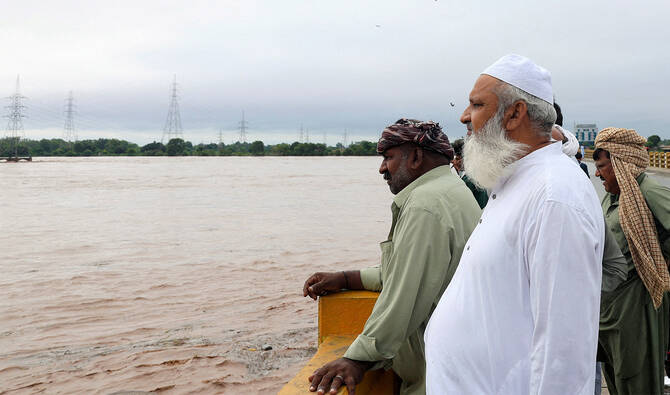

ISLAMABAD: Pakistan’s largest province of Punjab on Wednesday called in the army for rescue and relief operations in eight districts and evacuated 150,000 people to safe places after major rivers swelled with heavy monsoon rains, prompting flood warnings.
Since June 26, monsoon rains have killed 802 people across Pakistan, including 479 in Khyber Pakhtunkhwa province, 165 in Punjab, 57 in Sindh, 45 in Gilgit Baltistan, 24 in Balochistan and Azad Kashmir, and eight in Islamabad.
Floodwaters in the Sutlej, Chenab and Ravi rivers have now forced authorities to evacuate residents from vulnerable areas of Punjab, the country’s most populous province bordering India.
The Punjab government has called for the deployment of army units in eight districts – Lahore, Kasur, Sialkot, Faisalabad, Narowal, Okara, Hafizabad and Sargodha – for rescue and relief activities.
The provincial ministry said the army was called in “to assist civil administration and protect human lives,” with Army Aviation and other resources also on standby for use in flood-affected areas. Provincial disaster and rescue agencies, police and civil defense units were already working on the frontlines, it said.
“Yesterday [Aug. 26], the main challenge for us was that there was an abrupt increase in the Ravi and Chenab rivers within hours,” the top Provincial Disaster Management Authority (PDMA) official in Punjab, Irfan Ali Katia, told reporters during a briefing on Wednesday morning.
“The water went ... to medium and exceptionally high within hours. Because of this, we did the evacuations overnight.”
Katia said authorities had brought 150,000 people to safety. He described the flood levels as “historical peaks” not seen in decades, saying the last time comparable flows were recorded was in 2014.
“There was no breach anywhere,” he said. “Water remained within the flood plain everywhere. And I am very thankful to the Pakistan Army for their efforts at night.”
The PDMA chief said around 100 to 110 relief camps had been established along the Chenab and Ravi floodplains, providing food, medical and livestock cover to evacuees. He added that the Punjab government had also released emergency funds to districts:
“We have given 900 million rupees ($3.2 million) to all the vulnerable districts, to their deputy commissioners, for those arrangements.”
Katia urged those in floodplains to leave promptly, warning that “for the next 48 hours, this is critical for the Rawi River and downstream Khan in Chenab.”
‘EXTRAORDINARY’ RIVER FLOWS
The National Disaster Management Authority (NDMA) issued multiple flood alerts on Wednesday, warning of “extraordinary” flows in rivers.
At Marala on the Chenab River, discharge crossed 900,000 cusecs at 2 a.m., well above the dangerous threshold. At Khanki, the flow reached 450,000 cusecs, while the Ravi River at Jassar exceeded 200,000 cusecs, with Kot Naina recording 250,000 cusecs.
Authorities warned that low-lying areas around Shahdara, Park View and Motorway-2 near Lahore were at risk of inundation.
“The situation in the Chenab and Ravi rivers is extremely dangerous,” the NDMA said.
“Residents along riverbanks and waterways must immediately move to safer locations.”
“Avoid unnecessary travel in flood-hit areas, keep emergency kits (water, food, medicines) ready and safeguard important documents,” it added.
The NDMA said it was working in coordination with civil and military authorities nationwide, with the National Emergencies Operation Center on round-the-clock alert.
According to the Flood Forecasting Division in Lahore, exceptionally high flood levels are expected in the Chenab at Trimmu on Aug. 29, at Panjnad on Sept. 2, and in the Indus at Guddu and Sukkur between Sept. 4–5.
The bulletin also warned of “very high to exceptionally high flood levels” in the Sutlej at Ganda Singh Wala, the Ravi at Jassar, and downstream reaches.
The NDMA has warned that Punjab and Azad Kashmir are expected to receive more heavy rains over the next two to three days, raising fears of worsening floods.
PRIME MINISTER’S DIRECTIVES
Prime Minister Shehbaz Sharif chaired an emergency meeting on Wednesday on the situation in Punjab, particularly along the Chenab, Sutlej and Ravi rivers.
According to his office, the NDMA briefed him on flood forecasts and preparedness.
Sharif said early warnings had helped prevent loss of life and property but stressed that alerts must be delivered “more effectively.”
He directed that NDMA and Punjab’s PDMA remain in continuous contact, and that relief supplies, including tents, be dispatched immediately to affected areas.
The prime minister also instructed federal ministers for energy, communications and planning to travel to Lahore to coordinate with the provincial government, ensure uninterrupted power supply, and restore roads and communications.
He ordered urgent preparations for possible urban flooding in Gujrat, Sialkot and Lahore, and told officials to ensure advance warnings are issued in Sindh when floodwaters move downstream.
The United Nations said it had released $600,000 over the weekend to support Pakistan’s flood relief activities.
Officials say the current monsoon spell is likely to last until at least Sept. 10 and could rival the catastrophic floods of 2022, which killed more than 1,700 people and caused damage exceeding $30 billion.
Annual monsoon rains are vital for Pakistan’s agriculture and water supply but in recent years have also brought devastation, a trend experts link to climate change.
Despite contributing less than 1 percent of global greenhouse gas emissions, Pakistan is among the world’s most climate-vulnerable nations, suffering increasingly erratic weather, from droughts and heatwaves to record-breaking rains.


