

Arif Habib-led group plans to buy remaining 25% stake in Pakistan International Airlines

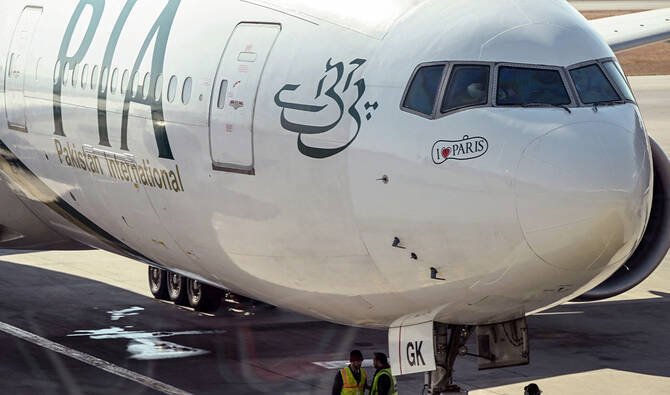
Ground staff stand next to the Pakistan International Airline (PIA) aircraft ahead of its takeoff for Paris at the Islamabad International Airport on January 10, 2025. (AFP/File)
Short Url
Updated 15 February 2026
Follow

Arif Habib-led group plans to buy remaining 25% stake in Pakistan International Airlines

  • Consortium bought 75 percent stake in Pakistan International Airlines in December 2025 for $482 million
  • Group will have to pay government $161 million by April 2027 for 25 percent stakes, says Arif Habib Ltd. CEO

ISLAMABAD: The Pakistani consortium led by Arif Habib Ltd. which bought a 75 percent stake in the Pakistan International Airlines (PIA) plans to secure full control of the airline, a senior official of the firm confirmed on Sunday. 

In December 2025, the consortium headed by Arif Habib Group secured a 75 percent stake in the PIA for Rs135 billion ($482 million) after several rounds of bidding, valuing the airline at Rs180 billion ($643 million). Pakistan had previously attempted to reform the debt-ridden airline, which had accumulated more than $2.8 billion in financial losses over the years. 

Arif Habib Ltd. CEO Shahid Habib told Arab News that since the PIA’s privatization documents were signed in January, the group will formally take over the airline at the end of April. He said as per the by-laws, the group will have to notify the government whether it intends to buy the remaining 25 percent stake in the airline or “leave it with the government.”

“At present, their [Arif Habib-led group’s] stated position is that they intend to acquire the 25 percent from the government,” Habib said.

He said once the group conveys its decision to buy the remaining 25 percent stakes in the airline, it will have 12 months to complete the payment.

“This means that from April to the following April [in 2027], they must pay the Government of Pakistan Rs45 billion [$161 million] more with 12% premium for the additional stake,” Habib said.

Habib said beyond ownership, the group intends to improve service for customers. This would include strengthening overall safety and security standards, enhancing staff performance and upgrading the airline’s ticketing system. 

He said the group intends to increase the frequency of flights on commercially viable routes.

“For example, routes that currently operate only two flights every two weeks could be expanded to as many as six flights per week,” Habib said.

“This would significantly improve passenger convenience and availability.”

Habib said currently, PIA has 18 operational aircraft, adding that some of them require capital expenditure (CAPEX) for upgrades and improvements. He said six to seven aircraft could be made operational with additional CAPEX.

“The medium-term goal is to expand the fleet from 18 to 38 aircraft over the coming years,” Habib said.

“While the exact timeline has not been specified, the intention is to achieve this within a defined multi-year framework.”

Habib shared leasing brand new aircraft would require time, adding that current delivery slots that are being offered for them are for 2030, 2031 and 2032.

He said that as an interim solution, relatively newer aircraft — around eight to ten years old — can be acquired for the airline.

“If orders are placed now, Boeing or comparable models, as well as Airbus aircraft in the seven-to-ten-year range, could be secured to stabilize and expand short-term operations,” he said. 

Once considered among Asia’s leading airlines, PIA struggled with chronic mismanagement, political interference, overstaffing, mounting debt and operational issues that led to a 2020 ban on flights to the European Union, UK and the US after a pilot licensing scandal.

The EU and the UK lifted the bans, providing fresh momentum to the carrier.


Sindh assembly passes resolution rejecting move to separate Karachi

Updated 21 February 2026
Follow

Sindh assembly passes resolution rejecting move to separate Karachi

  • Chief Minister Shah cites constitutional safeguards against altering provincial boundaries
  • Calls to separate Karachi intensified amid governance concerns after a mall fire last month

ISLAMABAD: The provincial assembly of Pakistan’s southern Sindh province on Saturday passed a resolution rejecting any move to separate Karachi, declaring its territorial integrity “non-negotiable” amid political calls to carve the city out as a separate administrative unit.

The resolution comes after fresh demands by the Muttahida Qaumi Movement (MQM) and other voices to grant Karachi provincial or federal status following governance challenges highlighted by the deadly Gul Plaza fire earlier this year that killed 80 people.

Karachi, Pakistan’s largest and most densely populated city, is the country’s main commercial hub and contributes a significant share to the national economy.

Chief Minister Syed Murad Ali Shah tabled the resolution in the assembly, condemning what he described as “divisive statements” about breaking up Sindh or detaching Karachi.

“The province that played a foundational role in the creation of Pakistan cannot allow the fragmentation of its own historic homeland,” Shah told lawmakers, adding that any attempt to divide Sindh or separate Karachi was contrary to the constitution and democratic norms.

Citing Article 239 of Pakistan’s 1973 Constitution, which requires the consent of not less than two-thirds of a provincial assembly to alter provincial boundaries, Shah said any such move could not proceed without the assembly’s approval.

“If any such move is attempted, it is this Assembly — by a two-thirds majority — that will decide,” he said.

The resolution reaffirmed that Karachi would “forever remain” an integral part of Sindh and directed the provincial government to forward the motion to the president, prime minister and parliamentary leadership for record.

Shah said the resolution was not aimed at anyone but referred to the shifting stance of MQM in the debate while warning that opposing the resolution would amount to supporting the division of Sindh.

The party has been a major political force in Karachi with a significant vote bank in the city and has frequently criticized Shah’s provincial administration over its governance of Pakistan’s largest metropolis.

Taha Ahmed Khan, a senior MQM leader, acknowledged that his party had “presented its demand openly on television channels with clear and logical arguments” to separate Karachi from Sindh.

“It is a purely constitutional debate,” he told Arab News by phone. “We are aware that the Pakistan Peoples Party, which rules the province, holds a two-thirds majority and that a new province cannot be created at this stage. But that does not mean new provinces can never be formed.”

Calls to alter Karachi’s status have periodically surfaced amid longstanding complaints over governance, infrastructure and administrative control in the megacity, though no formal proposal to redraw provincial boundaries has been introduced at the federal level.