

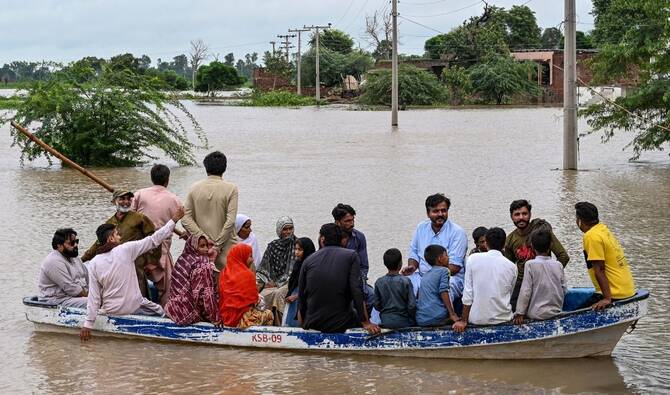

ISLAMABAD: The United Nations has released $600,000 in emergency relief funds for Pakistan, the UN secretary-general’s spokesperson confirmed this week, as the death toll from deadly monsoon rains and floods across the country crossed 800.
Monsoon rains have wreaked havoc across Pakistan, damaging crops, killing livestock and destroying thousands of houses in the country. Pakistan’s National Disaster Management Authority (NDMA) has reported 802 deaths from monsoon rains and floods since Jun. 26 and 1,088 injuries.
Rain continues to batter several parts of the country, especially its eastern, most populous Punjab province, where rising water levels in the Sutlej and Ravi rivers have prompted authorities to evacuate over 170,000 people from vulnerable areas.
“The [Pakistani] authorities are leading the response, with support from the United Nations and local partners,” Stéphane Dujarric, the UN secretary-general’s spokesperson, told reporters during a media briefing on Monday.
“Over the weekend, Tom Fletcher, our Emergency Relief Coordinator, released $600,000 from the regional pooled fund to support the ongoing efforts.”
Unusually heavy rains since Aug. 15 have killed 489 people and left 348 injured. Pakistan’s northwestern Khyber Pakhtunkhwa (KP) province has reported the highest deaths since mid-August, 408 and 258 injuries according to figures shared by the NDMA.
Dujarric said that according to the UN’s Office for the Coordination of Humanitarian Affairs, Pakistanis affected by the flooding need shelter supplies, medical assistance, cash, hygiene kits, clean drinking water and education.
Pakistan’s top economic decision-making body earlier on Tuesday approved the release of Rs3 billion ($10.8 million) in emergency funds for flood-affected families in the northern Gilgit-Baltistan region.
EVACUATIONS, RISING WATER LEVELS
Separately, the NDMA issued an advance alert to the provincial disaster agency in Punjab, the PDMA, regarding rising water levels in the Sutlej River and potential floods. The alert prompted large-scale evacuation operations in areas near the Sutlej River.
Prime Minister Shehbaz Sharif chaired a meeting to review the flood situation and relief operations across the country, his office said.
Sharif directed that rescue operations in the flood-hit districts of Punjab, affected by the overflowing Sutlej river, be further accelerated, the Prime Minister’s Office (PMO) said.
Officials informed Sharif that residents of vulnerable areas near the Sutlej River have been relocated, and that no loss of life has been reported so far.
“Rescue operations are continuing in flood-affected districts near Sutlej River and so far, 174,074 people have been safely evacuated,” the PMO said.
The prime minister was informed that work to restore power in KP’s flood-affected areas was underway, while in Gilgit-Baltistan, a two-kilometer stretch of the National Highway remains submerged.
“The meeting was informed that in the next 12 to 24 hours that heavy rainfall is expected in Lahore, Gujranwala, Gujrat and Rawalpindi divisions as well as in the districts of Azad Jammu and Kashmir, and parts of Gilgit Baltistan,” Sharif’s office said.
Officials say the ongoing monsoon spell is expected to last until at least Sept. 10, while the NDMA has warned the rains could rival the scale of the catastrophic floods of 2022, which killed more than 1,700 people and caused over $30 billion in damage.
Annual monsoon rains are crucial for Pakistan’s agriculture and water supply but in recent years have also unleashed devastation, intensified by shifting climate patterns.
Despite contributing less than 1 percent of global greenhouse gas emissions, Pakistan ranks among the countries most vulnerable to climate change. In recent years it has endured increasingly erratic weather, including droughts, heatwaves and record-breaking rains that have caused widespread loss of life and damage to property.
Experts warn that without urgent adaptation and mitigation measures, the human and economic toll of climate change in Pakistan will only deepen in the years ahead.


