

Australia expels Iran ambassador over antisemitic attacks

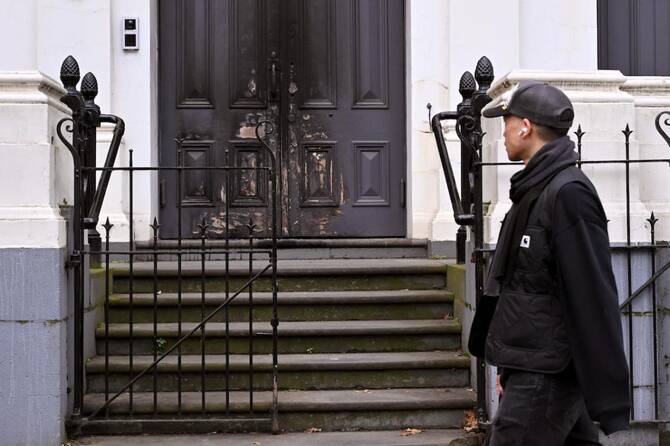
The East Melbourne Synagogue was vandalized in July. (FILE/AFP)
Short Url
Updated 26 August 2025
Follow

Australia expels Iran ambassador over antisemitic attacks

  • Australia’s government said Tuesday it is expelling Iran’s ambassador, accusing the country of being behind antisemitic attacks in Melbourne and Sydney

SYDNEY: Australia expelled Iran’s ambassador on Tuesday, accusing the country of being behind antisemitic arson attacks in Melbourne and Sydney.
It marks the first time Australia has expelled an ambassador since World War II.
Intelligence services reached a “deeply disturbing conclusion” that Iran directed at least two antisemitic attacks, Prime Minister Anthony Albanese said.
Tehran was behind a fire attack on a kosher cafe, the Lewis Continental Cafe, in Sydney’s Bondi suburb in October 2024, the prime minister told a news conference.
It also directed an arson attack on the Adass Israel Synagogue in Melbourne in December 2024, the prime minister said, citing the intelligence findings.
No physical injuries were reported in the two attacks.
“These were extraordinary and dangerous acts of aggression orchestrated by a foreign nation on Australian soil,” Albanese said.
“They were attempts to undermine social cohesion and sow discord in our community. It is totally unacceptable.”
Australia declared Iranian ambassador Ahmad Sadeghi “persona non grata” and ordered him and three other officials to leave the country within seven days.
Australia also withdrew its own ambassador to Iran and suspended the embassy’s operations in Tehran.
The Australian diplomats were all “safe in a third country,” the prime minister said.
Australia will also legislate to list Iran’s Islamic Revolutionary Guard Corps as a terrorist organization, he said.
Foreign Minister Penny Wong said it was the first time in the post war period that Australia had expelled an ambassador.
Australia would maintain diplomatic lines with Iran to advance the interests of Australians, Wong said.

Australia has had an embassy in Tehran since 1968.
Though Australians have been advised not to travel through Iran since 2020, Wong said that Canberra’s ability to provide consular assistance was now “extremely limited.”
“I do know that many Australians have family connections in Iran, but I urge any Australian who might be considering traveling to Iran, please do not do so,” she said.
“Our message is, if you are an Australian in Iran, leave now if it is safe to do so.”
Australia’s spy chief Michael Burgess said a “painstaking” intelligence service investigation had uncovered links between the antisemitic attacks and Iran’s Revolutionary Guard.
The probe found that the Guard directed at least two and “likely” more attacks on Jewish interests in Australia, said Burgess, director-general of the Australian Security Intelligence Organization.
The Revolutionary Guard, the ideological arm of Iran’s military, used a complex web of proxies to hide its involvement in the attacks, he said.
Iran’s embassy in Australia and its diplomats were not involved, however, the spy chief said.
The Australian intelligence service is still investigating possible Iranian involvement in a number of other attacks, Burgess said.
“Iran’s actions are utterly unacceptable. They put lives at risk. They terrified the community, and they tore at our social fabric,” he said.
“Iran and its proxies, literally and figuratively, lit the matches and fanned the flames.”


Louvre Museum closed as workers launch rolling strike

Museum staff protest outside the entrance to the Louvre in Paris on Monday. (AFP)
Updated 59 min 6 sec ago
Follow

Louvre Museum closed as workers launch rolling strike

  • After the memo, French President Emmanuel Macron announced a massive renovation plan for the museum, expected to cost €700 million to €800 million (up to $940 million)

PARIS: The Louvre closed its doors to thousands of disappointed visitors on Monday as staff launched a rolling strike to protest working conditions at the Paris landmark, two months after a shocking robbery.

Staff assembled outside the museum’s world-famous glass pyramid, blocking the main entrance and holding signs, as security agents turned tourists away.

“The Louvre on strike,” said a banner. 

FASTFACTS

• Staff assembled outside the museum’s world-famous glass pyramid, blocking the main entrance and holding signs, as security agents turned tourists away.

• The Louvre has become a symbol of so-called ‘over-tourism,’ with the 30,000 daily visitors facing what unions call an ‘obstacle course’ of hazards. course’ of hazards.

“All together all together,” striking staff shouted. “Who does the Louvre belong to? To us!“

Workers are demanding extra staff and measures to tackle overcrowding, adding to the woes of the world’s most visited museum just as France gears up for the Christmas holidays.

“We are angry,” Elize Muller, a security guard, told reporters. “We disagree with the way the Louvre has been managed.”

The strike comes nearly two months after the museum was victim of an embarrassing daylight heist that saw crown jewels worth $102 million stolen.

A notice in the museum’s courtyard said the Louvre would remain closed on Monday.

At a general meeting, around 400 employees voted unanimously to launch a strike, which can be renewed, to protest the “deterioration” of working conditions, the CGT and CFDT unions said.

Another general meeting was scheduled to take place Wednesday. The museum is closed on Tuesdays.

“I’m very disappointed, because the Louvre was the main reason for our visit in Paris, because we wanted to see the ‘Mona Lisa’,” said 37-year-old Minsoo Kim, who had traveled from Seoul with his wife for their honeymoon.

Natalia Brown, a 28-year-old tourist from London, said she understands “why they’re doing it,” but called it “unfortunate timing for us.”

Rachel Adams, a 60-year-old real estate agent from Utah, said she had heard of the plans to strike.

“I think that the Louvre makes a lot of money and they should be handling their finances quite a bit better. They had the big water leak. I mean, this is important stuff.”

Speaking on the eve of the action, Christian Galani, from the hard-left CGT union, said the strike would have broad support across the museum’s 2,200-strong workforce.

“We’re going to have a lot more strikers than usual,” Galani said.

“Normally, it’s front-of-house and security staff. This time, there are scientists, documentarians, collections managers, even curators and colleagues in the workshops telling us they plan to go on strike.”

All have different grievances, adding up to a picture of staff discontent inside the institution, just as it finds itself in a harsh public spotlight following the shocking robbery on Oct. 19.

Reception and security staff complain they are understaffed and required to manage vast flows of people, with the home of Leonardo da Vinci’s “Mona Lisa” welcoming several million people beyond its planned capacity each year.

A spontaneous walk-out protest in June led the museum to temporarily close.

The Louvre has become a symbol of so-called “over-tourism,” with the 30,000 daily visitors facing what unions call an “obstacle course” of hazards, long queues, and sub-standard toilets and catering.

Documentarians and curators are increasingly horrified by the state of disrepair inside the former royal palace, with a recent water leak and the closure of a gallery due to structural problems underlining the difficulties.

“The building is not in a good state,” chief Louvre architect Francois Chatillon admitted in front of lawmakers last month.

Under-fire Louvre boss Laurence des Cars, who faces persistent calls to resign, warned the government in January in a widely publicized memo about leaks, overheating and the declining visitor experience.

After the memo, French President Emmanuel Macron announced a massive renovation plan for the museum, expected to cost €700 million to €800 million (up to $940 million).

Questions continue to swirl since the break-in over whether it was avoidable and why the national treasure appeared to be poorly protected.

Two intruders used a portable extendable ladder to access the gallery containing the crown jewels, cutting through a glass door with angle grinders in front of startled visitors before stealing eight priceless items.

Investigations have since revealed that only one security camera was working outside when they struck, that guards in the control room did not have enough screens to watch the coverage in real time, and that police were initially misdirected.