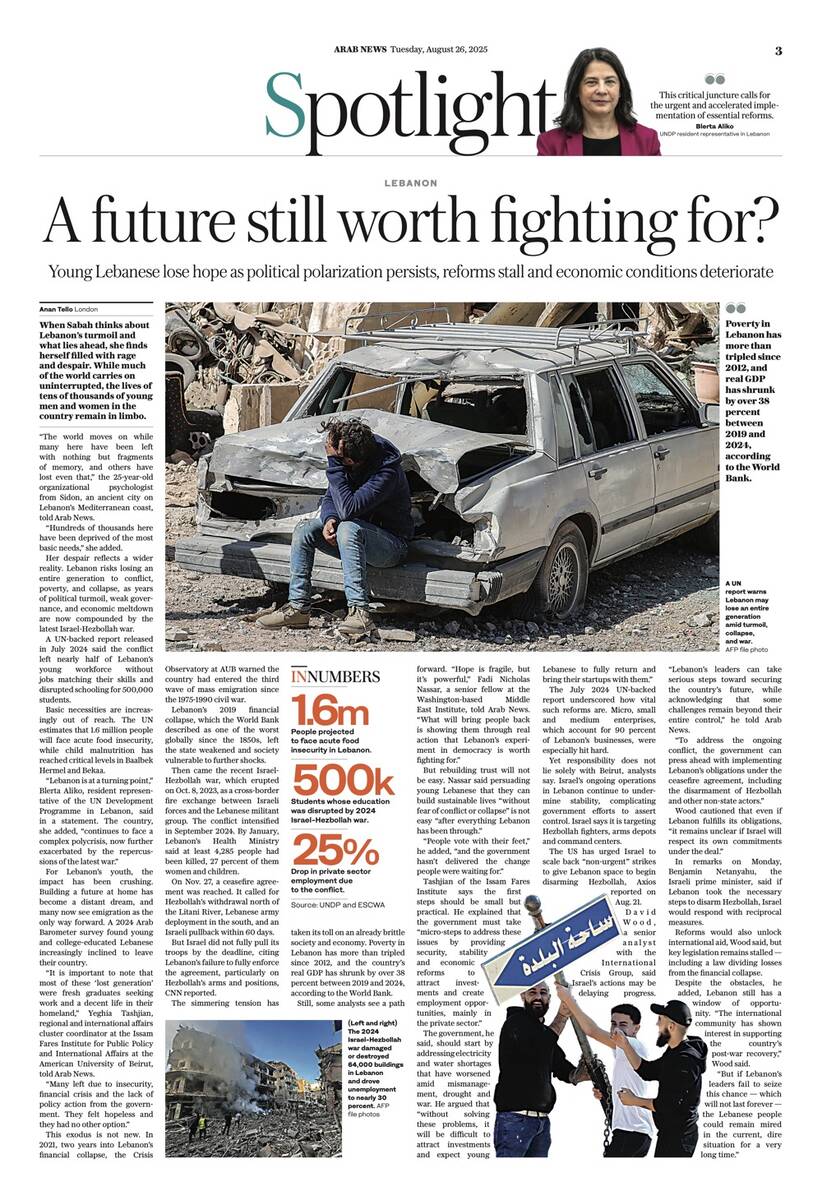
LONDON: When Sabah thinks about Lebanon’s turmoil and what lies ahead, she finds herself filled with rage and despair. While much of the world carries on uninterrupted, the lives of tens of thousands of young men and women in the country remain in limbo.
“The world moves on while many here have been left with nothing but fragments of memory, and others have lost even that,” the 25-year-old organizational psychologist from Sidon, an ancient city on Lebanon’s Mediterranean coast, told Arab News.
“Hundreds of thousands here have been deprived of the most basic needs,” she added. “They can’t access essential resources, their homes have been destroyed, their memories erased, their past lives vanished.”
Her despair reflects a wider reality. Lebanon stands on the brink of losing an entire generation to conflict, poverty and social and economic disintegration. Years of political turmoil, weak governance and economic meltdown were compounded by the latest war between Israel and Hezbollah.
A UN-backed report released in July 2024 said the conflict left nearly half of Lebanon’s young workforce without jobs matching their skills and disrupted schooling for 500,000 students. Between September and late November, 69 percent of children were forced out of classrooms.

Building a future at home has become a distant dream, and many now see emigration as the only way forward.
The report also found that the war displaced 1.2 million people, damaged or destroyed 64,000 buildings, pushed unemployment to nearly 30 percent, and rolled back human development to 2010 levels.
Basic necessities are increasingly out of reach. The UN estimates that 1.6 million people will face acute food insecurity, while child malnutrition has reached critical levels in Baalbek Hermel and Bekaa, where more than half of children under the age of two live in severe food poverty.
“Lebanon is at a turning point,” Blerta Aliko, resident representative of the UN Development Programme in Lebanon, said in a statement. The country, she added, “continues to face a complex polycrisis, now further exacerbated by the repercussions of the latest war.”
For Lebanon’s youth, the impact has been crushing. Building a future at home has become a distant dream, and many now see emigration as the only way forward. A 2024 Arab Barometer survey found young and college-educated Lebanese increasingly inclined to leave their country.
“It is important to note that most of these ‘lost generation’ were fresh graduates seeking work and a decent life in their homeland,” Yeghia Tashjian, regional and international affairs cluster coordinator at the Issam Fares Institute for Public Policy and International Affairs at the American University of Beirut, told Arab News.
“Many left due to insecurity, financial crisis and the lack of policy action from the government. They felt hopeless and they had no other option.”

The country’s real GDP has shrunk by over 38 percent between 2019 and 2024, according to the World Bank.
This exodus is not new. In 2021, two years into Lebanon’s financial collapse, the Crisis Observatory at AUB warned the country had entered the third wave of mass emigration since the 1975-1990 civil war, triggered by worsening all-round conditions.
Lebanon’s 2019 financial collapse, which the World Bank described as one of the worst globally since the 1850s, was the culmination of decades of fiscal mismanagement, entrenched clientelism and a post-civil war economy. The crisis left the state weakened and society vulnerable to further shocks.
Then came the recent Israel-Hezbollah war, which erupted on Oct. 8, 2023, as a cross-border fire exchange between Israeli forces and the Lebanese militant group. Hezbollah had moved to back Palestinians as Israel launched a widescale bombing campaign in the Gaza Strip in retaliation for a deadly Hamas-led attack on Oct. 7 that year.
The conflict intensified in September 2024, when Israeli strikes killed Hezbollah leader Hassan Nasrallah and other senior party leaders and commanders before its army began a ground invasion of southern Lebanon.
By January, Lebanon’s Health Ministry said at least 4,285 people had been killed, 27 percent of them women and children.
On Nov. 27, a ceasefire agreement, though fragile, was reached. It called for Hezbollah’s withdrawal north of the Litani River, Lebanese army deployment in the south, and an Israeli pullback within 60 days.
But Israel did not fully pull its troops by the deadline, citing Lebanon’s failure to fully enforce the agreement, particularly on Hezbollah’s arms and positions, CNN reported.

Lebanon has for decades struggled with severe electricity and water shortages, but the crises further deepened in 2024 and 2025.
The simmering tension has taken its toll on an already brittle society and economy. Poverty in Lebanon has more than tripled since 2012, and the country’s real GDP has shrunk by over 38 percent between 2019 and 2024, according to the World Bank.
Still, some analysts see a path forward. “Hope is fragile, but it’s powerful,” Fadi Nicholas Nassar, a senior fellow at the Washington-based Middle East Institute, told Arab News. “What will bring people back is showing them through real action that Lebanon’s experiment in democracy is worth fighting for.”
He added: “Lebanon’s government needs to show the people who left that this country is still worth coming back to as residents, not tourists. Worth their time, their dreams, their hopes.”
But rebuilding trust will not be easy. Nassar said persuading young Lebanese that they can build sustainable lives “without fear of conflict or collapse” is not easy “after everything Lebanon has been through.”
He drew a parallel to post-civil war recovery, when a generation invested in Lebanon’s promise — a promise now shattered for many.

A UN-backed report released in July 2024 said the conflict left nearly half of Lebanon’s young workforce without jobs matching their skills.
“After the civil war, an entire generation invested in the promise of Lebanon,” he said. “Now, the Lebanese are asked to believe again — to give what’s left of their youth, or the last hope of those who’ve spent a lifetime watching promises break.”
But can the people of Lebanon endure another disappointment, paid for in blood and sweat?
“Belief cannot survive another betrayal,” Nassar said. “If Lebanon is to rise, it must be worthy of the dreams entrusted to it. Lebanon, in the end, is nothing without the Lebanese.”
“People vote with their feet,” he added, “and the government hasn’t delivered the change people were waiting for.”
Tashjian of the Issam Fares Institute says the first steps should be small but practical. He explained that the government must take “micro-steps to address these issues by providing security, stability and economic reforms to attract investments and create employment opportunities, mainly in the private sector.”
INNUMBERS
• 1.6m People projected to face acute food insecurity in Lebanon.
• 500k Students whose education was disrupted by 2024 Israel-Hezbollah war.
• 25% Drop in private sector employment due to the conflict.
(Source: UNDP and ESCWA)
The government, he said, should start by addressing electricity and water shortages that have worsened amid mismanagement, drought and war. He argued that “without solving these problems, it will be difficult to attract investments and expect young Lebanese to fully return and bring their start-ups with them.”
Lebanon has for decades struggled with severe electricity and water shortages, but the crises further deepened in 2024 and 2025. On Aug. 17, 2024, the country’s last operational power plant shut down due to a lack of fuel, causing a nationwide blackout for 24 hours.
Tashjian also urged the creation of an online “National Skills Registry” to connect diaspora talent with jobs at home and new youth programs to encourage Lebanese abroad to return.

The country’s real GDP has shrunk by over 38 percent between 2019 and 2024, according to the World Bank.
“Third,” he added, “institutionalize relations between the diaspora and the Lebanese government by establishing ‘Lebanese Youth Councils’ to facilitate young Fulbright-style programs attracting the youth to visit Lebanon and seek new opportunities.”
The July 2024 UN-backed report underscored how vital such reforms are. Micro, small and medium enterprises, which account for 90 percent of Lebanon’s businesses, were especially hit hard.
Concentrated in Beirut and Mount Lebanon, firms suffered airstrikes, supply chain breakdowns and mass displacement of staff. The southern city of Nabatieh saw the worst destruction, with 31 percent of businesses damaged. Overall, 15 percent of MSMEs shut down permanently, while three-quarters suspended operations.
UNDP’s Aliko said the crisis demands “the urgent and accelerated implementation of essential reforms — particularly within public administration, as well as across socio-economic and financial sectors.”
Yet responsibility does not lie solely with Beirut, analysts say. Israel’s ongoing operations in southern and eastern Lebanon continue to undermine stability, complicating government efforts to assert control. Israel says it is targeting Hezbollah fighters, arms depots and command centers.
The US has urged Israel to scale back “non-urgent” strikes to give Lebanon space to begin disarming Hezbollah, Axios reported on Aug. 21.
David Wood, a senior analyst with the International Crisis Group, said Israel’s actions may be delaying progress. “Lebanon’s leaders can take serious steps toward securing the country’s future, while acknowledging that some challenges remain beyond their entire control,” he told Arab News.

“To address the ongoing conflict, the government can press ahead with implementing Lebanon’s obligations under the ceasefire agreement, including the disarmament of Hezbollah and other non-state actors.”
In early August, the Lebanese government announced a timeline for Hezbollah’s disarmament, with the goal of having a state monopoly on weapons before the end of 2025. In response, Hezbollah said it would treat the decision “as if it doesn’t exist.”
“The government of Prime Minister Nawaf Salam committed a grave sin by taking a decision to strip Lebanon of its weapons to resist the Israeli enemy,” the group said in a statement, warning that the decision “fully serves Israel’s interest.”
Wood cautioned that even if Lebanon fulfills its obligations, “it remains unclear if Israel will respect its own commitments under the deal.” He urged Washington to “help Lebanon by exerting diplomatic pressure on Israel to end its ongoing occupation in southern Lebanon and near-daily military operations.”
In remarks on Monday, Benjamin Netanyahu, the Israeli prime minister, welcomed the Lebanese cabinet’s “momentous decision,” saying that if Lebanon took the necessary steps to disarm Hezbollah, Israel would respond with reciprocal measures, including a phased reduction of its military presence in the country’s south.

The US has urged Israel to scale back “non-urgent” strikes to give Lebanon space to begin disarming Hezbollah.
Reforms would also unlock international aid, Wood said, but key legislation remains stalled — including a law dividing losses from the financial collapse.
“While the new leadership has made some progress on the reforms already, it still needs to usher in key legislation, including a law allocating losses from the collapse of Lebanon’s financial sector,” he said.
However, he added that “it could be difficult for the government to push through this controversial law, given the unresolved dispute over which parties should bear responsibility.”
Despite the obstacles, he added, Lebanon still has a window of opportunity. “The international community has shown interest in supporting the country’s post-war recovery,” Wood said.
“But if Lebanon’s leaders fail to seize this chance — which will not last forever — the Lebanese people could remain mired in the current, dire situation for a very long time.”