

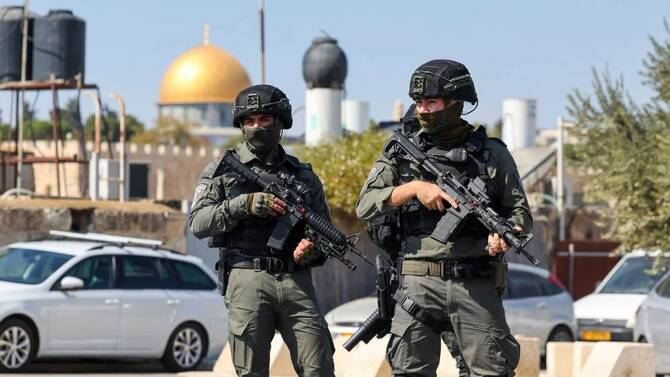
Senior UK defense figures toured Jerusalem as guests of Israeli firm bidding for military contract

Mike Cooper, a top civil servant at the MoD, visited the Mount of Olives, Wailing Wall and other sites in the city alongside two senior army officers and representatives of Elbit Systems in Sept. 2022. (AFP)
Short Url
Updated 25 August 2025
Follow

Senior UK defense figures toured Jerusalem as guests of Israeli firm bidding for military contract

  • Elbit Systems took coordinator of training program on trip before submitting bid for £2bn contract
  • Whistleblower: Brigadier who later joined firm also went on trip before passing info to Elbit before bid 

LONDON: A senior UK defense chief accepted a trip to Jerusalem partly paid for and run by an arms company while it was bidding for a British Army contract for a program he oversaw, The Times reported on Monday.

Mike Cooper, a top civil servant at the Ministry of Defence, visited the Mount of Olives, Wailing Wall and other sites in the city alongside two senior army officers and representatives of Elbit Systems Ltd. in September 2022.

Elbit is an Israel-based firm with its headquarters in the city of Haifa. It has a Britain-based arm, Elbit UK, with several factories across the country.

Cooper was, and remains, in charge of the British Army Collective Training Transformation Programme, designed to modernize the military’s training procedures.

Another of the three, Brig. Phil Kimber, later went to work for Elbit, to whom a company whistleblower alleges he passed information before it bid for the CTTP contract, The Times reported.

The trio also visited other companies in Israel, and an MoD source said the five-day trip was “normal business stuff.” All events and gifts during the trip, as well as its funding, were disclosed by the MoD.

The Times, though, reported that an Elbit employee said in an internal email that the trip had given the firm an “advantage” in winning the 15-year contract for the CTTP worth around £2 billion ($2.7 billion).

“The visit was a success — we won’t get another opportunity like this but neither will any other consortium,” The Times reported the employee as saying.

“They see us as highly credible and we need to be careful not to lose the advantage the Israel visit now gives us.”

The bidding process to partner for the CTTP was opened after the tour. A decision is expected soon, with Elbit UK bidding as part of a consortium that includes its Israeli parent company, The Times reported.

The employee told the newspaper that the trio visited Israel to see how Elbit could deliver training for the British Army similar to what it already provided to the Israeli military.

“Elbit was trying to impress them. They went round to see Elbit-delivered IDF (Israel Defense Forces) training,” the source added.

The Times reported that a letter to Cooper and Kimber from a senior Elbit UK figure in June 2023 allegedly said: “As you saw when you visited Israel last September, we understand what it takes to be an effective strategic partner, and we remain fully committed to bring this level of success to the army.” 

The letter added: “In a world of increasing complexity and global challenges, we recognise how critical CTTP remains to our army.”

The MoD previously decided that Elbit UK had gained no commercial advantage in the bidding process after a whistleblower alerted the ministry to Kimber passing information to the company, because Kimber was “not employed by the army at the time of the contract advert, pre-qualification questionnaire or invitation to negotiate.”

Elbit UK told The Times: “(We follow) the requirements and procedures advised by the advisory committee on business appointments regarding our employees who have served in the UK armed forces.”

The MoD told The Times: “This visit was part of routine engagement with industry and formally declared in the usual way.

“We maintain regular dialogue with defence companies interested in our programmes and ensure any conflicts of interest are managed during our procurement processes.”


Israeli army takes journalists into a tunnel in a Gaza city it seized and largely flattened

Updated 10 December 2025
Follow

Israeli army takes journalists into a tunnel in a Gaza city it seized and largely flattened

  • Israel and Hamas are on the cusp of finishing the first phase of the truce, which mandated the return of all hostages, living and dead, in exchange for Palestinians held by Israel
  • Hamas has said communication with its remaining units in Rafah has been cut off for months and that it was not responsible for any incidents occurring in those areas

RAFAH, Gaza Strip: One by one, the soldiers squeezed through a narrow entrance to a tunnel in southern Gaza. Inside a dark hallway, some bowed their heads to avoid hitting the low ceiling, while watching their step as they walked over or around jagged concrete, crushed plastic bottles and tattered mattresses.
On Monday, Israel’s military took journalists into Rafah — the city at Gaza’s southernmost point that troops seized last year and largely flattened — as the 2-month-old Israel-Hamas ceasefire reaches a critical point. Israel has banned international journalists from entering Gaza since the war began more than two years ago, except for rare, brief visits supervised by the military, such as this one.
Soldiers escorted journalists inside a tunnel, which they said was one of Hamas’ most significant and complex underground routes, connecting cities in the embattled territory and used by top Hamas commanders. Israel said Hamas had kept the body of a hostage in the underground passage: Hadar Goldin, a 23-year-old soldier who was killed in Gaza more than a decade ago and whose remains had been held there.
Hamas returned Goldin’s body last month as part of a US-brokered ceasefire in the war triggered by the militants’ Oct. 7, 2023, attack on southern Israel in which 1,200 people were killed and hundreds taken hostage. Israel’s retaliatory offensive has killed more than 70,000 Palestinians, according to Gaza’s Health Ministry, which operates under the Hamas-run government. The ministry does not differentiate between civilians and combatants, but says roughly half the dead have been women and children.
Israel and Hamas are on the cusp of finishing the first phase of the truce, which mandated the return of all hostages, living and dead, in exchange for Palestinians held by Israel. The body of just one more hostage remains to be returned.
Mediators warn the second phase will be far more challenging since it includes thornier issues, such as disarming Hamas and Israel’s withdrawal from the strip. Israel currently controls more than half of Gaza.
Israeli Prime Minister Benjamin Netanyahu is set to travel to Washington this month to discuss those next steps with US President Donald Trump.
Piles of rubble line Rafah’s roads
Last year, Israel launched a major operation in Rafah, where many Palestinians had sought refuge from offensives elsewhere. Heavy fighting left much of the city in ruins and displaced nearly one million Palestinians. This year, when the military largely had control of the city, it systematically demolished most of the buildings that remained standing, according to satellite photos.
Troops also took control of and shut the vital Rafah crossing, Gaza’s only gateway to the outside world that was not controlled by Israel.
Israel said Rafah was Hamas’ last major stronghold and key to dismantling the group’s military capabilities, a major war aim.
On the drive around Rafah on Monday, towers of mangled concrete, wires and twisted metal lined the roads, with few buildings still standing and none unscathed. Remnants of people’s lives were scattered the ground: a foam mattress, towels and a book explaining the Qur’an.
Last week, Israel said it was ready to reopen the Rafah crossing but only for people to leave the strip. Egypt and many Palestinians fear that once people leave, they won’t be allowed to return. They say Israel is obligated to open the crossing in both directions.
Israel has said that entry into Gaza would not be permitted until Israel receives all hostages remaining in the strip.
Inside the tunnel
The tunnel that journalists were escorted through runs beneath what was once a densely populated residential neighborhood, under a United Nations compound and mosques. Today, Rafah is a ghost town. Underground, journalists picked their way around dangling cables and uneven concrete slabs covered in sand.
The army says the tunnel is more than 7 kilometers (4 miles) long and up to 25 meters (82 feet) deep and was used for storing weapons as well as long-term stays. It said top Hamas commanders were there during the war, including Mohammed Sinwar — who was believed to have run Hamas’ armed wing and was the younger brother of Yahya Sinwar, the Hamas leader who helped mastermind the Oct. 7 attack. Israel has said it has killed both of them.
“What we see right here is a perfect example of what Hamas did with all the money and the equipment that was brought into Gaza throughout the years,” said Lt. Col. Nadav Shoshani. “Hamas took it and built an incredible city underground for the purposes of terror and holding bodies of hostages.”
Israel has long accused Hamas of siphoning off money for military purposes. While Hamas says the Palestinians are an occupied people and have a right to resist, the group also has a civilian arm and ran a government that provided services such as health care, a police force and education.
The army hasn’t decided what to do with the tunnel. It could seal it with concrete, explode it or hold it for intelligence purposes among other options.
Since the ceasefire began, three soldiers have been killed in clashes with about 200 Hamas militants that Israeli and Egyptian officials say remain underground in Israeli-held territory.
Hamas has said communication with its remaining units in Rafah has been cut off for months and that it was not responsible for any incidents occurring in those areas.
Both Israel and Hamas have accused each other of repeated violations of the deal during the first phase. Israel has accused Hamas of dragging out the hostage returns, while Palestinian health officials say over 370 Palestinians have been killed in continued Israeli strikes since the ceasefire took effect.