

Bangladesh runs out of resources for Rohingya as global support plunges

1 / 2
Muhammad Yunus, head of Bangladesh's interim government, addresses an international conference on the Rohingya crisis in Cox’s Bazar, Bangladesh on Aug. 25, 2025. (AFP)
2 / 2
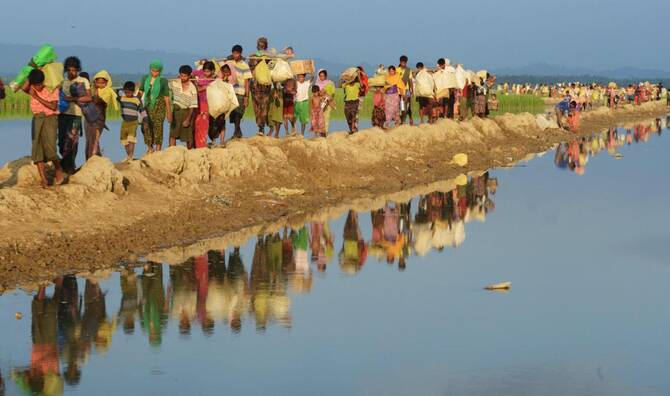
Rohingya Muslim refugees who were stranded after leaving Myanmar walk toward the Balukhali refugee camp after crossing the border in Bangladesh’s Ukhia district on November 2, 2017. (AFP)
Short Url
Updated 25 August 2025
Follow

Bangladesh runs out of resources for Rohingya as global support plunges

  • UN’s response plan for Rohingya crisis is only 36% funded for 2025-26
  • Bangladesh looks for alternative strategies to stop violence in Myanmar, expert says

DHAKA: Bangladesh is unable to allocate additional resources for the growing number of Rohingya refugees, the country’s leader said on Monday, as he called on the international community to deliver on UN commitments to address the crisis.

The chief of Bangladesh’s interim government, Nobel laureate Muhammad Yunus, was addressing a two-day conference in Cox’s Bazar, held by the Bangladeshi government ahead of a high-level meeting at the UN General Assembly in September.

It comes eight years after hundreds of thousands of Rohingya were forced to flee a military crackdown in Myanmar and take shelter in neighboring Bangladesh.

Today, more than 1.3 million Rohingya are cramped inside 33 camps in the Cox’s Bazar district on the country’s southeast coast, making it the world’s largest refugee settlement.

While the number of refugees arriving from Myanmar has increased by some 150,000 since last year, international aid is dwindling. The latest Joint Response Plan for the Rohingya Humanitarian Crisis in Bangladesh has only 36 percent funding from the requested 2025-26 amount of nearly $935 million.

Bangladesh, which is already grappling with domestic challenges, does not “foresee any scope whatsoever for further mobilization of resources from domestic sources” to sustain the refugees, Yunus said.

“During the last eight years, people of Bangladesh, in particular the host community here in Cox’s Bazaar, have been making tremendous sacrifices. The impacts on our economy, resources, environment and ecosystem, society and governance have been huge,” he told attendees.

“(The) Rohingya issue and its sustainable resolution must be kept alive on the global agenda, as they need our support until they return home.”

Despite multiple attempts from Bangladeshi authorities, a UN-backed repatriation and resettlement process has failed to take off for the past few years.

Efforts have been stalled by armed conflict in Myanmar since the military junta seized power in 2021, and the number of refuges has been steadily increasing. In 2024, it grew sharply as fighting escalated in Rakhine state between junta troops and the Arakan Army, a powerful local ethnic militia.

Yunus called on the international community to draft a practical roadmap to end the violence, enable the Rohingya’s return to Rakhine, and hold perpetrators of violence and ethnic cleansing accountable.

“We urge upon all to calibrate their relationship with Myanmar and Arakan Army, and all parties to the conflict, in order to promote an early resolution of the protracted crisis,” he said.

“We urge all of the international community to add dynamism to the ongoing international accountability processes at the International Court of Justice, International Criminal Court and elsewhere.”

As the UN conference on Rohingya nears, with another scheduled to take place in Doha in December, the meeting in Cox’s Bazaar — where donors will also visit the Rohingya camps — is seen as an attempt to find a new strategy to address the crisis. Regional efforts are also being encouraged, with the Association of Southeast Asian Nations earlier this month vowing to send a peace mission to Myanmar — its member state.

“We’ve seen during the last few months, especially during the interim government, that they have been trying to see if there could be some alternative ways of advocacy or getting Myanmar to accept certain positions through the ASEAN,” Asif Munier, a rights and migration expert, told Arab News.

“We know that it would be very difficult to get a common understanding at the UN Security Council to vote against Myanmar authorities. But if there could be other efforts to provide some sort of justice — that’s something that also should come up.”


EU indefinitely freezes Russian assets so Hungary and Slovakia can’t veto their use for Ukraine

Updated 3 sec ago
Follow

EU indefinitely freezes Russian assets so Hungary and Slovakia can’t veto their use for Ukraine

  • Costa said European leaders had committed in October “to keep Russian assets immobilized until Russia ends its war of aggression against Ukraine
  • “Next step: securing Ukraine’s financial needs for 2026–27”

BRUSSELS: The European Union on Friday indefinitely froze Russia’s assets in Europe to ensure that Hungary and Slovakia, both with Moscow-friendly governments, can’t prevent the billions of euros from being used to support Ukraine.
Using a special procedure meant for economic emergencies, the EU blocked the assets until Russia gives up its war on Ukraine and compensates its neighbor for the heavy damage that it has inflicted for almost four years.
EU Council President António Costa said European leaders had committed in October “to keep Russian assets immobilized until Russia ends its war of aggression against Ukraine and compensates for the damage caused. Today we delivered on that commitment.”
It’s a key step that will allow EU leaders to work out at a summit next week how to use the tens of billions of euros in Russian Central Bank assets to underwrite a huge loan to help Ukraine meet its financial and military needs over the next two years.
“Next step: securing Ukraine’s financial needs for 2026–27,” added Costa, who will chair the summit on Dec. 18.
The move also prevents the assets, estimated to total around 210 billion euros ($247 billion), from being used in any negotiations to end the war without European approval.
A 28-point plan drafted by US and Russian envoys stipulated that the EU would release the frozen assets for use by Ukraine, Russia and the United States. That plan, which surfaced last month, was rejected by Ukraine and its backers in Europe.
Hungarian Prime Minister Viktor Orbán – Russian President Vladimir Putin’s closest ally in Europe – accused the European Commission, which prepared the decision, “of systematically raping European law.”
The vast majority of the funds — around 193 billion euros ($225 billion) at the end of September — are held in Euroclear, a Belgian financial clearing house.
The money was frozen under sanctions that the EU imposed on Russia over the war it launched on Feb. 24, 2022, but these sanctions must be renewed every six months, and all 27 member countries must approve them for that to happen.
Hungary and Slovakia oppose providing more support to Ukraine.
Friday’s decision, which is based on EU treaty rules allowing the bloc to protect its economic interests in certain emergency situations, prevents them from blocking the sanctions rollover and make it easier to use the assets.
Orbán said on social media that it means that “the rule of law in the European Union comes to an end, and Europe’s leaders are placing themselves above the rules.”
“The European Commission is systematically raping European law. It is doing this in order to continue the war in Ukraine, a war that clearly isn’t winnable,” he wrote. He said that Hungary “will do everything in its power to restore a lawful order.”
In a letter to Costa, Slovak Prime Minister Robert Fico said that he would refuse to back any move that “would include covering Ukraine’s military expenses for the coming years.”
He warned “that the use of frozen Russian assets could directly jeopardize US peace efforts, which directly count on the use of these resources for the reconstruction of Ukraine.”
But the commission argues that the war has imposed heavy costs by hiking energy prices and stunting economic growth in the EU, which has already provided nearly 200 billion euros ($235 billion) in support to Ukraine.
Belgium, where Euroclear is based, is opposed to the “reparations loan” plan. It says that the plan “entails consequential economic, financial and legal risks,” and has called on other EU countries to share the risk.
Russia’s Central Bank, meanwhile, said on Friday that it has filed a lawsuit in Moscow against Euroclear for damages it says were caused when Moscow was barred from managing the assets. Euroclear declined to comment.
In a separate statement, the Central Bank also described wider EU plans to use Russian assets to aid Ukraine as “illegal, contrary to international law,” arguing that they violated “the principles of sovereign immunity of assets.”