

Bangladesh runs out of resources for Rohingya as global support plunges

1 / 2
Muhammad Yunus, head of Bangladesh's interim government, addresses an international conference on the Rohingya crisis in Cox’s Bazar, Bangladesh on Aug. 25, 2025. (AFP)
2 / 2
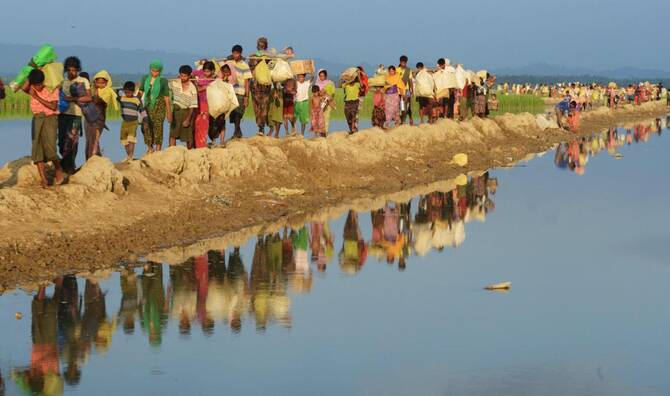
Rohingya Muslim refugees who were stranded after leaving Myanmar walk toward the Balukhali refugee camp after crossing the border in Bangladesh’s Ukhia district on November 2, 2017. (AFP)
Short Url
Updated 25 August 2025
Follow

Bangladesh runs out of resources for Rohingya as global support plunges

  • UN’s response plan for Rohingya crisis is only 36% funded for 2025-26
  • Bangladesh looks for alternative strategies to stop violence in Myanmar, expert says

DHAKA: Bangladesh is unable to allocate additional resources for the growing number of Rohingya refugees, the country’s leader said on Monday, as he called on the international community to deliver on UN commitments to address the crisis.

The chief of Bangladesh’s interim government, Nobel laureate Muhammad Yunus, was addressing a two-day conference in Cox’s Bazar, held by the Bangladeshi government ahead of a high-level meeting at the UN General Assembly in September.

It comes eight years after hundreds of thousands of Rohingya were forced to flee a military crackdown in Myanmar and take shelter in neighboring Bangladesh.

Today, more than 1.3 million Rohingya are cramped inside 33 camps in the Cox’s Bazar district on the country’s southeast coast, making it the world’s largest refugee settlement.

While the number of refugees arriving from Myanmar has increased by some 150,000 since last year, international aid is dwindling. The latest Joint Response Plan for the Rohingya Humanitarian Crisis in Bangladesh has only 36 percent funding from the requested 2025-26 amount of nearly $935 million.

Bangladesh, which is already grappling with domestic challenges, does not “foresee any scope whatsoever for further mobilization of resources from domestic sources” to sustain the refugees, Yunus said.

“During the last eight years, people of Bangladesh, in particular the host community here in Cox’s Bazaar, have been making tremendous sacrifices. The impacts on our economy, resources, environment and ecosystem, society and governance have been huge,” he told attendees.

“(The) Rohingya issue and its sustainable resolution must be kept alive on the global agenda, as they need our support until they return home.”

Despite multiple attempts from Bangladeshi authorities, a UN-backed repatriation and resettlement process has failed to take off for the past few years.

Efforts have been stalled by armed conflict in Myanmar since the military junta seized power in 2021, and the number of refuges has been steadily increasing. In 2024, it grew sharply as fighting escalated in Rakhine state between junta troops and the Arakan Army, a powerful local ethnic militia.

Yunus called on the international community to draft a practical roadmap to end the violence, enable the Rohingya’s return to Rakhine, and hold perpetrators of violence and ethnic cleansing accountable.

“We urge upon all to calibrate their relationship with Myanmar and Arakan Army, and all parties to the conflict, in order to promote an early resolution of the protracted crisis,” he said.

“We urge all of the international community to add dynamism to the ongoing international accountability processes at the International Court of Justice, International Criminal Court and elsewhere.”

As the UN conference on Rohingya nears, with another scheduled to take place in Doha in December, the meeting in Cox’s Bazaar — where donors will also visit the Rohingya camps — is seen as an attempt to find a new strategy to address the crisis. Regional efforts are also being encouraged, with the Association of Southeast Asian Nations earlier this month vowing to send a peace mission to Myanmar — its member state.

“We’ve seen during the last few months, especially during the interim government, that they have been trying to see if there could be some alternative ways of advocacy or getting Myanmar to accept certain positions through the ASEAN,” Asif Munier, a rights and migration expert, told Arab News.

“We know that it would be very difficult to get a common understanding at the UN Security Council to vote against Myanmar authorities. But if there could be other efforts to provide some sort of justice — that’s something that also should come up.”


Ethiopia embraces big projects but risks another war by seeking access to the sea

Updated 6 sec ago
Follow

Ethiopia embraces big projects but risks another war by seeking access to the sea

Ethiopia ‘s prime minister loves big projects. With a mega-dam completed on the Nile, Abiy Ahmed now plans Africa’s largest airport and a nuclear power plant. But the threat of war is back as the landlocked nation seeks its most audacious feat yet: access to the sea.
The prime minister hailed the country’s transformation in a parliamentary address in late October. The capital, Addis Ababa, has seen a development boom. The Grand Ethiopian Renaissance Dam was inaugurated in July. Abiy has called it a “harbinger of tomorrow’s dawn” that will end the reliance on foreign aid for Africa’s second most populous nation. The country has been one of the world’s biggest aid recipients.
But multiple challenges lie ahead that could badly damage the economy, which has seen some of the strongest growth on the continent.
Eritrea
Abiy’s government is determined to regain access to the Red Sea, which Ethiopia lost when Eritrea seceded in 1993 after decades of guerrilla warfare.
The countries made peace in recent years, bringing Abiy a Nobel Peace Prize, then teamed up for a devastating war against Ethiopia’s Tigray region. Now tensions have returned.
In June, Eritrea accused Ethiopia of having a “long-brewing war agenda” aimed at seizing its Red Sea ports. Ethiopia insists it wants to gain sea access peacefully.
Ethiopia recently claimed Eritrea was “actively preparing to wage war against it.” It has also accused Eritrea of supporting Ethiopian rebel groups.
Magus Taylor, deputy Horn of Africa director at the International Crisis Group, described the tensions as concerning.
“There’s a possibility of mistakes or miscalculation,” he said. “And the situation could deteriorate further in the coming months.”
Egypt
Egypt relies on the Nile for nearly all its drinking water and fiercely opposed the Grand Ethiopian Renaissance Dam, asserting that it would threaten the supply. Egypt and Ethiopia have held several rounds of inconclusive talks to regulate the use of the dam, especially in times of drought.
Since the dam’s inauguration, Cairo has toughened its rhetoric against Ethiopia. In September, it said it reserved “the right to take all necessary measures … to defend the existential interests of its people.”
Ethiopia says the dam is critical for its development as it seeks to lift millions of people out of poverty.
Egypt has also sought to exploit tensions between Ethiopia and its neighbors. It has bolstered security ties with Eritrea and signed a security pact with Somalia, which last year reacted furiously when Ethiopia signed a port deal with the breakaway region of Somaliland, over which Somalia claims sovereignty.
Ethnic conflicts

The war in Ethiopia’s Tigray region ended with a peace deal in late 2022, but the country’s two largest regions — Amhara and Oromia — are wracked by ethnic-based insurgencies that threaten internal security.
Both the group of loosely organized militias called Fano in Amhara, and the Oromo Liberation Army Oromia, claim to represent those oppressed by the federal government.
Witnesses have reported massacres and other extrajudicial killings by all sides. Kidnapping for ransom has become commonplace, and humanitarian aid groups struggle to deliver supplies.
Amnesty International has described the cycle of violence as a “revolving door of injustices.”
Meanwhile, the peace deal for Tigray risks unraveling. Southern areas of Tigray have seen clashes between regional forces and local militias aligned with the federal government. Tigray’s rulers accused the federal government of “openly breaching” the agreement after a drone strike hit its forces.
Abiy’s government now accuses Tigray’s rulers of colluding with Eritrea.
Economic inequality
The insecurity contrasts starkly with the mood in Addis Ababa, where Abiy has spent billions of dollars on a face lift that has included creating bike lanes, a conference center, parks and museums.
The prime minister wants to turn the capital, already home to the African Union continental body and one of Africa’s busiest airports, into a hub for international tourists and investors.
He has floated Ethiopia’s currency, opened the banking sector and launched a stock exchange — all dramatic steps for a country where the economy has long been state-owned and state-managed.
The reforms helped Ethiopia secure a $3.4 billion bailout from the International Monetary Fund last year. But investors are wary about Ethiopia’s internal insecurity and tensions with its neighbors.
Poverty, meanwhile, has risen alarmingly. About 43 percent of Ethiopians now live under the poverty line, up from 33 percent in 2016, two years before Abiy took power, according to the World Bank. That’s due in part to rising food and fuel prices as well as defense spending taking up more of Ethiopia’s budget.
The sense of prosperity prevailing in Addis Ababa is not shared by Ethiopia’s regions, said Taylor with the International Crisis Group.
“Abiy has a firm grip on the country at the center, but then you have these periphery conflicts partly based on feelings of injustice – that they are poor and the center is rich,” he said. “So we expect this kind of instability to continue in these areas.”