

Rabi Al-Awwal moon not sighted, Pakistan to mark Eid Milad-un-Nabi on Sept. 6

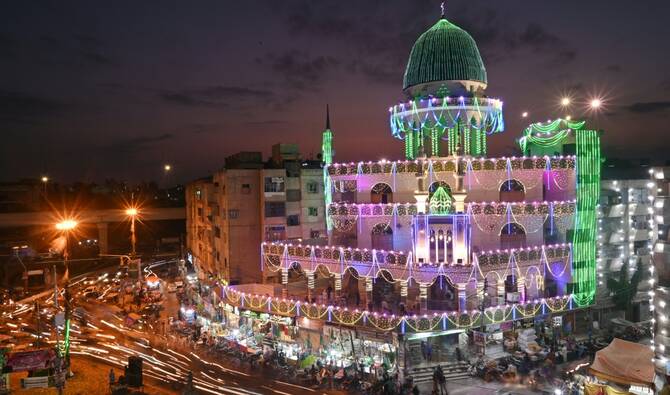
A view of an illuminated mosque is pictured on the eve of Eid Milad-un-Nabi, the birthday of the Prophet Mohammed (PBUH), in Karachi on September 16, 2024. (AFP/File)
Short Url
Updated 24 August 2025
Follow

Rabi Al-Awwal moon not sighted, Pakistan to mark Eid Milad-un-Nabi on Sept. 6

  • Muslims mark the 12th of Rabi Al-Awwal as the birth anniversary of Prophet Muhammad
  • In Pakistan, the day dawns with a 31-gun salute, followed by Seerat-un-Nabi conferences

ISLAMABAD: The crescent for the Islamic month of Rabi Al-Awwal could not be sighted in Pakistan, the religious affairs ministry announced on Sunday, with the country now due to mark Eid Milad-un-Nabi on Sept. 6.

Rabi Al-Awwal is the third month in the Islamic calendar. The month holds special significance for Muslims around the world as they observe the 12th of the month as Mawlid Al-Nabi, the birthday of Prophet Muhammad (PBUH). In Pakistan and some other countries in Asia, it is referred to as Eid Milad-un-Nabi.

On Sunday, the central moon-sighting committee held a session in the southern port city of Karachi, presided over by its chairman, Maulana Abdul Khabeer, to sight the Rabi Al-Awwal moon.

“The moon of Rabi Al-Awwal 1447 AH has not been sighted,” the religious affairs ministry said, citing a decision of the moon-sighting committee. “Therefore, the 1st Rabi Al-Awwal 1447 AH shall commence from Tuesday.”

Consequently, the 12th of Rabi Al-Awwal will fall on Saturday, Sept. 6.

In Pakistan, the day dawns with a 31-gun salute in the Pakistani federal capital of Islamabad and a 21-gun salute in all provincial capitals.

The religious affairs ministry organizes the annual Seerat-un-Nabi Conference on the day to encourage research and discussion on various aspects of the life of the Prophet (PBUH) and their application in modern times.

Various conferences and events are held across the country, at which religious scholars highlight the teachings of the Prophet (PBUH) to enlighten the daily lives and strengthen the moral fabric of society.

Pakistan, Azerbaijan call for de-escalation in the region amid widening Iran conflict

Updated 10 sec ago
Follow

Pakistan, Azerbaijan call for de-escalation in the region amid widening Iran conflict

  • PM Sharif condemns drone strike on the Nakhchivan exclave of Azerbaijan targeting civilians
  • He tells President Ilham Aliyev Pakistan stands in full solidarity with Azerbaijan and its people

PESHAWAR: Pakistan and Azerbaijan called for de-escalation in the region on Friday amid intensifying attacks on Iran by Israel and the United States, a day after drone strikes targeted civilians in Azerbaijan’s Nakhchivan exclave.

The appeal came during a telephone conversation between Prime Minister Shehbaz Sharif and Azerbaijan’s President Ilham Aliyev, according to an official statement, as tensions across the Middle East and the Gulf region continue to rise.

The call followed drone attacks on Thursday that wounded four people in Nakhchivan, an Azerbaijani exclave bordering Iran.

Baku accused Tehran of launching the drones and threatened retaliation, while Iran denied the allegation and blamed Israel — a close ally of Azerbaijan — for attempting to stage a provocation.

“During their conversation, the Prime Minister condemned, in the strongest terms, the drone attacks on Nakhchivan exclave of Azerbaijan yesterday that targeted innocent civilians,” said the statement released by Sharif office after the conversation. “He assured the Azerbaijani leadership that Pakistan stands in complete solidarity and support with the brotherly people of Azerbaijan at this difficult time.”

“The two leaders stressed on the need for de-escalation and restoration of peace in the region,” it added.

Sharif also briefed Aliyev on Pakistan’s diplomatic outreach following the crisis in Iran and the Gulf region.

Aliyev thanked the Pakistani leader for the call and appreciated the expression of solidarity from Pakistan, according to the statement.

Pakistan and Azerbaijan maintain close political and defense ties, with Islamabad also offering Azerbaijan and other Central Asian states connectivity to its southern ports to facilitate trade.

Pakistan has also repeatedly urged all sides involved in the escalating Iran confrontation to avoid further escalation and resolve disputes through dialogue and diplomacy.