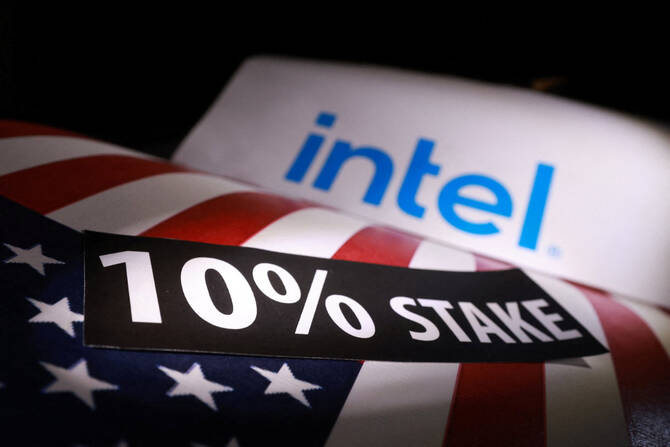
WASHINGTON: President Donald Trump on Friday announced the US government has secured a 10 percent stake in struggling Silicon Valley pioneer Intel in a deal that was completed just a couple weeks after he was depicting the company’s CEO as a conflicted leader unfit for the job.
“The United States of America now fully owns and controls 10 percent of INTEL, a Great American Company that has an even more incredible future,” Trump wrote in a post.
The US government is getting the stake through the conversion of $11.1 billion in previously issued funds and pledges. All told, the government is getting 433.3 million shares of non-voting stock priced at $20.47 apiece — a discount from Friday’s closing price at $24.80. That spread means the US government already has a gain of $1.9 billion, on paper.
The remarkable turn of events makes the US government one of Intel’s largest shareholders at a time that the Santa Clara, California, company is in the process of jettisoning more than 20,000 workers as part of its latest attempt to bounce back from years of missteps taken under a variety of CEOs.
Intel’s current CEO, Lip-Bu Tan, has only been on the job for slightly more than five months, and earlier this month, it looked like he might be on shaky ground already after some lawmakers raised national security concerns about his past investments in Chinese companies while he was a venture capitalist. Trump latched on to those concerns in an August 7 post demanding that Tan resign.
But Trump backed off after the Malaysian-born Tan professed his allegiance to the US in a public letter to Intel employees and went to the White House to meet with the president, leading to a deal that now has the US government betting that the company is on the comeback trail after losing more than $22 billion since the end of 2023. Trump hailed Tan as “highly respected” CEO in his Friday post.
In a statement, Tan applauded Trump for “driving historic investments in a vital industry” and resolved to reward his faith in Intel. “We are grateful for the confidence the President and the Administration have placed in Intel, and we look forward to working to advance US technology and manufacturing leadership,” Tan said.
Intel’s current stock price is just slightly above where it was when Tan was hired in March and more than 60 percent below its peak of about $75 reached 25 years ago when its chips were still dominating the personal computer boom before being undercut by a shift to smartphones a few years later. The company’s market value currently stands at about $108 billion — a fraction of the current chip kingpin, Nvidia, which is valued at $4.3 trillion.
The stake is coming primarily through US government grants to Intel through the CHIPS and Science Act that was started under President Joe Biden’s administration as a way to foster more domestic manufacturing of computer chips to lessen the dependence on overseas factories.
But the Trump administration, which has regularly pilloried the policies of the Biden administration, saw the CHIPs act as a needless giveaway and is now hoping to make a profit off the funding that had been pledged to Intel.
“We think America should get the benefit of the bargain,” US Commerce Secretary Howard Lutnick said earlier this week. “It’s obvious that it’s the right move to make.”
About $7.8 billion had been been pledged to Intel under the incentives program, but only $2.2 billion had been funded so far. Another $3.2 billion of the government investment is coming through the funds from another program called “Secure Enclave.”
Although US government can’t vote with its shares and won’t have a seat on Intel’s board of directors, critics of the deal view it as a troubling cross-pollination between the public and private sectors that could hurt the tech industry in a variety of ways.
For instance, more tech companies may feel pressured to buy potentially inferior chips from Intel to curry favor with Trump at a time that he is already waging a trade war that threatens to affect their products in a potential scenario cited by Scott Lincicome, vice president of general economics for the Cato Institute.
“Overall, it’s a horrendous move that will have real harms for US companies, US tech leadership, and the US economy overall,” Lincicome posted Friday.
The 10 percent stake could also intensify the pressure already facing Tan, especially if Trump starts fixating on Intel’s stock price while resorting to his penchant for celebrating his past successes in business.
Nancy Tengler, CEO of money manager Laffer Tengler Investments, is among the investors who abandoned Intel years ago because of all the challenges facing Intel.
“I don’t see the benefit to the American taxpayer, nor do I see the benefit, necessarily to the chip industry,” Tengler said while also raising worries about Trump meddling in Intel’s business.
“I don’t care how good of businessman you are, give it to the private sector and let people like me be the critic and let the government get to the business of government.,” Tengler said.
Although rare, it’s not unprecedented for the US government to become a significant shareholder in a prominent company. One of the most notable instances occurred during the Great Recession in 2008 when the government injected nearly $50 billion into General Motors in return for a roughly 60 percent stake in the automaker at a time it was on the verge of bankruptcy. The government ended up with a roughly $10 billion loss after it sold its stock in GM.
The US government’s stake in Intel coincides with Trump’s push to bring production to the US, which has been a focal point of the trade war that he has been waging throughout the world. By lessening the country’s dependence on chips manufactured overseas, the president believes the US will be better positioned to maintain its technological lead on China in the race to create artificial intelligence.
Even before gaining the 10 percent stake in Intel, Trump had been leveraging his power to reprogram the operations of major computer chip companies. The administration is requiring Nvidia and Advanced Micro Devices, two companies whose chips are powering the AI craze, to pay a 15 percent commission on their sales of chips in China in exchange for export licenses.


![]()

Trump turns $11.1 billion in US government funds into a 10 percent stake in downtrodden Intel
Short Url
https://arab.news/ru4c6
Trump turns $11.1 billion in US government funds into a 10 percent stake in downtrodden Intel
- US govt getting the stake through the conversion of $11.1 billion in previously issued funds and pledges, making a gain of $1.9 billion, on paper
- Remarkable turn of events comes at a time that the chipmaker is in the process of laying off more than 20,000 workers in bid to bounce back from years of missteps


Latest updates


© 2026 SAUDI RESEARCH & PUBLISHING COMPANY, All Rights Reserved And subject to Terms of Use Agreement.