

Recipes for Success: Chef Saleh Aljabali offers advice and a matazeez recipe

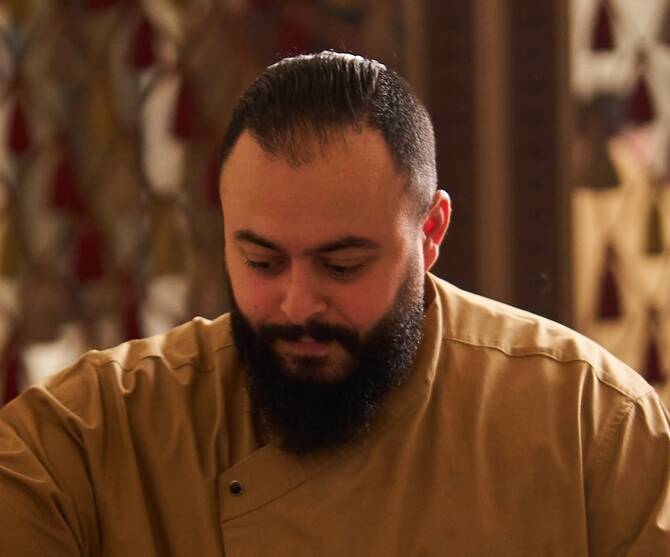
Chef Saleh Aljabali. (Supplied)
Short Url
Updated 22 August 2025
Follow

Recipes for Success: Chef Saleh Aljabali offers advice and a matazeez recipe

  • The head chef of Najdi Signature Restaurant in Diriyah offers advice and a matazeez recipe 

DIRIYAH: For Chef Saleh Aljabali, his culinary passion was fired as early as kindergarten. “The earliest memory would be when I was three, four years,” he tells Arab News. “At the kindergarten, we were taught to make French toast. And I got excited about it. That was the spark.” 

From experimenting at home with family and friends to pursuing the craft alongside his engineering studies, he soon realized cooking was his calling. “This is my passion and this is what I prefer to do,” he says. 

Today, that passion has found its home at Najdi Signature Restaurant in Bab Samhan Hotel, a Luxury Collection Property in Diriyah. “It’s the first Najdi cuisine restaurant in a five-star hotel in the region, if not in the world,” Saleh explains. “The idea is to serve authentic Najdi dishes, presented with a modern twist.” 

When you started out, what was the most common mistake you made? 

Not trusting the ingredients enough. I would over-season and overcomplicate, or try to impress with too many techniques in one dish. But I learned that restraint is a skill in itself, and sometimes the best thing you can do is to let the ingredients speak for themselves. Another mistake was rushing the process — especially with traditional dishes that require time and patience. Najdi cuisine, for example, is all about slow cooking. You cannot rush it and expect authenticity. 

 What’s your top tip for amateur chefs? 

Taste as you go. It sounds simple, but it’s the most important habit — adjusting seasoning, acidity and texture throughout the process makes a huge difference. On a practical level, invest in a good knife and keep it sharp. It makes prep faster, safer and more enjoyable. 

What one ingredient can instantly improve any dish and why? 

I’d choose lemon. A splash of acidity can brighten flavors, balance richness, and add complexity. It’s a game changer, for sure. 

When you go out to eat, do you find yourself critiquing the food? Or are you able to switch off? 

I can’t really escape my invisible chef’s hat. Not necessarily for critiquing, just out of interest for what the presentation, taste and service is like. It’s automatic. 

What’s the most common issue you find in other restaurants? 

Inconsistent seasoning — either too bland or unevenly distributed. It’s a small thing, but it affects the entire experience.  

What’s your favorite cuisine to eat? 

I’m always drawn to street food, because of the simplicity of it. Especially when I’m traveling. There’s something incredibly touching about the food and the people and how they interpret themselves through the food. Everybody is intentional about the balance and the flavor. It’s inspiring. 

What’s your go-to dish if you have to cook something quickly at home?  

A grilled chicken sandwich with fresh rustic bread. Season the chicken with salt and pepper, garlic, a touch of cumin, a squeeze of lemon juice… that’s it. I recommend avocado with it too. And crisp lettuce, tomato, and chili mayo.  

What customer behavior most frustrates you?  

When guests ask for major changes to a dish without understanding the idea behind it. Like, removing key ingredients that actually define the dish and its purpose. 

What’s the most difficult dish for you to get right? 

Gursan, a traditional Najdi dish made of a thin wheat bread soaked in rich vegetable and meat stock — sometimes tomato sauce as well — is tricky. The difficulty lies in getting the texture right, because the bread must absorb the broth and the flavors without becoming too soggy. It’s a delicate balance which depends on timing, temperature and the consistency of the sauce. Because it’s such a beloved dish with deep cultural roots, there’s a lots of pressure in getting it right and honoring its authenticity while presenting it in a refined way. It’s a dish that demands respect, patience and precision. 

As a head chef, what are you like? Are you a disciplinarian, or are you more laid back? 

Sometimes I’m actually too friendly. That’s not always a good thing, but I believe and leading with respect and consistency.  A kitchen is a high-pressure environment, for sure, but that doesn’t mean it has to be hostile. I’m not someone who shouts often. I mean, when firmness is needed, then it’s needed, but it’s not a style of leading. I prefer to communicate clearly, set high standards and support my team in reaching them. I always remind my team we’re not just cooking, we’re creating an experience. That requires passion, precision and, most definitely, teamwork. 

Chef Saleh’s pigeon-stuffed matazeez with seasonal vegetables 

INGREDIENTS: 

3 tomatoes; 2 carrots; 1 pumpkin; 2 zucchini; 3 onions; afilla cress, 1 bunch; 1 whole pigeon; 50g truffle; 500g whole wheat flour; 100g ghee; 1tbsp bizar seasoning; 3 bay leaves; 5 pieces of cardamom; 5 black pepper corns; 1tbsp lomi powder; tap water (as needed) 

INSTRUCTIONS: 

1. In a pot Sautee 1 pc. of onion with whole pigeon, cardamom and bay leaves. 

2. Add a cup of water and let it simmer for 1 hour 

3. In a mixing bowl add the flour, salt, water and mix the dough. 

4. Rest it for half an hour, then sheet it and cut it with 2-inch ring cutter and keep it covered in the chiller. 

5. Strain the pigeon, keep the sock on the side and pull the meat of the pigeon. 

6. Cut carrots, pumpkin, zucchini, local truffle, the rest of the onions, and the tomato. 

7. Sautee onion, tomato then add bizar spices, strained stock and let it cook. 

8. In a small pan add the ghee and chopped onion and cook it slowly then add Bizar spices and Lomi powder for the kishna. 

9. Fill the pigeon meat inside the dough and shape it as per the picture. 

10. Boil matazeez in the stock along with the vegetables. 

11. Arrange it in the plate as round shape 5 pcs of matazeez then add the vegetables and kishna in between. 

12. Reduce and strain the stock and add in a sauce bowl.  

13. Garnish the plate with some Affilla cress. 


Inside the third Diriyah Contemporary Art Biennale  

Updated 15 sec ago
Follow

Inside the third Diriyah Contemporary Art Biennale  

  • What visitors can expect from ‘In Interludes and Transitions,’ which runs until May 2 

RIYADH: The third Diriyah Contemporary Art Biennale, which runs until May 2, features works by more than 70 artists from across the globe, exploring themes of movement, migration, and transition.  

Artistic directors Nora Razian and Sabih Ahmed worked with a group of curators on the biennale, titled “In Interludes and Transitions,” to explore the intersections of geographies, histories and cultures that have connected the Arab region to the world while centering the main motif of procession.  

The biennale is divided into five galleries, as well as various activations, installations and performances.  

Petrit Halilaj's 'Very volcanic over this green feather.' (AN/ Huda Bashatah)

In the show’s Disjointed Choreographies gallery, artists “grapple with their relationships to the past, celebrate the legacy of historical and cultural figures, and tell the stories that shape their worlds.Here, the past does not recede, but strides alongside the present,” the show catalogue states.  

In Disjointed Choreographies, Kosovan artist Petrit Halilaj revisits drawings he made as a child in a refugee camp in Albania, remembering both the beauty and violence around him, in his installation “Very volcanic over this green feather,” while Puerto Rican artist Daniel Lind-Ramo’s cast of assembled sculptures celebrates the enduring bond of a community. Together the works in this gallerycelebrate the collective over the individual. 

Rajesh Chaitya Vangad's untitled work. (Supplied)

In the A Hall of Chants gallery, Ahmed said during a media tour of the biennale, “we’re looking at who the voices are and how muted or amplified we allow them to be. We want to invoke the various voices we’re surrounded by.” He added that Gayatri Spivak's original essay “Can the Subaltern Speak?” was a reference point through which to pose questions: “Are we listening? When do we choose to listen and when do we not? Whose voices become noise, and whose voices remain voices? These often change in history and over time,” he said.  

Although the biennale’s focus is on global movements, the artistic directors have approached the subject choreographically instead of cartographically.  

Pio Abad's 'Vanwa.' (AN/ Huda Bashatah)

For example, in Rajesh Chaitya Vangad’s untitled work, created in the Warli style of painting, we see a choreography of community: a procession of people in celebration, others seeking refuge, children playing, birds flying, rivers flowing, worshippers chanting, the phases of the moon changing. The more you look, the more voices you hear.  

Saudi artist Mohammad Al-Ghamdi mixes his interest in mechanics with traditional artifacts such as doors and windows to form something akin to an aerial image in his untitled mixed media on wood works. Here, discarded items become a language to translate the continuously changing nature of Earth and its cultures.  

Also using earthly items to form a literal language is Filipino artist Pio Abad. His installation “Vanwa” consists of letters carved out of mud bricks created from sand from Riyadh to assemble a traditional poem in Ivatan, a language that is becoming minoritized within the Philippines. Translated, it reads: “Bury me under your fingernails/That I may be eaten along with every food you eat/That I may be drunk along with every cup of water you drink.” 

Ahmed explained: “We wanted it to be in a scenographic conversation with the valley, Wadi Hanifa (which can be seen behind the work), almost as if the Earth is asking us ‘Are we reading between the lines?’” 

The A Collective Observation gallery focuses on diverse knowledge systems and technologies that “shape how we sense the world, from interpreting the cosmic and the geologic, to reading data points and Al-generated models,” examining “the tools and concepts through which we orient ourselves in the present, querying their … infallibility,” the catalogue states. 

In the gallery A Forest of Echoes, there are processions that are poetic, mythological, spiritual, as well as microbial. The catalogue bills it as “a polyphonous transmission of enlivened pasts and possible futures.” 

“Forests are various microhabitats jostling with each other. It’s various forms of life —airborne, landborne, and waterborne — sometimes in generative and regenerative relationships, but sometimes in violent and parasitical relationships. Those are the densities we wanted to include of various ecosystems and microhabitats the artworks themselves are trying to produce,” Ahmed said.  

If we think of the world sonically, he explained, echoes become time capsules that carry singular and collective selves, carry them out, reverberate, and bring them back to us. In that sense, the exhibition also tackles time and coincidence of the past and the present.  

Saudi artist Faisal Samra’s commissioned work “Immortal Moment III,” for example, contemplates his position in the world within cosmic time. On a tent cloth, he performs gestures and improvised choreography to paint a physical representation of abstracted human action.  

Oscar Santillan’s “Anthem,” meanwhile, centralizes tree tumors as a main motif that responds to sounds produced by visitors to create animal-like noises, complemented by AI and synthetic biology, while Shadia Alem’s “Transformation Jinniyat Lar” is a series of acrylic paintings of female Jinns drawing from local and regional folklore that depicts them as custodians and protectors of the river Lar. 

Throughout the biennale, Ahmed said, “we want to invoke processions that are planetary; the sandstorms, the hurricanes, the tectonic plates moving: all of that level of procession, as well as procession that’s social, which means processions of people moving together, having to move by circumstance or by choice, sometimes due to displacement, and sometimes (to seek) better opportunities.”