Pakistan forecasts heavy rains in Karachi this week, warns of power outages and floods

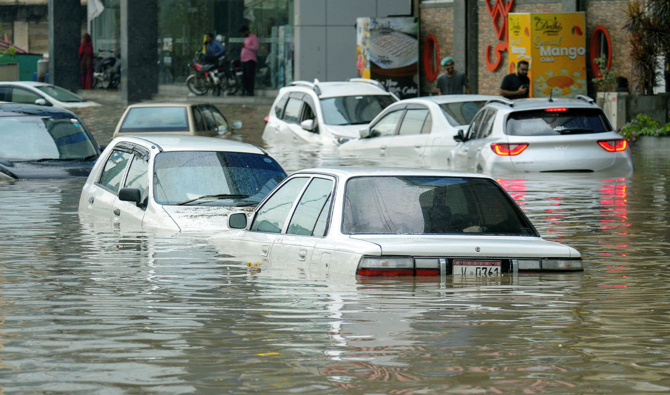
Partially submerged vehicles move, as some are parked, after the monsoon rain in Karachi, Pakistan, August 19, 2025. (Reuters)
Short Url
Updated 22 August 2025
Follow

Pakistan forecasts heavy rains in Karachi this week, warns of power outages and floods

  • Torrential rains have lashed Pakistan’s financial hub this week, killing 17, triggering floods, power outages
  • “Strong” rainfall system expected to enter southern Sindh province from Aug. 24 to 28, says Pakistan’s NDMA

KARACHI: Pakistan’s National Disaster Management Authority (NDMA) forecast heavy rains for the country’s commercial hub Karachi and its neighboring city Hyderabad this week, warning that the monsoon downpours are likely to trigger urban flooding and power outages. 

Karachi was hit by torrential rains on Tuesday, triggering flooding in many parts of the city that left thousands stranded on the city’s main arteries for hours. Visuals of motorcyclists wading through waist-high water and cars floating on the city’s main underpasses went viral on social media, triggering anger at the provincial government. 

According to Karachi Mayor Murtaza Wahab, the city received over 200 millimeters of rainfall on Tuesday and Wednesday. The rains killed 17 people, according to Rescue 1122 emergency service, and left many areas of the city without power for over 24 hours. Wahab has been posting on social media regularly, saying the city government has been busy draining water from several main arteries of the city that are now open for traffic. 

In its press release on Thursday, the NDMA warned that a “strong” rainfall system was expected in Sindh from Aug. 24 to 28. It added that Karachi and its neighboring Hyderabad city would receive heavy rainfall on Thursday night. 

“Torrential rain may cause urban flooding and power outages,” the NDMA said in its alert. 

The disaster management authority urged citizens to avoid traveling on waterlogged roads and stay away from electric poles during the rains. It also called on them to secure electrical appliances and adopt safety measures while using them.

“Residents of low-lying areas should keep an emergency kit ready, including essential items such as water, food, flashlights, and a first aid kit,” the NDMA said. 

Karachi, a city of more than 20 million with dilapidated infrastructure, has often seen even moderate rains trigger flooding in parts of the city, threatening residents’ lives and causing hours-long power outages.

Karachi has faced repeated bouts of urban flooding in recent years. In July-August 2009, the heaviest rains in three decades killed at least 26 people and damaged infrastructure. Torrential downpours in August 2017 left 23 dead and large parts of the city paralyzed, while heavy rains in 2019 killed 11, mostly from electrocution and collapsing structures.

Pakistan’s financial capital braces for heavy rains as other parts of the country reel from the monsoon showers. Deadly monsoon rains and floods have killed at least 458 people and injured 253 in several parts of the country from Aug. 15. 

Pakistan’s Khyber Pakhtunkhwa province has reported the highest number of deaths since mid-August, with 394 people killed there as the northwestern province continues to receive heavy rains. Cumulatively, 771 people have been killed and 993 have been injured due to rain-related incidents since Jun. 26 in Pakistan. KP has reported the highest number of deaths since June, 465, followed by Punjab with 165, northern Gilgit-Baltistan with 45, Sindh with 42, Balochistan and Azad Jammu and Kashmir with 23 casualties each while eight persons have died in Islamabad. 

Pakistan’s Met Office on Thursday warned strong monsoon currents from the Arabian Sea and Bay of Bengal were likely to penetrate upper parts of the country from Aug. 22. A westerly wave was also expected to reach the same regions by the night of Aug. 22.

Pakistan is one of the most climate-vulnerable nations in the world, despite contributing less than 1 percent of global greenhouse gas emissions. Annual monsoons are vital for agriculture and water needs but in recent years have unleashed destructive flooding and landslides. 

In 2022, unprecedented rainfall and glacier melt left more than 1,700 people dead and inflicted an estimated $30 billion in losses, according to the government.

Pakistan announces four-day work week among austerity measures to offset impact of Middle East crisis

Updated 5 sec ago
Follow

Pakistan announces four-day work week among austerity measures to offset impact of Middle East crisis

  • The development comes as ongoing US-Israeli strikes on Iran disrupt oil supplies in Strait of Hormuz, push prices past $119 a barrel
  • Islamabad bans government purchases, cuts fuel allocation for vehicles as well as workforce in public and private offices by 50 percent

ISLAMABAD: Prime Minister Shehbaz Sharif on Monday announced austerity measures, including a four-day work week and cuts in government expenditures, to offset the impact of rising global oil prices due to an ongoing conflict in the Middle East.

Global fuel supply lines have been disrupted in the Strait of Hormuz, which supplies nearly a fourth of world oil consumption, after Tehran blocked it following United States-Israeli strikes on Iran and counterattacks against US interests in the Gulf region.

Oil prices surged more than 25 percent globally on Monday to $119.50 a barrel, the highest levels since mid-2022, as some major producers cut supplies and fears of prolonged shipping disruptions gripped the market due to the expanding US-Israeli war with Iran.

In his televised address on Sunday night, Sharif said global oil prices were expected to rise again in the coming days but vowed not to let the people bear their brunt, announcing austerity measures to lessen the impact of fuel price hikes.

“Fifty percent staff in public and private entities will work from home,” he announced, adding this would not be applicable to essential services. “Offices will remain open for four days a week. One-day additional off is being given to conserve oil, but it would not be applicable to banks.”

Sharif didn’t specify working days of the week and the government was likely to issue a notification in this regard.

He said a decrease of 50 percent was being made in fuel allocation for government vehicles immediately for the next two months, but they would not include ambulances and public buses.

“Cabinet members, advisers and special assistants will not draw salaries for the next two months, 25 percent salaries of parliamentarians are being deducted, two-day salaries of Grade 20 and above officers, or those who are paid Rs300,000 ($1,067) a month, are being deducted for public relief,” he said.

Similarly, there will be 20 percent reduction in public department expenses and a complete ban on the purchase of cars, furniture, air conditioners and other goods, according to the prime minister.

Foreign trips of ministers and other government officials will also be banned along with government dinners and iftar buffets, while teleconferences and online meetings will be given priority.

Sharif’s comments were aired hours after Pakistani authorities said the country had “comfortable levels” of petroleum stocks and the supply chains were functioning smoothly, despite intensifying Middle East conflict.

Petroleum Minister Ali Pervaiz Malik said three oil shipments were due to reach Pakistan this week, state media reported.

Meanwhile, Pakistan Navy (PN) launched ‘Operation Muhafiz-ul-Bahr’ to safeguard national energy shipments, the Pakistani military said on Monday, amid disruptions to critical sea lanes due to the conflict.

The navy is conducting escort operations in close coordination with the Pakistan National Shipping Corporation (PNSC), according to the Inter-Services Public Relations (ISPR), the military’s media wing. It is fully cognizant of the prevailing maritime situation and is actively monitoring and controlling the movement of merchant vessels to ensure their safe and secure transit.

“With approximately 90 percent of Pakistan’s trade conducted via sea, the operation aims to ensure that vital sea routes remain safe, secure, and uninterrupted,” the ISPR said on Monday. “Currently, PN ships are escorting 2 x Merchant Vessels, one of which is scheduled to arrive Karachi today.”