


KARACHI: Pakistan’s National Disaster Management Authority (NDMA) forecast heavy rains for the country’s commercial hub Karachi and its neighboring city Hyderabad this week, warning that the monsoon downpours are likely to trigger urban flooding and power outages.
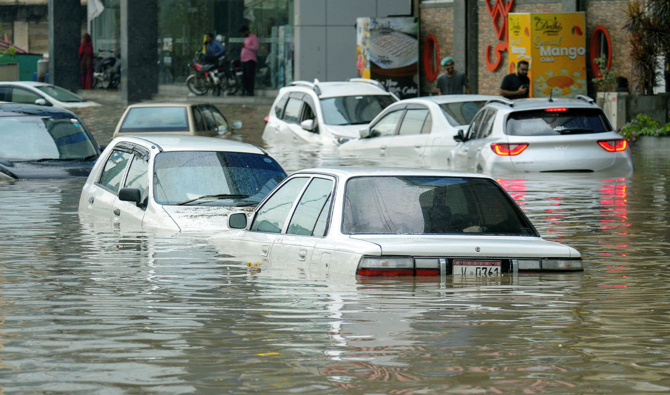
Karachi was hit by torrential rains on Tuesday, triggering flooding in many parts of the city that left thousands stranded on the city’s main arteries for hours. Visuals of motorcyclists wading through waist-high water and cars floating on the city’s main underpasses went viral on social media, triggering anger at the provincial government.
According to Karachi Mayor Murtaza Wahab, the city received over 200 millimeters of rainfall on Tuesday and Wednesday. The rains killed 17 people, according to Rescue 1122 emergency service, and left many areas of the city without power for over 24 hours. Wahab has been posting on social media regularly, saying the city government has been busy draining water from several main arteries of the city that are now open for traffic.
In its press release on Thursday, the NDMA warned that a “strong” rainfall system was expected in Sindh from Aug. 24 to 28. It added that Karachi and its neighboring Hyderabad city would receive heavy rainfall on Thursday night.
“Torrential rain may cause urban flooding and power outages,” the NDMA said in its alert.
The disaster management authority urged citizens to avoid traveling on waterlogged roads and stay away from electric poles during the rains. It also called on them to secure electrical appliances and adopt safety measures while using them.
“Residents of low-lying areas should keep an emergency kit ready, including essential items such as water, food, flashlights, and a first aid kit,” the NDMA said.
Karachi, a city of more than 20 million with dilapidated infrastructure, has often seen even moderate rains trigger flooding in parts of the city, threatening residents’ lives and causing hours-long power outages.
Karachi has faced repeated bouts of urban flooding in recent years. In July-August 2009, the heaviest rains in three decades killed at least 26 people and damaged infrastructure. Torrential downpours in August 2017 left 23 dead and large parts of the city paralyzed, while heavy rains in 2019 killed 11, mostly from electrocution and collapsing structures.
Pakistan’s financial capital braces for heavy rains as other parts of the country reel from the monsoon showers. Deadly monsoon rains and floods have killed at least 458 people and injured 253 in several parts of the country from Aug. 15.
Pakistan’s Khyber Pakhtunkhwa province has reported the highest number of deaths since mid-August, with 394 people killed there as the northwestern province continues to receive heavy rains. Cumulatively, 771 people have been killed and 993 have been injured due to rain-related incidents since Jun. 26 in Pakistan. KP has reported the highest number of deaths since June, 465, followed by Punjab with 165, northern Gilgit-Baltistan with 45, Sindh with 42, Balochistan and Azad Jammu and Kashmir with 23 casualties each while eight persons have died in Islamabad.
Pakistan’s Met Office on Thursday warned strong monsoon currents from the Arabian Sea and Bay of Bengal were likely to penetrate upper parts of the country from Aug. 22. A westerly wave was also expected to reach the same regions by the night of Aug. 22.
Pakistan is one of the most climate-vulnerable nations in the world, despite contributing less than 1 percent of global greenhouse gas emissions. Annual monsoons are vital for agriculture and water needs but in recent years have unleashed destructive flooding and landslides.
In 2022, unprecedented rainfall and glacier melt left more than 1,700 people dead and inflicted an estimated $30 billion in losses, according to the government.


