- Governments and companies are exploring renewable energy and smart cooling to balance AI growth with environmental sustainability
- Experts say innovation and infrastructure choices can either exacerbate or alleviate pressures on the region’s limited water resources
DUBAI: In a region long defined by oil wealth, a new resource rush is unfolding, not for petroleum, but for digital power. Across the Gulf, an explosion in artificial intelligence development and cloud infrastructure is placing a strain on another resource in even shorter supply — water.
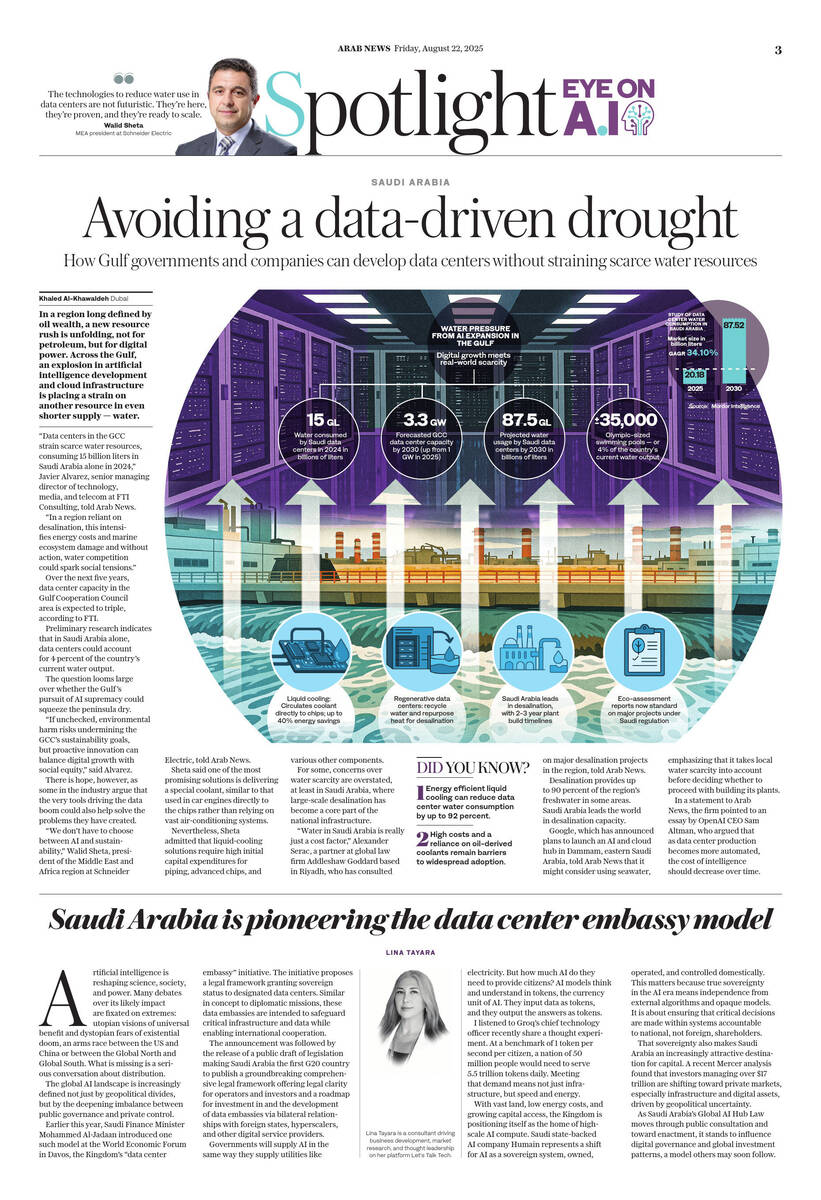
“Data centres in the GCC strain scarce water resources, consuming 15 billion liters in Saudi Arabia alone in 2024,” Javier Alvarez, senior managing director of technology, media, and telecom at FTI Consulting, told Arab News.
“In a region reliant on desalination, this intensifies energy costs and marine ecosystem damage and without action, water competition could spark social tensions.”
Over the next five years, data center capacity in the Gulf Cooperation Council area is expected to triple — from just over 1 gigawatt today to 3.3 GW by 2030 — a pace that outstrips the global average, according to FTI.
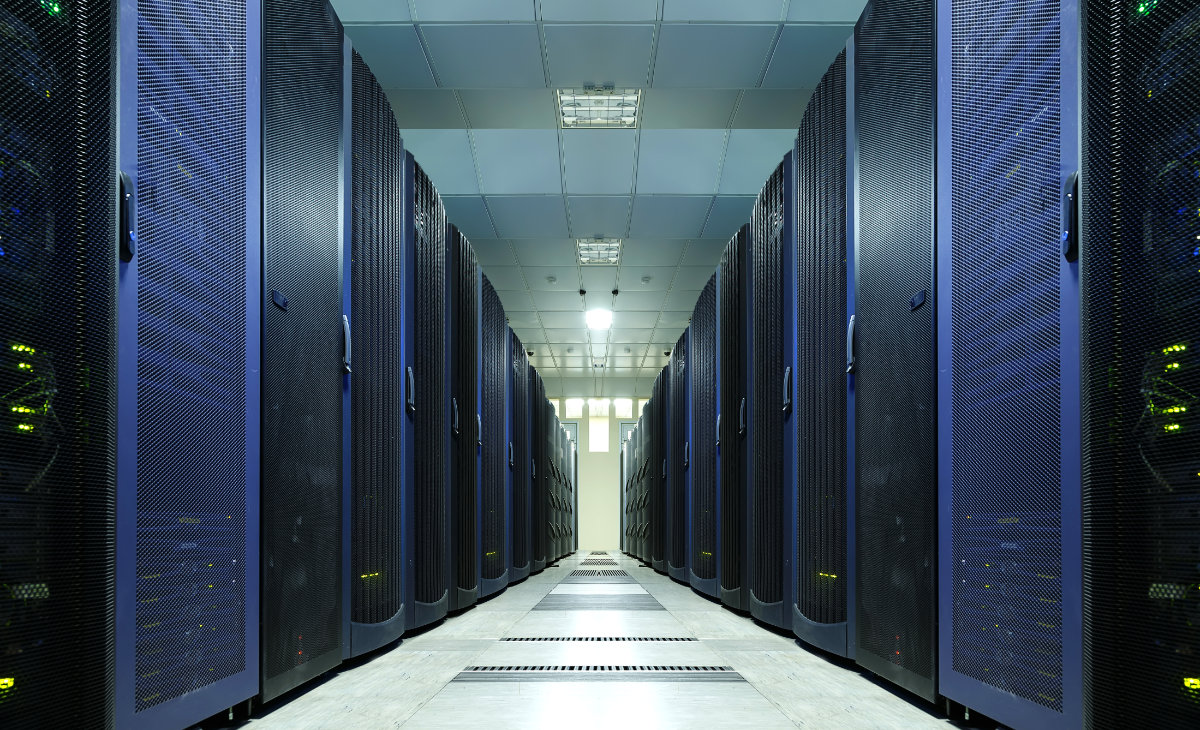
These sprawling digital warehouses, often likened to the “brains” of AI and the internet, are energy-intensive. But less widely known is their voracious appetite for water, a resource already stretched thin across the arid Gulf.
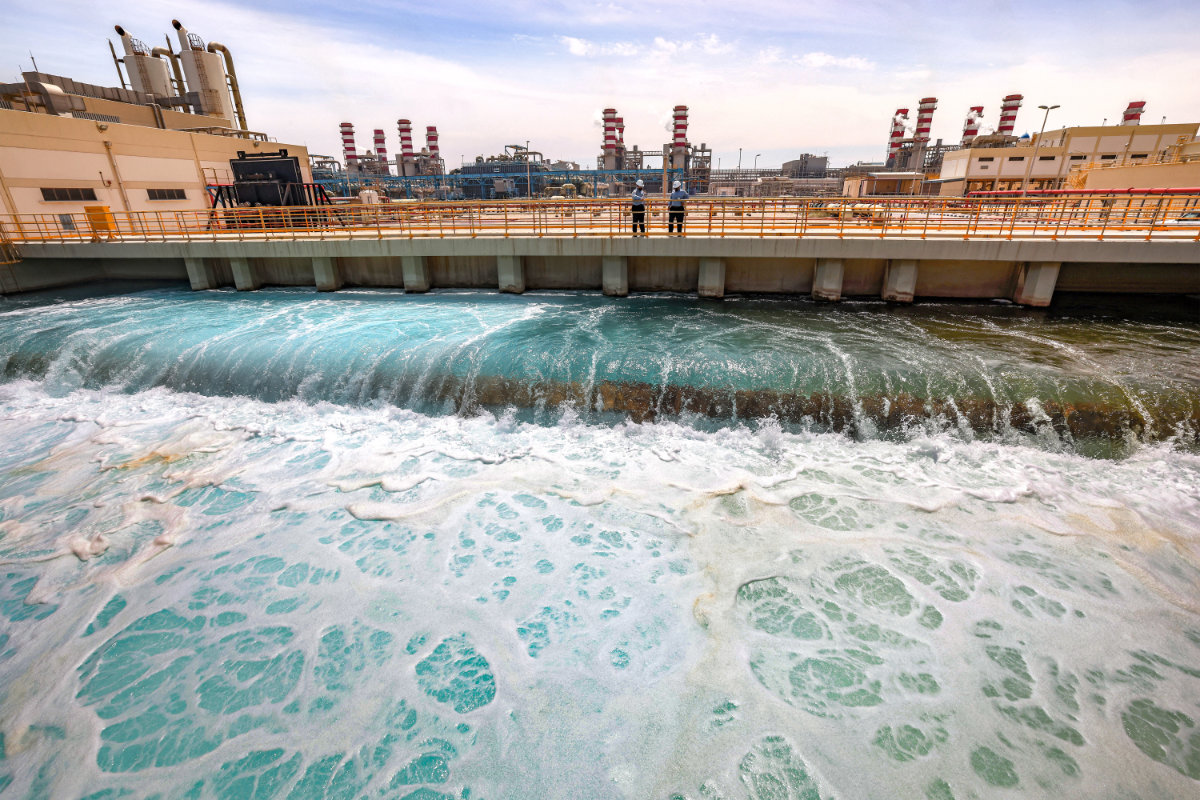
In a region where summer temperatures regularly exceed 45 degrees centigrade, the job of cooling thousands of heat-belching servers requires vast amounts of water — often drawn from expensive, energy-intensive desalination plants.
Preliminary research indicates that in Saudi Arabia alone, data centers could account for 87.52 billion liters — roughly 35,000 Olympic-sized swimming pools, or four percent of the country’s current water output.
Industry leaders and regional policymakers are racing to balance digital ambitions with sustainability concerns. But the question looms large over whether the Gulf’s pursuit of AI supremacy could squeeze the peninsula dry.
“If unchecked, environmental harm risks undermining the GCC’s sustainability goals, but proactive innovation can balance digital growth with social equity,” said Alvarez.
There is hope, however, as some in the industry argue that the very tools driving the data boom — AI and smart systems — could also help solve the problems they have created.
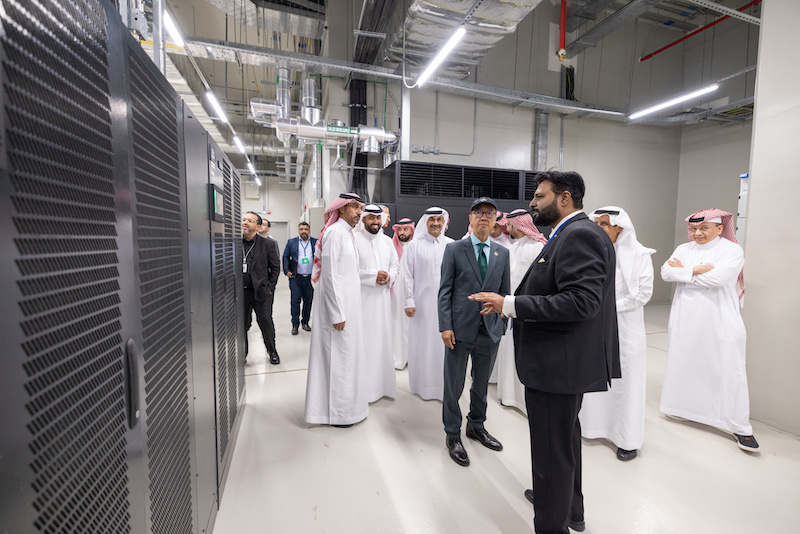
“We don’t have to choose between AI and sustainability,” Walid Sheta, president of the Middle East and Africa region at Schneider Electric, one of the companies at the forefront of developing more efficient data centers across the globe, told Arab News.
Sheta said one of the most promising solutions is delivering a special coolant, similar to that used in car engines — usually a mix of water and glycerol or other hydrocarbon liquids — directly to the chips rather than relying on vast air-conditioning systems.
The result, Sheta says, is dramatically higher thermal efficiency and significantly lower energy and water consumption.
This sentiment was echoed by Alvarez, who said the technology was already proving its worth, pointing to projects by Khazna, Datavolt and Alfanar as regional examples where it was being put to work.
“Liquid cooling, championed by companies like Schneider Electric or Vertiv, slashes data center water use by up to 92 percent, vital for the GCC’s arid climate,” he said.
Nevertheless, Sheta admitted that cost, complexity, and speed of implementation remained major barriers. Liquid-cooling solutions require high initial capital expenditures for piping, advanced chips, and various other components.
Still, Schneider says that over time, the savings in energy, which can be anywhere between 20 and 40 percent, primarily from the removal of chillers and server fans, make the solution cost-effective, especially for larger data centers.
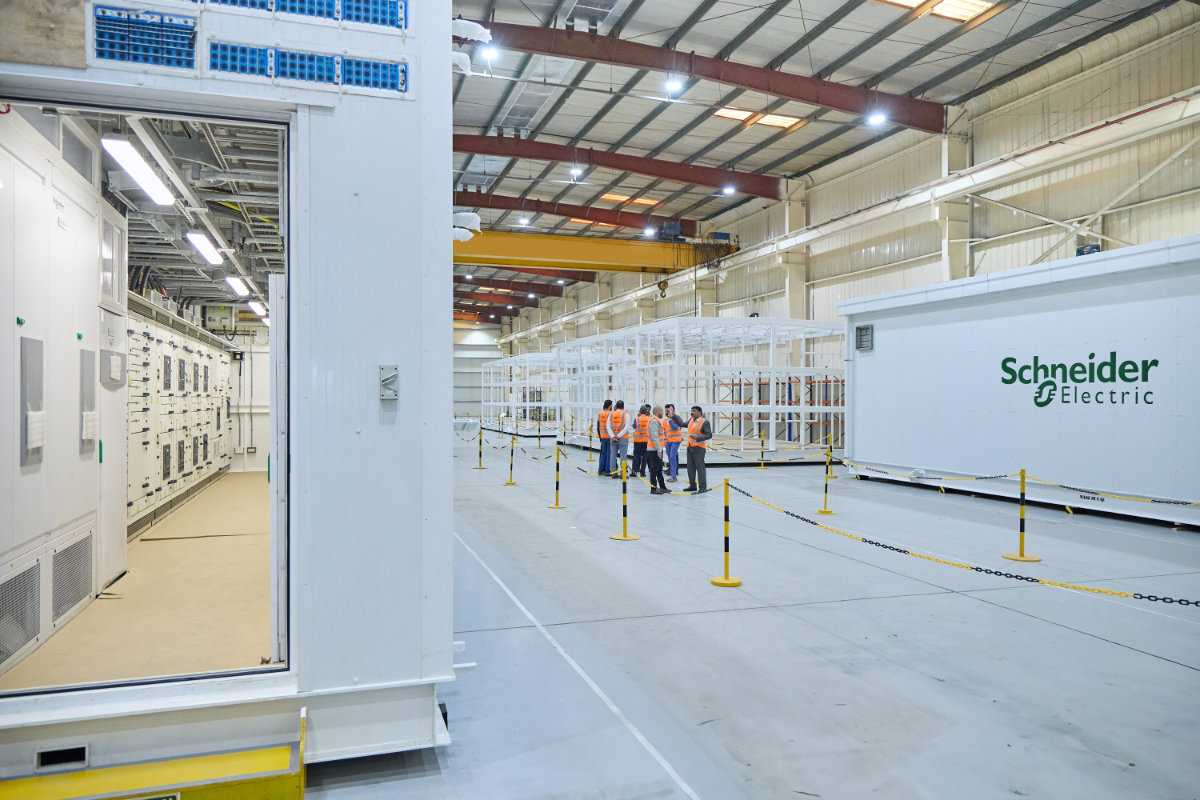
The firm’s own analysis found that both air and liquid solutions were roughly the same in terms of capital expenditure, with air-cooled data centers costing $7.02 per watt and the liquid-cooled solution $6.98 per watt.
“Many operators are still focused on short-term returns,” said Sheta. “But the long-term savings in water, energy, and operational resilience are substantial.”
Alvarez also cautioned against assuming liquid cooling is a silver bullet, especially considering the unsustainable nature of procuring the coolants, which still usually come from oil derivatives.
“High upfront costs and specialized maintenance challenge smaller firms, risking economic disparity. And environmental concerns over cooling fluids also loom,” he said.
For some, concerns over water scarcity are overstated, at least in Saudi Arabia, where large-scale desalination has become a core part of the national infrastructure.
“Water in Saudi Arabia is really just a cost factor,” Alexander Sarac, a partner at global law firm Addleshaw Goddard based in Riyadh, who has consulted on major desalination projects in the region, told Arab News.
Desalination, the process of converting seawater into potable water, provides up to 90 percent of the region’s freshwater in some areas. Saudi Arabia leads the world in desalination capacity and has ambitious plans to expand further.
However, the process is energy-intensive and produces saline waste, also known as brine, which can raise sea temperatures and increase water salinity when discharged.
Google, which has announced plans to launch an AI and cloud hub in Dammam, eastern Saudi Arabia, told Arab News that it might consider using seawater, emphasizing that it takes local water scarcity into account before deciding whether to proceed with building its plants.
One study led by researchers at Khalifa University in Abu Dhabi estimated that a 50-fold increase in desalination by 2050 could raise temperatures in the Arabian Gulf by 0.6 C, which could damage marine ecosystems.
Nevertheless, Sarac believes Saudi Arabia is managing the risks through strong environmental protections and believes issues with brine waste could be resolved down the line with technology that would see the brine reused for mineral extraction and other uses.
“We take substantial effort to prepare ecological assessment reports for all of the projects we work on,” he said. “These are governed by strong environmental regulations.”
Sarac added that the Kingdom’s renewable energy investments are helping offset the environmental footprint of desalination, with some projects like the proposed 1.5 GW Datacom data center in Saudi Arabia’s NEOM touted to run fully on renewables.
“The regulatory framework is very conducive,” he said. “Talking to friends in Europe, they’re jealous. There’s land, there’s capital, and there isn’t too much red tape.
“I would say what makes this region special is really its potential access to huge amounts of renewable energy at the lowest global prices. It really makes it a perfect place for energy-intensive industries.”
OpenAI, one of the central players in the global AI boom, is still finalizing details for its 1 GW Stargate project in Abu Dhabi. But the company insists it is taking sustainability seriously.
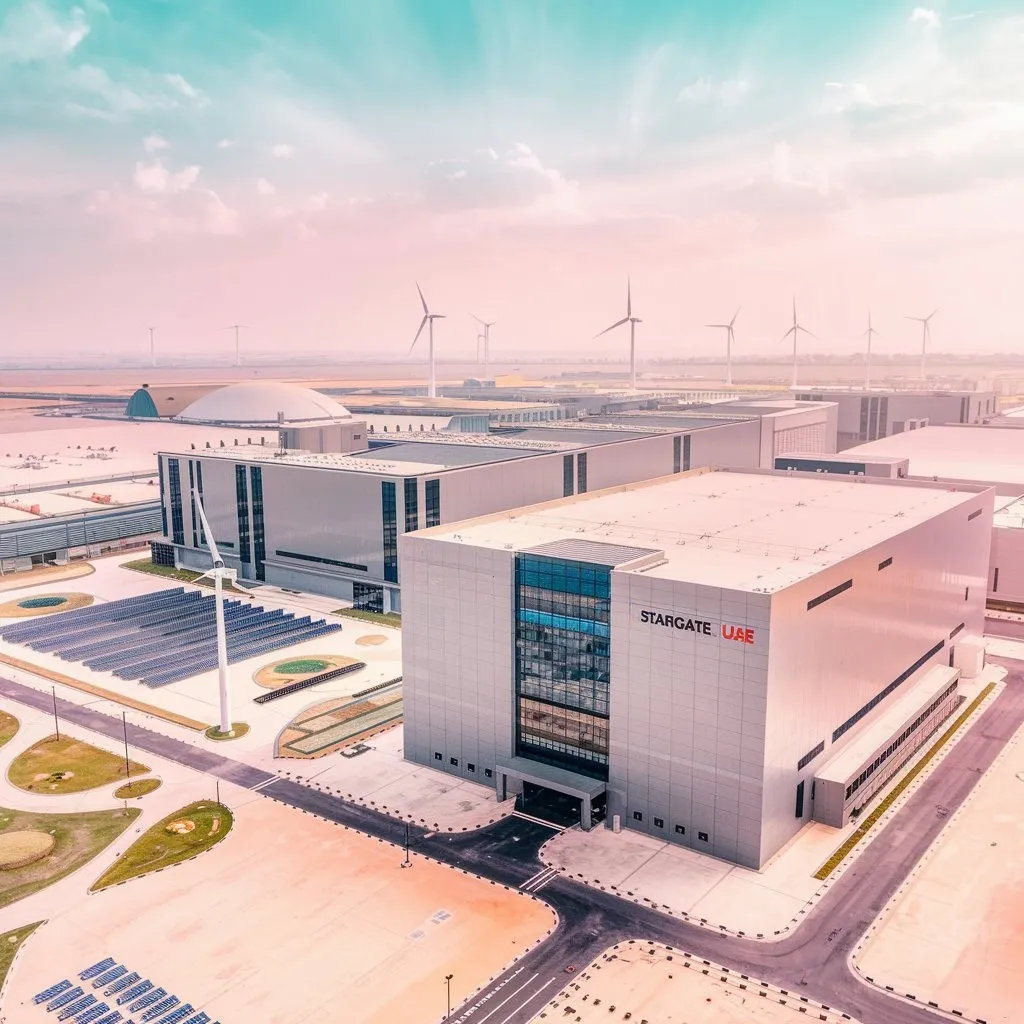
In a statement to Arab News, the firm pointed to an essay by OpenAI CEO Sam Altman, who argued that as data center production becomes more automated, the cost of intelligence — including its environmental cost — should decrease over time.
“People are often curious about how much energy a ChatGPT query uses; the average query uses about 0.34 watt-hours,” Altman wrote. “It also uses about 0.000085 gallons of water; roughly 1/15th of a teaspoon.”
Despite the exponential growth of AI queries and the mounting energy and water needs behind them, Schneider Electric’s Sheta remains cautiously optimistic.
“Many facilities continue to rely on conventional cooling methods, and water efficiency is not yet a universal priority,” he said. “That needs to change. The environmental cost of inaction is too high, and the opportunity to lead is too great.
“The technologies to reduce water use in data centers are not futuristic. They’re here, they’re proven, and they’re ready to scale. What’s holding us back is not innovation, but adoption.”