

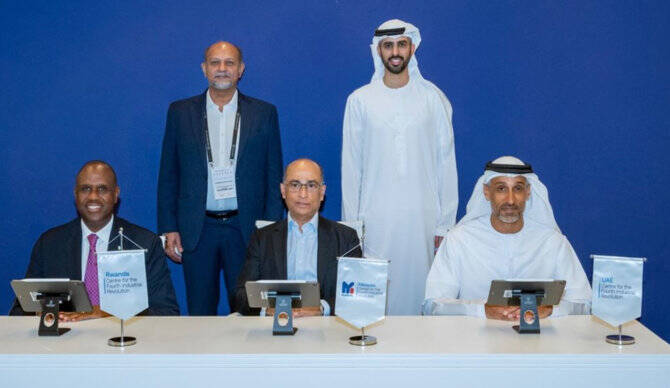

RIYADH: Artificial intelligence adoption in the Global South is set to accelerate under a new UAE-led partnership with Malaysia and Rwanda aimed at expanding ethical AI use and knowledge sharing.
The agreement, signed under the World Economic Forum’s Center for the Fourth Industrial Revolution global network, builds on an initiative launched by the UAE and Rwanda at the 2024 WEF Annual Meeting in Davos, according to a press release.
The partnership comes amid rising global concern that emerging technologies could exacerbate inequality. The UN estimates the AI market will reach $4.8 trillion by 2033, warning that without inclusive frameworks, the Global South risks being left behind.
Gobind Singh Deo, minister of digital in Malaysia, said his country “is proud to join forces with the UAE and Rwanda in this visionary initiative to bridge global AI expertise and accelerate digital transformation for a more inclusive and sustainable future.”
He added: “This partnership involving Malaysia Center4IR, C4IR UAE, and C4IR Rwanda reflects our collective goal for a future that is driven by responsible AI innovation.”
Singh Deo expressed hope that the C4IR Network AI Fellowship Program, developed through the collaboration, would act as a crucial bridge connecting AI leaders and experts across continents.
“By sharing knowledge, exchanging talent, and co-creating solutions, we aim to address the critical challenges and harness the immense potential of AI for the benefit of not only our nations, but the wider global community,” he added.
The memorandum of understanding was witnessed by UAE Minister of State for Artificial Intelligence Omar Al-Olama and Malaysia’s Singh Deo. It aims to deepen South-South collaboration on technology policy, research, and skills development.
With Malaysia now joining, the expanded C4IR AI Fellowship Program will support talent exchange, joint innovation, and responsible governance frameworks led by Global South countries.
“This expanded partnership will help the Global South to unlock greater value from AI and Fourth Industrial Revolution applications,” said Khalfan Belhoul, CEO of Dubai Future Foundation.
“Guided by our leadership, the UAE is committed to building and strengthening global collaboration to achieve inclusive, sustainable development through technology and knowledge sharing,” he added.
Crystal Rugege, managing director of the Rwanda Center for the Fourth Industrial Revolution, noted that the strategic partnership complemented Rwanda’s flagship initiatives, including the AI Innovation Lab and the Global AI Summit on Africa, thereby enhancing efforts to promote cutting-edge research, knowledge transfer, and capacity building.
“By strengthening responsible AI governance and accelerating practical AI adoption, we are committed to empowering Rwanda, our partner countries, and the global AI ecosystem to fully leverage AI for sustainable and inclusive development,” she added.
The Global Center for the Fourth Industrial Revolution Network brings together public and private sector partners to harness emerging technologies while managing their risks. It promotes the responsible use of these technologies through a global network of independent centers.


