Prince William's new home sows doubt over Buckingham Palace's future
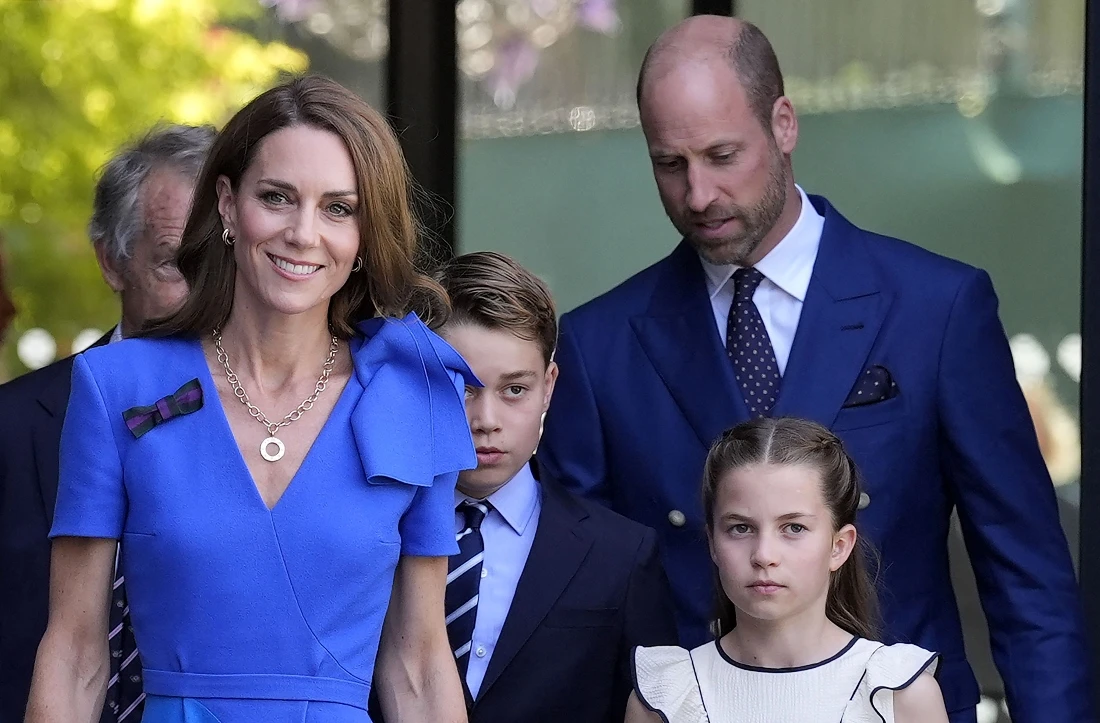
Britain's Catherine Princess of Wales, Princess Charlotte, Prince George, Prince William of Wales arrive to attend Wimbledon's men's singles final tennis match in Southwest London, UK. (AFP)
Short Url
Updated 21 August 2025
Follow

Prince William's new home sows doubt over Buckingham Palace's future

LONDON: Britain's future king Prince William and his family are moving to a new home on the royal Windsor estate, prompting uncertainty about the future of Buckingham Palace.
They will reportedly move into Forest Lodge, an eight-bedroom mansion dating to the late 18th century, larger than their current four-bedroom home on the estate, west of London.
William and his wife Catherine, the Princess of Wales, are said to regard the property as their "forever home", according to The Sun newspaper which broke the story, citing a source close to the couple.
A Kensington Palace spokesperson confirmed to AFP "the Wales family will move house later this year", without giving further details.
The Sun added that the couple were paying for the renovations, the move and the rent themselves, as insiders told the daily they were hoping for a "fresh start" following Kate's 2024 cancer diagnosis and treatment.
William and Catherine's three children George, 12, Charlotte, 10, and Louis, seven, all attend a nearby school.
But the family putting down permanent roots at Windsor has cast uncertainty over Buckingham Palace's future as the official London residence of the monarch.
"It would be a disaster if Buckingham Palace were sidelined," royal commentator Richard Fitzwilliams told AFP.
"It is an iconic building, comparable only to the White House and known worldwide," he said.
Sovereigns have lived at Buckingham Palace since 1837.
Located in the heart of London, not far from parliament and Number 10 Downing Street, it is also the venue for numerous royal events from summer garden parties to state banquets.
During the summer months, parts of the 755-room palace are open to the public.
But King Charles III, 76, does not live there currently and will not do so for the foreseeable future amid an ongoing £369 million ($429 million) renovation.

The extensive work, which also saw the late queen Elizabeth II relocating to Windsor Castle before her death in 2022, is not due to be completed until 2027.
Charles, who announced in early 2024 that he had been diagnosed with cancer, does plan to make Buckingham Palace his London base after the work is finished.
But he is widely reported to prefer the more homely Clarence House where he has lived since 2003.
"It is the intention of King Charles and Queen Camilla to do so (move to Buckingham Palace) although given that he is battling cancer, this may well not happen," Fitzwilliams said.
Like Charles, William is said to be keen to open up the vast palace to more tourists and expand royal events there, according to The Daily Mail.
It is just one of a string of properties used by the royal family, either owned privately or by the Crown.
The late queen's preferred homes were Windsor Castle and Balmoral Castle in Scotland, to which she would retreat every summer.
Christmases were spent at Sandringham House in eastern England.
Charles meanwhile lavished attention on Highgrove House in western England, where he transformed the gardens, and he resides at Birkhall on the Balmoral estate when in Scotland.
Other royal properties include the Palace of Holyroodhouse in Edinburgh.

William and Catherine also enjoy a number of homes.
Holidays are spent at Anmer Hall on the Sandringham estate and they have use of the vast apartment 1A at Kensington Palace in west London.
"There is the danger the monarchy is perceived to have too many homes," Fitzwilliams said.
But he added "those who criticise the monarchy's costs should note that the Buckingham Palace renovation is on schedule and not exceeding its budget".
Buckingham Palace would always have a vital role to play, he added.
"It absolutely must remain the centre of the monarchy, whether or not William and Catherine actually live in it," he said.
Daily Mail columnist Amanda Platell, however, cautioned about a less visible future king not being in residence at Buckingham Palace.
A YouGov poll last year found that only a third (35 percent) of 18- to 24-year-olds wanted to maintain the monarchy, compared to "fairly broad" support in the population overall.
"I fear a future part-time king hiding away in Forest Lodge... could result in an even greater collapse of support among his subjects," she wrote.
har/jkb/js
Daily Mail


Egypt reveals restored colossal statues of pharaoh in Luxor

Updated 14 December 2025
Follow

Egypt reveals restored colossal statues of pharaoh in Luxor

  • Amenhotep III, one of the most prominent pharaohs, ruled during the 500 years of the New Kingdom, which was the most prosperous time for ancient Egypt

LUXOR: Egypt on Sunday revealed the revamp of two colossal statues of a prominent pharaoh in the southern city of Luxor, the latest in the government’s archeological events that aim at drawing more tourists to the country.
The giant alabaster statues, known as the Colossi of Memnon, were reassembled in a renovation project that lasted about two decades. They represent Amenhotep III, who ruled ancient Egypt about 3,400 years ago.
“Today we are celebrating, actually, the finishing and the erecting of these two colossal statues,” Mohamed Ismail, secretary-general of the Supreme Council of Antiquities, said ahead of the ceremony.
Ismail said the colossi are of great significance to Luxor, a city known for its ancient temples and other antiquities. They’re also an attempt to “revive how this funerary temple of King Amenhotep III looked like a long time ago,” Ismail said.
Amenhotep III, one of the most prominent pharaohs, ruled during the 500 years of the New Kingdom, which was the most prosperous time for ancient Egypt. The pharaoh, whose mummy is showcased at a Cairo museum, ruled between 1390–1353 BC, a peaceful period known for its prosperity and great construction, including his mortuary temple, where the Colossi of Memnon are located, and another temple, Soleb, in Nubia.
The colossi were toppled by a strong earthquake in about 1200 BC that also destroyed Amenhotep III’s funerary temple, said Ismail.
They were fragmented and partly quarried away, with their pedestals dispersed. Some of their blocks were reused in the Karnak temple, but archeologists brought them back to rebuild the colossi, according to the Antiquities Ministry.
In late 1990s, an Egyptian German mission, chaired by German Egyptologist Hourig Sourouzian, began working in the temple area, including the assembly and renovation of the colossi.
“This project has in mind … to save the last remains of a once-prestigious temple,” she said.
The statues show Amenhotep III seated with hands resting on his thighs, with their faces looking eastward toward the Nile and the rising sun. They wear the nemes headdress surmounted by the double crowns and the pleated royal kilt, which symbolizes the pharaoh’s rule.
Two other small statues on the pharaoh’s feet depict his wife, Tiye.
The colossi — 14.5 meters and 13.6 meters respectively — preside over the entrance of the king’s temple on the western bank of the Nile. The 35-hectare complex is believed to be the largest and richest temple in Egypt and is usually compared to the temple of Karnak, also in Luxor.
The colossi were hewn in Egyptian alabaster from the quarries of Hatnub, in Middle Egypt. They were fixed on large pedestals with inscriptions showing the name of the temple, as well as the quarry.
Unlike other monumental sculptures of ancient Egypt, the colossi were partly compiled with pieces sculpted separately, which were fixed into each statue’s main monolithic alabaster core, the ministry said.
Sunday’s unveiling in Luxor came just six weeks after the inauguration of the long-delayed Grand Egyptian Museum, the centerpiece of the government’s bid to boost the country’s tourism industry. The mega project is located near the famed Giza Pyramids and the Sphinx.
In recent years, the sector has started to recover after the coronavirus pandemic and amid Russia’s war on Ukraine — both countries are major sources of tourists visiting Egypt.
“This site is going to be a point of interest for years to come,” said Tourism and Antiquities Minister Sherif Fathy, who attended the unveiling ceremony. “There are always new things happening in Luxor.”
A record number of about 15.7 million tourists visited Egypt in 2024, contributing about 8 percent of the country’s GDP, according to official figures.
Fathy, the minister, has said about 18 million tourists are expected to visit the country this year, with authorities hoping for 30 million visitors annually by 2032.