

PIF launches ‘azm’ program to equip Saudis for labor market needs

1 / 2
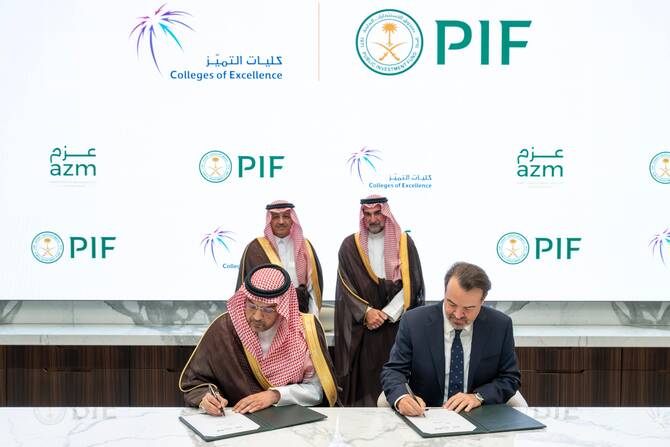
Saudi Education Minister Yousef Al-Benyan and PIF Governor Yasir Al-Rumayyan attended the signing ceremony, alongside partners from the Technical and Vocational Training Corp., Colleges of Excellence, Human Resources Development Fund, and Roshn Group. PIF
2 / 2
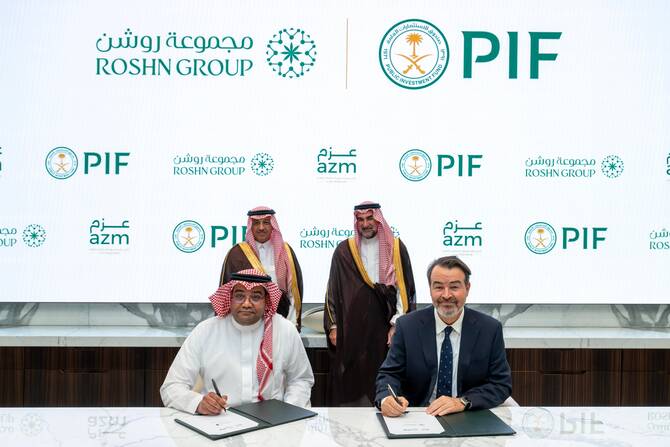
Saudi Education Minister Yousef Al-Benyan and PIF Governor Yasir Al-Rumayyan attended the signing ceremony, alongside partners from the Technical and Vocational Training Corp., Colleges of Excellence, Human Resources Development Fund, and Roshn Group. PIF
Short Url
Updated 20 August 2025
Follow

PIF launches ‘azm’ program to equip Saudis for labor market needs

  • Program aims to create pipeline of technically skilled Saudis to meet PIF’s investment needs
  • It will offer tailored training at competitive costs

JEDDAH: Saudi Arabia’s Public Investment Fund launched a strategic program designed to build skills, address labor market needs, and support economic diversification to boost national talent. 

The “azm” workforce development program was unveiled at a signing ceremony attended by Education Minister Yousef Al-Benyan and PIF Governor Yasir Al-Rumayyan, alongside partners from the Technical and Vocational Training Corp., Colleges of Excellence, Human Resources Development Fund, and Roshn Group. 

The launch underscores PIF’s role in advancing Vision 2030, Saudi Arabia’s plan to transition to a knowledge-based economy and reduce reliance on oil revenues. 

In a post on its official X account, PIF said it launched “the ‘azm’ program to empower national talents and equip them with the expertise and skills required by the labor market, thereby contributing to building a stronger and more diverse national economy, through a signing ceremony that included the program’s partners.” 

According to the sovereign wealth fund, azm aims to create a pipeline of technically skilled Saudis to meet the needs of PIF’s investments, portfolio companies, and ecosystem partners. It focuses on employer-driven skill development, with 80 percent of training based on hands-on, real-world applications. 

Under the program, PIF signed memoranda of understanding with TVTC and the Colleges of Excellence to manage and deliver training. The agreements cover curriculum development, contracting with local and international providers, overseeing registration and evaluation, and operating training facilities. 

“Future cooperation between Colleges of Excellence and the fund includes launching an academic entity under the azm program to serve as a specialized training body in developing technical and professional skills for Saudi youth,” the Colleges of Excellence posted on its X account.

The fund said azm will offer tailored training at competitive costs, apply rigorous learner selection, and provide financial incentives to cover tuition. Employers partnering with the program will gain access to a job-ready Saudi workforce trained to their specifications. 

PIF said azm leverages its existing experience in delivering training across portfolio companies and taps into a broad network of local and international providers. It also benefits from strong ties with accreditation bodies and access to government funding mechanisms for workforce development.


Egypt targets 5 million tonnes of local wheat next year

Updated 16 November 2025
Follow

Egypt targets 5 million tonnes of local wheat next year

  • Egypt typically imports about 10 million tonnes a year, with the state buyer obtaining roughly half of that for the country’s bread subsidy program on which 70 million people rely

CAIRO: Egypt has targeted procurement of 5 million tonnes of local wheat next season as it moves away from being one of the world’s top wheat importers to self-sufficiency, the Supply Ministry said on Sunday.

Egypt typically imports about 10 million tonnes a year, with the state buyer obtaining roughly half of that for the country’s bread subsidy program on which 70 million people rely.

In the first half of this year, however, imports were a quarter less than the same period last year, according to shipping and trading data reviewed by Reuters. The government’s share of those imports dropped by more than half to about 1.6 million tonnes, reflecting slower procurement since the state buyer changed from the General Authority for Supply Commodities to the Future of Egypt for Sustainable Development. The ministry said that it procured more than 4 million tonnes of wheat during the domestic harvest.

Reserves of strategic commodities are within safe buffers and as high as last year or higher in some commodities, the Supply Ministry added without providing more data.

In November 2024, Egypt’s wheat stocks covered five months of consumption, below the six-month threshold Egypt hopes to maintain. 

Last week Reuters reported that the Future of Egypt, which took over purchasing in December, had ditched the formal tenders of GASC in favor of informal negotiations, spurring mounting trade tensions and a drop in Egypt’s wheat imports.