

PIF launches ‘azm’ program to equip Saudis for labor market needs

1 / 2
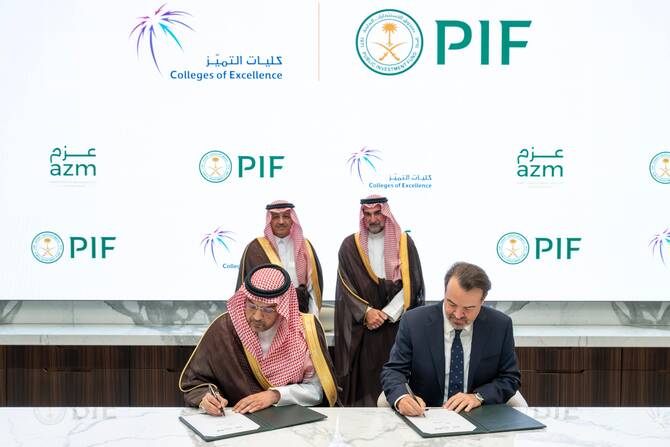
Saudi Education Minister Yousef Al-Benyan and PIF Governor Yasir Al-Rumayyan attended the signing ceremony, alongside partners from the Technical and Vocational Training Corp., Colleges of Excellence, Human Resources Development Fund, and Roshn Group. PIF
2 / 2
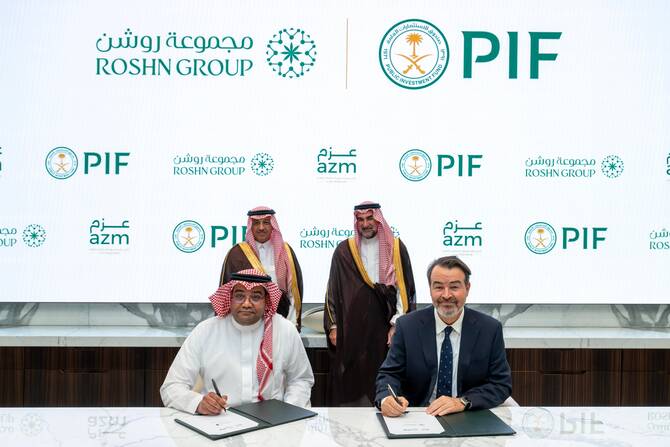
Saudi Education Minister Yousef Al-Benyan and PIF Governor Yasir Al-Rumayyan attended the signing ceremony, alongside partners from the Technical and Vocational Training Corp., Colleges of Excellence, Human Resources Development Fund, and Roshn Group. PIF
Short Url
Updated 20 August 2025
Follow

PIF launches ‘azm’ program to equip Saudis for labor market needs

  • Program aims to create pipeline of technically skilled Saudis to meet PIF’s investment needs
  • It will offer tailored training at competitive costs

JEDDAH: Saudi Arabia’s Public Investment Fund launched a strategic program designed to build skills, address labor market needs, and support economic diversification to boost national talent. 

The “azm” workforce development program was unveiled at a signing ceremony attended by Education Minister Yousef Al-Benyan and PIF Governor Yasir Al-Rumayyan, alongside partners from the Technical and Vocational Training Corp., Colleges of Excellence, Human Resources Development Fund, and Roshn Group. 

The launch underscores PIF’s role in advancing Vision 2030, Saudi Arabia’s plan to transition to a knowledge-based economy and reduce reliance on oil revenues. 

In a post on its official X account, PIF said it launched “the ‘azm’ program to empower national talents and equip them with the expertise and skills required by the labor market, thereby contributing to building a stronger and more diverse national economy, through a signing ceremony that included the program’s partners.” 

According to the sovereign wealth fund, azm aims to create a pipeline of technically skilled Saudis to meet the needs of PIF’s investments, portfolio companies, and ecosystem partners. It focuses on employer-driven skill development, with 80 percent of training based on hands-on, real-world applications. 

Under the program, PIF signed memoranda of understanding with TVTC and the Colleges of Excellence to manage and deliver training. The agreements cover curriculum development, contracting with local and international providers, overseeing registration and evaluation, and operating training facilities. 

“Future cooperation between Colleges of Excellence and the fund includes launching an academic entity under the azm program to serve as a specialized training body in developing technical and professional skills for Saudi youth,” the Colleges of Excellence posted on its X account.

The fund said azm will offer tailored training at competitive costs, apply rigorous learner selection, and provide financial incentives to cover tuition. Employers partnering with the program will gain access to a job-ready Saudi workforce trained to their specifications. 

PIF said azm leverages its existing experience in delivering training across portfolio companies and taps into a broad network of local and international providers. It also benefits from strong ties with accreditation bodies and access to government funding mechanisms for workforce development.


Saudi Arabia opens December ‘Sah’ sukuk sale at 4.68% return 

Updated 10 sec ago
Follow

Saudi Arabia opens December ‘Sah’ sukuk sale at 4.68% return 

RIYADH: Saudi Arabia has opened subscriptions for its December issuance of the government-backed “Sah” savings sukuk, offering investors an annual return of 4.68 percent, slightly lower than the 4.71 percent provided in the previous month. 

In a post on X, the National Debt Management Center announced that the subscription window opened at 10:00 a.m. Saudi time on Dec. 7 and will close at 3:00 p.m. on Dec. 9. 

Part of the 2025 issuance calendar managed by the NDMC, the sukuk reflects the Kingdom’s continued efforts to promote financial inclusion and encourage personal savings. 

Launched under the Financial Sector Development Program — a key component of the Vision 2030 agenda — Sah aims to raise the national savings rate to 10 percent by 2030, up from about 6 percent currently. 

According to NDMC, the minimum subscription amount is SR1,000 ($266.56), while the maximum is capped at SR200,000 per investor. The sukuk carries a one-year maturity and offers fixed returns paid at redemption. 

Subscriptions are available exclusively to Saudi nationals aged 18 and above through approved investment platforms, including SNB Capital, Aljazira Capital, Alinma Investment, SAB Invest and Al-Rajhi Capital. 

Sukuk are Shariah-compliant financial instruments that grant investors partial ownership in an issuer’s underlying assets, serving as a popular alternative to conventional bonds. 

Last month, NDMC announced that it raised SR5.83 billion through its riyal-denominated sukuk program.  

The November issuance was divided into five tranches, with the first one valued at SR700 million, set to mature in 2027.  

The second tranche amounted to SR1.37 billion, maturing in 2029, while the third tranche, worth SR180 million, will expire in 2032.  

The fourth tranche, valued at SR197 million, is due in 2036, while the last tranche, due in 2039, was valued at SR3.38 billion. 

Saudi Arabia’s debt market has seen robust growth in recent years, drawing strong investor interest in fixed-income instruments amid a global environment of rising interest rates. 

In October, Kuwait Financial Center, also known as Markaz, reported that Saudi Arabia dominated the Gulf Cooperation Council’s primary debt market in the third quarter of 2025, raising $20.32 billion through 36 issuances — a 62.7 percent year-on-year increase in value.