


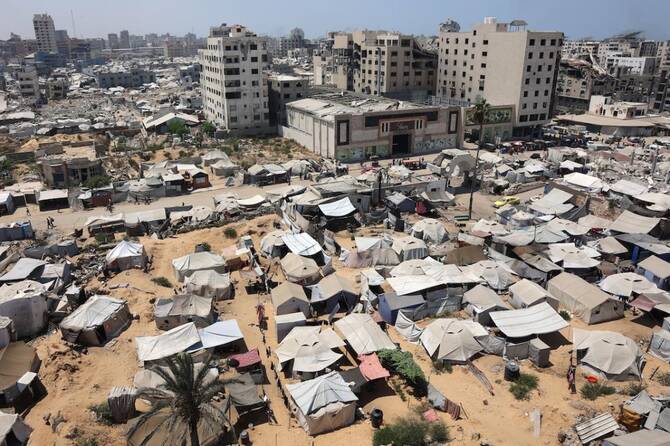

JERUSALEM: Israel’s military said Wednesday it will call up 60,000 reservists ahead of an expanded military operation in Gaza City. Many residents have chosen to stay despite the danger, fearing nowhere is safe in a territory facing shortages of food, water and other necessities.
Calling up extra military reservists is part a plan Defense Minister Israel Katz approved to begin a new phase of operations in some of Gaza’s most densely populated areas, the military said. The plan, which is expected to receive the chief of staff’s final approval in the coming days, also includes extending the service of 20,000 additional reservists who are already on active duty.
In a country of fewer than 10 million people, the call-up of reservists is the largest in months and carries economic and political weight. It comes days after hundreds of thousands of Israelis rallied for a ceasefire, as negotiators scramble to get Israel and Hamas to agree to end their 22 months of fighting, and as rights groups warn that an expanded assault could deepen the crisis in the Gaza Strip, where most of the roughly 2 million inhabitants have been displaced, many areas have been reduced to rubble, and the population faces the threat of famine.
Gaza City operation could begin within days
An Israeli military official, speaking on the condition of anonymity in line with military regulations, said troops will operate in parts of Gaza City where they haven’t been deployed yet and where Israel believes Hamas is still active. Israeli troops in the the city’s Zeitoun neighborhood and in Jabaliya, a refugee camp in the northern Gaza Strip, are already preparing the groundwork for the expanded operation, which could begin within days.
Though the timeline wasn’t clear, Prime Minister Benjamin Netanyahu’s office said Wednesday that Netanyahu “has directed that the timetables ... be shortened” for launching the offensive.
Gaza City is Hamas’ military and governing stronghold, and one of the last places of refuge in the northern Strip, where hundreds of thousands are sheltering. Israeli troops will be targeting Hamas’ vast underground tunnel network there, the official added.
Although Israel has targeted and killed much of Hamas’ senior leadership, parts of Hamas are actively regrouping and carrying out attacks, including launching rockets toward Israel, the official said.
Netanyahu has said the war’s objectives are to secure the release of remaining hostages and ensure that Hamas and other militants can never again threaten Israel.
The planned offensive, announced earlier this month, comes amid heightened international condemnation of Israel’s restrictions on food and medicine reaching Gaza and fears that many Palestinians will be forced to flee.
“It’s pretty obvious that it will just create another mass displacement of people who have been displaced repeatedly since this phase of the conflict started,” United Nations spokesman Stephane Dujarric told reporters.
Associated Press journalists saw small groups heading south from the city this week, but it’s unclear how many others will voluntarily flee. Some said they would wait to see how events unfold, with many insisting that nowhere is safe from airstrikes.
“What we’re seeing in Gaza is nothing short of apocalyptic reality for children, for their families, and for this generation,” Ahmed Alhendawi, regional director of Save the Children, said in an interview. “The plight and the struggle of this generation of Gaza is beyond being described in words.”
Some reservists question the war’s goals
The call-up comes amid a growing campaign by exhausted reservists who accuse the Israeli government of perpetuating the war for political reasons and failing to bring home the 50 remaining hostages, 20 of whom are believed to be alive.
The hostages’ families and former army and intelligence chiefs have also expressed opposition to the expanded operation in Gaza City. Most of the families want an immediate ceasefire and worry that an expanded assault could imperil the surviving hostages.
Guy Poran, a retired air force pilot who has organized veterans campaigning to end the war, said many reservists are spent after repeated tours lasting hundreds of days and resent those who haven’t been called up.
“Even those that are not ideologically against the current war or the government’s new plans don’t want to go because of fatigue or their families or their businesses,” he said.
Hamas-led militants started the war when they attacked Israel on Oct. 7, 2023, killing roughly 1,200 people, mostly civilians, and abducting 251. Most of the hostages have been released in ceasefires or other deals. Hamas says it will only free the rest in exchange for a lasting ceasefire and an Israeli withdrawal.
Israel has yet to respond to a ceasefire proposal
Arab mediators and Hamas said this week that the militant group’s leaders had agreed to the terms of a proposed 60-day ceasefire, though similar announcements have been made in the past that didn’t lead to a lasting truce.
Egypt and Qatar have said they are waiting for Israel’s response.
Egypt’s foreign minister, Badr Abdelatty, spoke by phone Wednesday with US envoy Steve Witkoff to discuss the proposed ceasefire in the hopes of winning Israel’s acceptance, the Egyptian foreign ministry said. During the call, Abdelatty urged Israel to “put an end to this unjust war” by negotiating a comprehensive deal and “to lay the foundations for a just settlement of the Palestinian cause,” according to the Egyptian government.
An Israeli official who spoke on condition of anonymity because they weren’t authorized to speak to the media said Israel is in constant contact with the mediators in an effort to secure the hostages’ release.
Netanyahu has repeatedly said he will oppose a deal that doesn’t include the “complete defeat of Hamas.”
Also Wednesday, Israel gave final approval to a controversial settlement project east of Jerusalem in the occupied West Bank. The development in what’s called E1 would effectively cut the territory in two. Palestinians and rights groups say it could destroy hopes for a future Palestinian state.
Gaza’s death toll rises
At least 27 Palestinians were killed and more than 100 were wounded Wednesday at the Zikim crossing in northwestern Gaza as a crowd rushed toward a UN convoy transporting humanitarian aid, according to health officials.
“The majority of casualties were killed by gunshots fired by the Israeli troops,” said Fares Awad, head of the Health Ministry’s ambulance and emergency service in northern Gaza. “The rush toward the trucks and the stampede killed and injured others.”
The dead included people seeking aid and Palestinians guarding the convoy, Awad told the AP. The Israeli military did not immediately respond to a request for comment.
More than 62,122 people have been killed during Israel’s offensive, Gaza’s Health Ministry said Monday. The ministry is part of the Hamas-run government and staffed by medical professionals. The ministry does not say how many of the dead were civilians or combatants, but it said women and children make up around half of them.
In addition, 154 adults have died from malnutrition-related causes since late June, when the ministry began counting such deaths, and 112 children have died from malnutrition-related causes since the war began.


