

China’s Lenovo to establish regional HQ in Saudi Arabia 

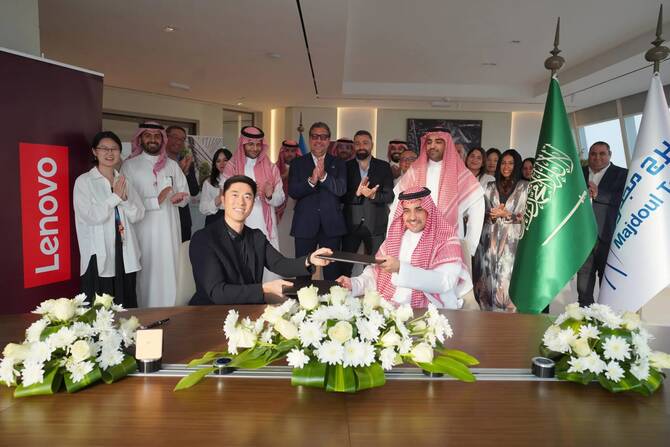
Lenovo has appointed Lawrence Yu as head of regional HQ and Giovanni Di Filippo as vice president & general manager for Saudi Arabia, strengthening its leadership team to accelerate growth in the Kingdom. Supplied
Short Url
Updated 19 August 2025
Follow

China’s Lenovo to establish regional HQ in Saudi Arabia 

  • Move is part of Lenovo’s strategic partnership with ALAT
  • It aligns with government-backed Riyadh regional headquarters program launched in 2021

RIYADH: Chinese technology firm Lenovo Group has announced plans to set up a regional headquarters in Saudi Arabia to strengthen its footprint across the Middle East. 

This move is part of Lenovo’s strategic partnership with ALAT, a company owned by the Public Investment Fund, aiming to support the computer maker’s transformation efforts and broaden its global manufacturing presence, according to a statement. 

Set to be located in Al Majdoul Tower, the new regional base aligns with Lenovo’s long-term dedication to contributing to the Kingdom’s Vision 2030 and driving the country’s digital transformation and economic diversification efforts. 

It also aligns with Saudi Arabia’s government-backed Riyadh regional headquarters program, launched in 2021, which offers incentives such as a 30-year corporate income tax exemption and withholding tax relief, alongside regulatory support for multinationals operating in the Kingdom. 

Matt Dobrodziej, president of Lenovo Europe, Middle East, and Africa, said: “Through our strategic partnership with ALAT and investment in advanced manufacturing, we are proud to contribute to the Kingdom’s Vision 2030 by supporting industrial diversification, accelerating digital transformation, and enabling sustainable economic growth.”

He added: “Our initiatives in Saudi Arabia, including the RHQ, flagship retail space, and the Riyadh-based manufacturing facility, are projected to contribute up to $10 billion to non-oil gross domestic product by 2030, reinforcing our commitment to the Kingdom’s long-term development.”  

As part of the partnership, Lenovo and ALAT began construction in February on a 200,000 sq. meters advanced manufacturing plant located in Riyadh Integrated, within the Special Integrated Logistics Zone. The facility is expected to start producing millions of “Saudi Made” devices by 2026. 

Lenovo is also advancing efforts to set up its regional headquarters in Riyadh. This hub will play a key role in driving the company’s wider regional strategy, which includes investments in a flagship retail location, a VIP customer center, research and development, marketing initiatives, and strategic collaborations throughout Saudi Arabia. 

Almost 600 international companies have set up bases in the Kingdom since 2021, including Northern Trust, IHG Hotels & Resorts, and Deloitte, the Saudi Press Agency reported in March. 

The latest move underlines the strengthening bilateral relations between the Kingdom and China, with Saudi Arabia being the largest trading partner of the Asian country in the Middle East since 2001.  

China and Saudi Arabia are strategic partners in various other sectors such as energy and finance, as well as the Belt and Road Initiative. 


European gas prices soar almost 50% as Iran conflict halts Qatar LNG output

Updated 21 sec ago
Follow

European gas prices soar almost 50% as Iran conflict halts Qatar LNG output

  • Analysts warn prolonged disruption could push prices higher
  • Some shipments of oil, LNG through Strait of Hormuz suspended
  • Benchmark Asian LNG price up almost 39 percent

LONDON: ​Benchmark Dutch and British wholesale gas prices soared by almost 50 percent on Monday, after major liquefied natural gas exporter Qatar Energy said it had halted production due to attacks in the Middle East.

Qatar, soon to cement its role as the world’s second largest LNG exporter after the US, plays a major role in balancing both Asian and European markets’ demand of LNG.

Most tanker owners, oil majors and ‌trading houses ‌have suspended crude oil, fuel and liquefied natural ​gas shipments ‌via ⁠the ​Strait of ⁠Hormuz, trade sources said, after Tehran warned ships against moving through the waterway.

Europe has increased imports of LNG over the past few years as it seeks to phase out Russian gas following Russia’s invasion of Ukraine.

Around 20 percent of the world’s LNG transits through the Strait of Hormuz and a prolonged suspension or full closure would increase global competition for other ⁠sources of the gas, driving up prices internationally.

“Disruptions to ‌LNG flows would reignite competition between ‌Asia and Europe for available cargoes,” said ​Massimo Di Odoardo, vice president, gas ‌and LNG research at Wood Mackenzie.

The Dutch front-month contract at the ‌TTF hub, seen as a benchmark price for Europe, was up €14.56 at €46.52 per megawatt hour, or around $15.92/mmBtu, by 12:55 p.m. GMT, ICE data showed.

Prices were already some 25 percent higher earlier in the day but extended gains ‌after QatarEnergy’s production halt.

Benchmark Asian LNG prices jumped almost 39 percent on Monday morning with the S&P Global ⁠Energy Japan-Korea-Marker, widely used ⁠as an Asian LNG benchmark, at $15.068 per million British thermal units, Platts data showed.

“If LNG/gas markets start to price in an extended period of losses to Qatari LNG supply, TTF could potentially spike to 80-100 euros/MWh ($28-35/mmBtu),” Warren Patterson, head of commodities strategy at ING, said. The British April contract was up 40.83 pence at 119.40 pence per therm, ICE data showed.

Europe is also relying on LNG imports to help fill its gas storage sites which have been depleted over the winter and are currently around 30 percent full, the latest data from Gas Infrastructure ​Europe showed. In the European carbon ​market, the benchmark contract was down €1.10 at €69.17 a tonne