

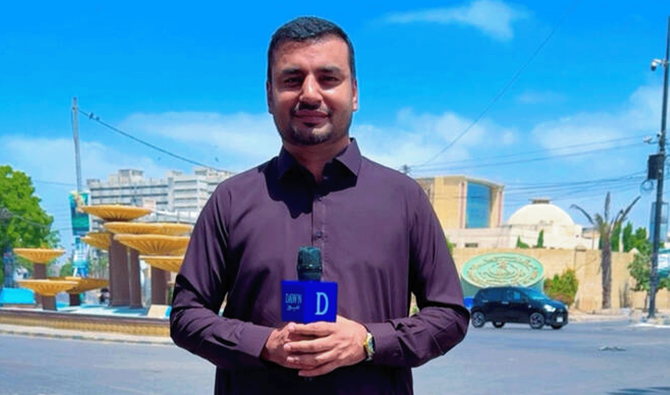
Three-member panel to probe Pakistani journalist Khawar Hussain’s death in Sindh’s Sanghar

File photo of late journalist Khawar Hussain, posted by him on social media on June 7, 2025. (Facebook/k.hussains/File)
Short Url
Updated 18 August 2025
Follow

Three-member panel to probe Pakistani journalist Khawar Hussain’s death in Sindh’s Sanghar

  • Hussain’s body was found inside his vehicle parked outside a restaurant in Sanghar on Saturday
  • The untimely death has shocked the media fraternity and prompted calls for credible investigation

KARACHI: Authorities in Pakistan’s Sindh province have set up a three-member committee to probe journalist Khawar Hussain’s death in the Sanghar district under mysterious circumstances, police said on Sunday.

Hussain’s body was recovered from his hometown of Sanghar outside a local restaurant on Hyderabad Road on Saturday night, according to police officials. The journalist sustained a gunshot wound to his head.

Police said the death appeared to be a suicide after they found a pistol clutched in Hussain’s hand at the site of the incident, local media reported. But the claim was widely rejected by Hussain’s friends and associates on social media.

Sindh Chief Minister Murad Ali Shah ordered a probe into the death, after which DIG Crime and Investigation Wing Amir Farooqi notified a three-member investigation committee on Sunday evening.

“The committee will do preliminary investigation and ascertain facts from all angles,” read a notification issued from Farooqi’s office.

“The complete report into the incident may be finalized in two days.”

The probe panel is headed by Azad Khan, additional inspector general of the Sindh counter-terrorism department (CTD), with DIG Karachi West Irfan Baloch and Sanghar SSP Abid Baloch as members.

Hussain was a Karachi-based correspondent for Dawn News. The news of his death drew condemnations from the Karachi Press Club and senior members of the Sindh government.

“Sindh Chief Minister Syed Murad Ali Shah has taken notice of the unnatural death of senior journalist Khawar Hussain in Sanghar,” a statement from Shah’s office said on Saturday.

“The chief minister has sought a report from the inspector general of police. The real cause of death must be determined through investigation.”

On Sunday, DIG Faisal Bashir Memon told Arab News the pistol clutched in Hussain’s hand at the time of his death belongs to the journalist who had been keeping it for personal safety.

“He parked his car and went to the restroom twice. According to the CCTV footage, he was alone. Khawar asked the hotel manager about the restroom, then returned to his car and sat inside. He stepped out of the car again and asked the watchman about the restroom. He went toward the restroom once more and then came back and sat in the car again,” Memon told Arab News.

“The CCTV camera was installed on the other side of the driver’s seat, and no one else was seen in the footage. The hotel manager later told the watchman to check if Khawar wanted to order something as he had been sitting [inside his car there] for quite a while. When the watchman went to the car, Khawar’s body was found inside with a gunshot wound.”

Police were awaiting the post-mortem report and the journalist’s call data record (CDR) as they intended to probe the death from both murder and suicide angles, according to DIG Memon.

As per a report released by the Pakistan-based media and development sector watchdog Freedom Network last year, 184 incidents of violence against journalists took place in Sindh between 2018 and 2023. These included the killings of 10 journalists in the province.


Eight killed as protesters storm US Consulate in Karachi after Iran confirms Khamenei killed

Updated 15 min 59 sec ago
Follow

Eight killed as protesters storm US Consulate in Karachi after Iran confirms Khamenei killed

  • Protesters smashed doors, set fire to property as police used tear gas to disperse crowds
  • Protests spread to Shia-majority areas of Gilgit-Baltistan, UN office torched, curfew imposed

ISLAMABAD: At least eight people were killed in clashes near the US Consulate in Karachi on Sunday, the Edhi Foundation said, as protests erupted across parts of Pakistan following Iran’s confirmation that Supreme Leader Ayatollah Ali Khamenei was killed in joint US–Israeli strikes.

Hundreds of protesters gathered outside the consulate on Sunday morning, with some attempting to storm the compound and vandalizing property, according to footage circulating on social media and international news reports.

Videos showed protesters armed with sticks smashing doors and windows. Separate footage appeared to show property inside the consulate premises set on fire. International media outlets reported that police used tear gas and baton charges to disperse the crowd.

“The number of people killed during the firing and unrest near the American Consulate on Mai Kolachi Road has risen to eight,” the Edhi Foundation, a major charity and rescue organization, said in a statement.

Police officers take position outside US Consulate following protesters stormed the U.S. Consulate in Karachi, Pakistan, on March 1, 2026. (AN photo)

Speaking to Arab News, Edhi Foundation Chairman Faisal Edhi said over 30 people were injured apart from the eight killed. He said some of the injured were critically wounded, adding that the death toll could increase. 

Edhi said protesters were shot by the security personnel from inside the US consulate. 

Sindh Home Minister Zia-ul-Hassan Lanjar directed authorities to strengthen security around sensitive installations as unrest intensified.

“No one will be allowed to take the law into their own hands,” Lanjar said in a statement issued by his office.

He added that law enforcement agencies were fully alert and monitoring the situation, and vowed that action would be taken in accordance with the law against those disturbing public order.

The violence came hours after Iranian authorities confirmed Khamenei was killed in coordinated strikes carried out by the United States and Israel, dramatically escalating tensions in the Middle East and triggering protests in several countries.

PROTESTS SPREAD

Demonstrations were also reported in Skardu, in Pakistan’s northern Gilgit-Baltistan region, where hundreds of people staged a sit-in on a main road to protest Khamenei’s killing.

Smoke billows over building in Skardu, Pakistan, on March 1, 2026, as protesters set UN office in district on fire. (Social media)

Shabbir Mir, spokesperson for the Gilgit-Baltistan chief minister, told Arab News that a United Nations office in the district had been set on fire.

“The protesters have torched an UN office in Skardu,” Mir confirmed.

The unrest in Pakistan follows a sharp escalation in the Middle East after the United States and Israel launched coordinated strikes in Iran on Saturday.

According to US officials, the operation targeted Revolutionary Guard command facilities, air defense systems, missile and drone launch sites, and military airfields. The US military said it suffered no casualties and reported minimal damage to its bases despite what it described as “hundreds of Iranian missile and drone attacks.”

Iran retaliated by launching missiles and drones toward Israel and targeting US military installations in Bahrain, Kuwait and Qatar. Israeli ally UAE said its air defense systems intercepted dozens of Iranian missiles and drones, but debris from the interceptions caused material damage in Abu Dhabi and Dubai, and at least one civilian, including a Pakistani national, was killed.

The UAE government condemned the strikes as a “blatant violation of national sovereignty and international law,” and issued rare emergency alerts urging residents to seek shelter, underscoring how the conflict has rippled far beyond Iran’s borders. 

The Israeli military said dozens of Iranian missiles were fired toward Israeli territory, many of which were intercepted. Israel’s Magen David Adom rescue service said a woman in the Tel Aviv area died after being wounded in a missile strike.