

Heavy rains expected in Puerto Rico and Virgin Islands as Hurricane Erin nears

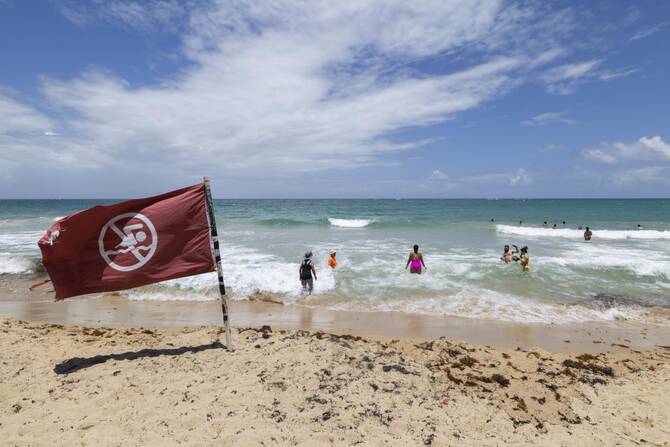
Above, a warning flag flies on the beach as people swim in Condado, Puerto Rico as Hurricane Erin approaches on Aug. 15, 2025. (AP)
Short Url
Updated 16 August 2025
Follow

Heavy rains expected in Puerto Rico and Virgin Islands as Hurricane Erin nears

  • Storm expected to remain over open waters, although tropical storm watches were issued for Anguilla, Barbuda, St. Martin, St. Barts, Saba, St. Eustatius and St. Maarten

SAN JUAN, Puerto Rico: Hurricane Erin strengthened into a Category 2 storm on Friday as it approached the northeast Caribbean, prompting forecasters to warn of possible flooding and landslides.

The storm is expected to remain over open waters, although tropical storm watches were issued for Anguilla, Barbuda, St. Martin, St. Barts, Saba, St. Eustatius and St. Maarten.

Heavy rains were forecast to start late Friday in Antigua and Barbuda, the US and British Virgin Islands and southern and eastern Puerto Rico. Up to 10 centimeters are expected, with isolated totals of up to 15 centimeters, according to the National Hurricane Center in Miami.

The hurricane center also warned of dangerous swells but said the threat of direct impacts in the Bahamas and along the east coast of the United States “appears to be gradually decreasing.”

The storm was located 405 kilometers northeast of Anguilla as of the hurricane center’s 11 p.m. EDT advisory. It had maximum sustained wind speeds of 160kph and was moving west north-west at 27kph.

Hurricane specialist and storm surge expert Michael Lowry said Erin is forecast to eventually take a sharp turn northeast that would put it on a path between the US and Bermuda.

“All of our best consensus aids show Erin turning safely east of the United States next week, but it’ll be a much closer call for Bermuda, which could land on the stronger eastern side of Erin,” he said.

Erin is the Atlantic season’s first hurricane. It is forecast to become a major Category 3 storm late this weekend and pass some 320 kilometers north of Puerto Rico.

The US government has deployed more than 200 employees from the Federal Emergency Management Agency and other agencies to Puerto Rico as a precaution as forecasters issued a flood watch for the entire US territory from late Friday into Monday.

Puerto Rico Housing Secretary Ciary Perez Pena said 367 shelters have been inspected and could be opened if needed.

The US Coast Guard said Friday that it closed six seaports in Puerto Rico and two in the US Virgin Islands to all incoming vessels unless they had received prior authorization.

Meanwhile, officials in the Bahamas said they prepared some public shelters as a precaution as they urged people to track the hurricane.

“These storms are very volatile and can make sudden shifts in movement,” said Aarone Sargent, managing director for the Bahamas’ disaster risk management authority.

Dangerous surf and rip currents are expected to affect the US East Coast next week, with waves reaching up to five meters along parts of the North Carolina coast that could cause beach erosion, according to AccuWeather.

“Erin is forecast to explode into a powerful Category 4 hurricane as it moves across very warm waters in the open Atlantic. Water temperatures at the surface and hundreds of feet deep are several degrees higher than the historical average,” said Alex DaSilva, AccuWeather’s lead hurricane expert.

Erin is the fifth named storm of the Atlantic hurricane season, which runs from June 1 to Nov. 30.

This year’s season is once again expected to be unusually busy. The forecast calls for six to 10 hurricanes, with three to five reaching major status with winds of more than 177kph.


Thai villagers stay behind to guard empty homes as border clashes force mass evacuations

Updated 2 sec ago
Follow

Thai villagers stay behind to guard empty homes as border clashes force mass evacuations

SURIN: Fighting that has flared along the Thai-Cambodian border has sent hundreds of thousands of Thai villagers fleeing from their homes close to the frontier since Monday. Their once-bustling communities have fallen largely silent except for the distant rumble of firing across the fields.
Yet in several of these villages, where normally a few hundred people live, a few dozen residents have chosen to stay behind despite the constant sounds of danger.
In a village in Buriram province, about 6 miles (10 kilometers) from the border, Somjai Kraiprakon and roughly 20 of her neighbors gathered around a roadside house, keeping watch over nearby homes. Appointed by the local administration as Village Security Volunteers, they guarded the empty homes after many residents were forced to flee and with fewer security officials stationed nearby than usual.
The latest large-scale fighting derailed a ceasefire pushed by US President Donald Trump, which halted five days of clashes in July triggered by longstanding territorial disputes. As of Saturday, around two dozen people had been reported killed in the renewed violence.
At a house on the village’s main intersection, now a meeting point, kitchen and sleeping area, explosions were a regular backdrop, with the constant risk of stray ammunition landing nearby. Somjai rarely flinched, but when the blasts came too close, she would sprint to a makeshift bunker beside the house, built on an empty plot from large precast concrete drainage pipes reinforced with dirt, sandbags and car tires.
She volunteered shortly after the July fighting. The 52-year-old completed a three-day training course with the district administration that included gun training and patrol techniques before she was appointed in November. The volunteer village guards are permitted to carry firearms provided by relevant authorities.
The army has emphasized the importance of volunteers like Somjai in this new phase of fighting, saying they help “provide the highest possible confidence and safety for the public.”
According to the army, volunteers “conduct patrols, establish checkpoints, stand guard inside villages, protect the property of local people, and monitor suspicious individuals who may attempt to infiltrate the area to gather intelligence.”
Somjai said the volunteer team performs all these duties, keeping close watch on strangers and patrolling at night to discourage thieves from entering abandoned homes. Her main responsibility, however, is not monitoring threats but caring for about 70 dogs left behind in the community.
“This is my priority. The other things I let the men take care of them. I’m not good at going out patrolling at night. Fortunately I’m good with dogs,” she said, adding that she first fed a few using her own money, but as donations began coming in, she was able to expand her feeding efforts.
In a nearby village, chief Praden Prajuabsook sat with about a dozen members of his village security team along a roadside in front of a local school. Around there, most shops were already closed and few cars could be seen passing once in a while.
Wearing navy blue uniforms and striped purple and blue scarves, the men and women chatted casually while keeping shotguns close and watching strangers carefully. Praden said the team stationed at different spots during the day, then started patrolling when night fell.
He noted that their guard duty is around the clock, and it comes with no compensation and relies entirely on volunteers. “We do it with our own will, for the brothers and sisters in our village,” he said.
Beyond guarding empty homes, Praden’s team, like Somjai, also ensures pets, cattle and other animals are fed. During the day, some members ride motorbikes from house to house to feed pigs, chickens and dogs left behind by their owners.
Although his village is close to the battlegrounds, Praden said he is not afraid of the sounds of fighting.
“We want our people to be safe… we are willing to safeguard the village for the people who have evacuated,” he said.