

Thousands flee as Pakistan readies offensive in northwestern tribal district against Taliban

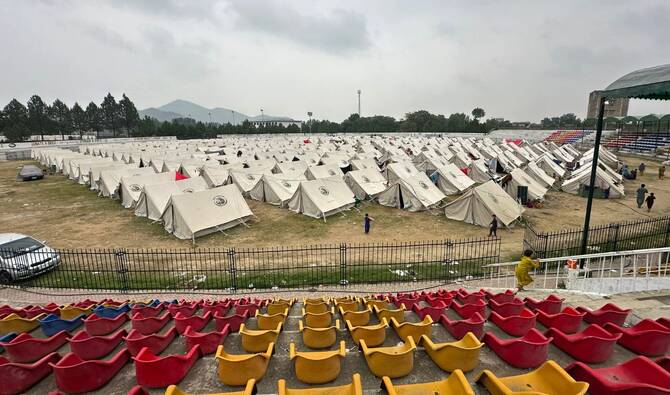
Internally Displaced People (IDPs), who fled their homes following a targeted operation by security forces against militants, walk through a makeshift camp set up in a sports complex in Khar, the main town of Bajaur, a district in northwestern Pakistan near the Afghanistan border on August 13, 2025. (AFP)
Short Url
Updated 15 August 2025
Follow

Thousands flee as Pakistan readies offensive in northwestern tribal district against Taliban

  • Local representatives say about 500 Taliban militants are in Mamund area of Bajaur
  • Deputy commissioner says offensive will be swift, allowing residents to return quickly

KARACHI: Thousands of people have left their homes in Pakistan’s Bajaur tribal district as security forces prepare to launch an offensive against Pakistani Taliban fighters who are said to have crossed into the territory from Afghanistan in recent weeks, according to a local lawmaker, a tribal elder and an official.

The mass displacement follows the collapse of talks between a local jirga — or a council of elders — and the militants in the Mamund area, which borders Afghanistan. Authorities have set a Saturday deadline for evacuations before beginning what they call a “targeted operation,” according to Dr. Hamid Ur Rehman, a local lawmaker from the northwestern Khyber Pakhtunkhwa province’s ruling Pakistan Tehreek-e-Insaf (PTI) party.

“People have been given time until tomorrow to vacate their homes, after which security forces will start movement,” Rehman told Arab News over the phone after visiting a camp being set up for the internally displaced people (IDPs).

Rehman said the crisis began on July 29 after reports of the Taliban entering Mamund.

“Military action started along with the imposition of a night curfew [last month],” he said, adding that the development followed the jirga, which included representatives from all political parties, including himself, and tribal elders.

He said the jirga was convened to engage militants in the hope of “resolving the issue peacefully.”

However, he added that negotiations hit a wall when a senior Taliban leader told the jirga he lacked the authority to make any decisions.

“We have come for war,” Rehman quoted him as saying, “and we have been ordered to fight [by the group’s leadership].”

Rehman said the local government had not given formal permission for a full-scale operation, adding the provincial government’s stance was to oppose any action that harms civilians.

He said the military action following evacuation from the designated villages on Saturday will be a “targeted operation.”

NECESSARY ACTION

Malik Khalid Khan, a local elder, said the military told the jirga to either “deal with these people [the Taliban] or let the security forces handle the situation.”

“Since we couldn’t do it, the military action has become necessary,” he added.

Quoting military officials, Khan, who also participated in the jirga, said the number of militants in Mamund was between 400 and 500, adding that their presence had affected about 40,000 people from 20 villages who had to vacate their homes.

Deputy Commissioner of Bajaur, Shahid Ali Khan, confirmed the developments, saying the planned offensive had affected 80 percent of the population of Lowe Mamund tehsil and less than 30 percent of War Mamund tehsil.

“Of the total affected, almost 90 percent have been accommodated by host communities at their homes. Around 3,500 families are living in homes of host communities, 1,600 families have been housed in camps and over 400 families are in a sports complex,” he informed.

“The provincial government is providing a Rs75,000 [$265] financial package per family, with registration already underway and some families already having received the package in the form of an ATM card,” he added.

Khan said the military action would be swift and drive all Taliban militants out of the area.

“It will be a matter of days,” he said, adding that the IDPs will be sent back to their homes immediately after their areas are cleared.

However, local journalist Bilal Yasir said many residents are wary of such promises.

“Many of them believe previous operations were also ineffective,” he told Arab News, referring to a series of military campaigns in the northwestern tribal districts that uprooted residents while international forces were still in neighboring Afghanistan.

“They say they will once again be forced to live as IDPs for years,” he continued, “and nothing will be done for their rehabilitation.”


Pakistan stocks recover as oil supply fears ease after Islamabad seeks Red Sea route— analyst

Updated 05 March 2026
Follow

Pakistan stocks recover as oil supply fears ease after Islamabad seeks Red Sea route— analyst

  • Pakistan has sought Saudi help to secure oil supplies via Red Sea port after Iran’s closure of Strait if Hormuz
  • Analyst says higher crude oil prices, expectations of IMF releasing next loan tranche also triggered bullish activity

ISLAMABAD: Pakistani stocks marked a sharp recovery when trading closed on Thursday, as institutional activity increased following Islamabad’s move to seek crude oil supplies through the Red Sea port eased oil supply fears, a financial analyst said. 

Pakistani stocks have recorded a sharp decline this week, with the benchmark KSE-100 index recording its largest-ever single-day decline on Monday when it plunged 16,089 points. Escalating conflict in the Middle East triggered panic selling at the Pakistani bourse, forcing a temporary trading halt on Monday. 

The KSE-100 index, however, gained 3.49 percent or 5,433.46 points to close at 161,210.67 when trading ended on Thursday, up from the previous close of 155,777.21 points, according to Pakistan Stock Exchange’s (PSX) data.

Pakistan’s Petroleum Minister Ali Pervaiz Malik met Saudi Ambassador Nawaf bin Said Al-Malki on Wednesday to discuss Iran’s closure of the key Strait of Hormuz, which has threatened Pakistan’s energy supply. Roughly 20 percent of the global oil and gas supply passes through the route. Saudi Arabia indicated it could facilitate shipments through the Red Sea port of Yanbu, offering an alternative route if Gulf shipping lanes remain disrupted, the petroleum ministry said on Wednesday. 

“Stocks staged a sharp recovery at PSX amid institutional activity on easing fuel supply fears after KSA [Kingdom of Saudi Arabia] commits oil supplies through the Red Sea port,” Ahsan Mehanti, chief executive officer at Arif Habib Commodities, told Arab News.

He said higher global crude oil prices and expectations of the International Monetary Fund releasing its next tranche of the $7 billion loan for Pakistan also helped bullish activity at the PSX.

An IMF mission was in Pakistan to hold talks on the third review of a $7 billion Extended Fund Facility multi-year program, and for the second review of the $1.4 billion Resilience and Sustainability Facility this week.

However, the delegation left for Türkiye amid tensions in the Gulf. Pakistani officials have said talks are likely to continue virtually in the coming days. 

Pakistani brokerage Topline Securities said in its daily market review report that strong institutional buying “turned the tide” on Thursday after the market’s recent overreaction to regional issues.

The report added that Hub Power Company (HUBC), Oil & Gas Development Company (OGDC), Fauji Fertilizer Company (FFC), Engro Corporation (ENGROH), and Meezan Bank Limited (MEBL) collectively contributed 2,197 points to the KSE benchmark’s gain.

Topline Securities said 723 million shares were traded on Thursday, with K-Electric Limited (KEL) stealing the spotlight as more than 1.17 billion shares changed hands.

Pakistani investors are closely monitoring developments in the Gulf, particularly around energy routes and further retaliatory actions, as the conflict’s trajectory remains uncertain.