

Pakistan launches third Chinese-built Hangor-class submarine amid deepening defense ties

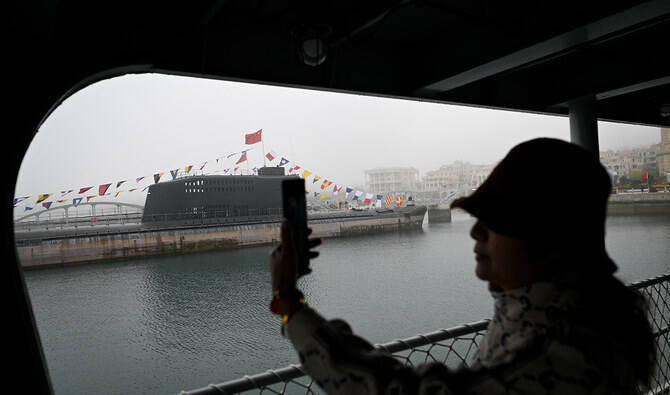
This picture taken during a media tour organised by the Chinese People's Liberation Army Navy (PLAN) to mark its 75th founding anniversary, shows a woman taking pictures of a submarine at the PLA Naval Museum in Qingdao, China's Shandong province on April 23, 2024. (AFP/File)
Short Url
Updated 15 August 2025
Follow

Pakistan launches third Chinese-built Hangor-class submarine amid deepening defense ties

  • The launch comes months after Pakistan’s brief but intense military standoff with India
  • Eight-submarine deal includes technology transfer, with four vessels to be built in Pakistan

KARACHI: Pakistan on Friday launched its third Hangor-class submarine in China, the navy said in a statement, in the latest sign of the country’s growing military ties with Beijing.

The launch comes months after Pakistan’s brief but intense military standoff with India, which saw the two nuclear-armed neighbors exchange air, missile, drone and artillery attacks.

In recent years, Islamabad has strengthened its defence collaboration with China, inducting state-of-the-art Chinese hardware across all three services, including Z-10ME attack helicopters earlier this month and JF-17 fighter jets jointly developed with Beijing.

The navy said the new vessel, equipped with modern sensors and weapons, will enhance its capabilities to safeguard national interests and contribute to a “secure and cooperative maritime environment.”

“Their cutting-edge weaponry and advanced sensors would be instrumental in sustaining regional power equilibrium and ensuring maritime stability,” Vice Admiral Abdul Samad, Deputy Chief of Naval Staff Project-2, said at the launch ceremony in Wuhan, according to a navy statement.

The launch took place at Wuchang Shipbuilding Industry Group’s Shuangliu Base and was attended by senior officials from both Pakistan and China, including representatives of China Shipbuilding & Offshore International Company Ltd (CSOC).

Samad commended the steady progress of the project, praised the work of Chinese shipbuilders and said the Hangor-class program would “bring a fresh dimension” to Pakistan-China naval cooperation.

The submarines are a new generation of diesel-electric attack vessels and equipped with advanced sensors and modern weapon systems to strengthen the country’s underwater warfare capabilities.

Pakistan signed a contract with CSOC to acquire eight Hangor-class submarines. Four are being built in China, while the remaining four will be produced in Pakistan at Karachi Shipyard & Engineering Works Limited under a transfer-of-technology program.

The first two submarines in the series were launched in 2024, with deliveries expected over the next several years.


Pakistan to launch AI screening in January to target fake visas, agent networks

Updated 05 December 2025
Follow

Pakistan to launch AI screening in January to target fake visas, agent networks

  • New system to flag forged-document travelers before boarding and pre-verify eligibility
  • Move comes amid increasing concern over fake visas, fraudulent agents, forged papers

ISLAMABAD: Pakistan will roll out an AI-based immigration screening system in Islamabad from January to detect forged documents and prevent illegal overseas travel, the government said on Thursday. 

The move comes amid increasing concern over fake visas, fraudulent agents and forged papers, with officials warning that such activity has contributed to deportations, human smuggling and reputational damage abroad. Pakistan has also faced scrutiny over irregular migration flows and labor-market vulnerability, particularly in the Gulf region, prompting calls for more reliable pre-departure checks and digital verification.

The reforms include plans to make the protector-stamp system — the clearance required for Pakistani citizens seeking overseas employment — “foolproof”, tighten labor-visa documentation, and cancel the passports of deportees to prevent them from securing visas again. The government has sought final recommendations within seven days, signalling a rapid enforcement timeline.

“To stop illegal immigration, an AI-based app pilot project is being launched in Islamabad from January,” Interior Minister Mohsin Naqvi said following a high-level meeting chaired by him and Minister for Overseas Pakistanis Chaudhry Salik Hussain.

Naqvi said the new screening technology is intended to determine travelers’ eligibility in advance, reducing airport off-loads and closing loopholes exploited by traffickers and unregistered agents.

The interior minister added that Pakistan remains in contact with foreign governments to improve the global perception and ranking of the green passport, while a uniform international driving license will be issued through the National Police Bureau.

The meeting also approved zero-tolerance measures against fraudulent visa brokers, while the Overseas Pakistanis Ministry pledged full cooperation to streamline the emigration workflow. Minister Hussain said transparency in the protector process has become a “basic requirement,” particularly for labor-migration cases.

Pakistan’s current immigration system has long struggled with document fraud, with repeated cases of passengers grounded at airports due to forged papers or agent-facilitated travel. The launch of an AI screening layer, if implemented effectively, could shift the burden from manual counters to pre-flight verification, allowing authorities to identify risk profiles before departure rather than after arrival abroad.

The reforms also come at a moment when labor mobility is tightening globally. Gulf states have begun demanding greater documentation assurance for imported labor, while European and Asian destinations have increased scrutiny following trafficking arrests and irregular-entry routes from South Asia. For Pakistan, preventing fraudulent departures is increasingly linked to protecting genuine workers, reducing deportation cycles and stabilizing the country’s overseas employment footprint.