

India says international court lacks authority to rule on Pakistan water treaty

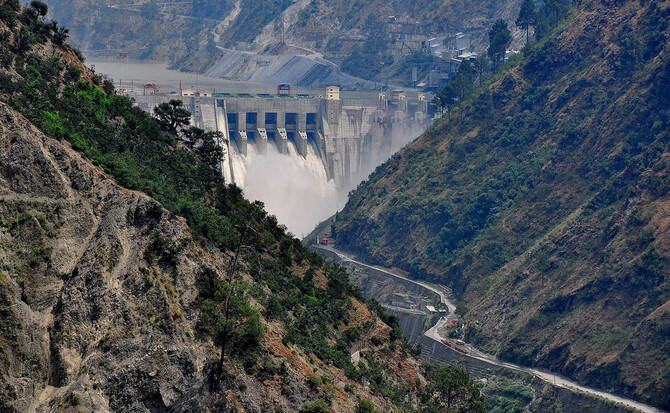
A photo of Kishanganga Hydroelectric Plant, which is part of a run-of-the-river hydroelectric scheme that is designed to divert water from the Kishanganga River (Neelum River in Pakistan) to a power plant in the Jhelum River basin. It will have an installed capacity of 330 MW. (Photo courtesy: ICIMOD)
Short Url
Updated 15 August 2025
Follow

India says international court lacks authority to rule on Pakistan water treaty

  • India does not recognize the Court of Arbitration’s jurisdiction over the Indus Waters Treaty
  • Pakistan has hailed ruling backing its position on Indian hydro-power projects on western rivers

NEW DELHI: The international Court of Arbitration lacks any legal authority to make pronouncements on the Indus Waters Treaty between India and Pakistan as New Delhi has never recognized the legitimacy of the court, India’s foreign ministry said on Thursday.

A ruling from the Court of Arbitration last week backed Pakistan by saying that India must adhere to the Indus Waters Treaty in the design of new hydro-electric power stations on rivers that flow west into Pakistan.

Under the 1960 Indus Waters Treaty, three rivers that flow westwards were awarded to Pakistan, with India getting three eastern flowing rivers. Pakistan fears its neighbor India could choke its main water supply, with 80 percent of the country’s agriculture and hydro-power dependent on those three river flows.

In 2023, Pakistan brought a case to the Hague-based Permanent Court of Arbitration over the design of Indian hydro-power projects on rivers that were awarded to Pakistan under the treaty.

The court, in a ruling on Friday that was posted on its website on Monday, said it had jurisdiction over the dispute and ruled the treaty “does not permit India to generate hydro-electric power on the Western Rivers based on what might be the ideal or best practices approach for engineering” of these projects.

Instead, the design of these projects must adhere “strictly” to the specifications laid down in the treaty, the court said.

Pakistan’s Attorney General, Mansoor Usman, said in an interview on Tuesday that, by and large, the court had accepted Pakistan’s position, especially on the design issue of the new hydropower projects.

“I am sure it is clear now that India cannot construct any of these projects in violation of the court’s decision,” he told Reuters.

Pakistan’s foreign ministry said late Monday that the court ruling said that India had to “let flow” the waters of the three rivers for Pakistan’s unrestricted use.

The court said its findings are final and binding on both countries, according to the foreign office statement.

An Indian official pointed to a June statement by India’s foreign ministry, which said that India has never recognized the existence in law of the Court of Arbitration.

Tensions between the two countries over the Indus Waters Treaty soared when India unilaterally said in April that it would hold the treaty in abeyance in response to the killing of 26 civilians in Indian-controlled Kashmir, an attack it blamed on Islamabad. Pakistan denied involvement. Conflict then erupted in May, the most serious fighting between the two countries in decades, before it ended with a ceasefire announcement by US President Donald Trump.


Customs seize narcotics, smuggled goods, vehicles worth $4.9 million in southwest Pakistan

Updated 16 December 2025
Follow

Customs seize narcotics, smuggled goods, vehicles worth $4.9 million in southwest Pakistan

  • Customs seize 22.14 kg narcotics, consignments of smuggled betel nuts, Hino trucks, auto parts, says FBR
  • Smuggled goods enter Pakistan’s Balochistan province from neighboring countries Iran and Afghanistan

ISLAMABAD: Pakistan Customs seized narcotics, smuggled goods and vehicles worth a total of Rs1.38 billion [$4.92 million] in the southwestern Balochistan province on Tuesday, the Federal Board of Revenue (FBR) said in a statement. 

Customs Enforcement Quetta seized and recovered 22.14 kilograms of narcotics and consignments of smuggled goods comprising betel nuts, Indian medicines, Chinese salt, auto parts, a ROCO vehicle and three Hino trucks in two separate operations, the FBR said. All items cost an estimated Rs1.38 billion, it added. 

Smuggled items make their way into Pakistan through southwestern Balochistan province, which borders Iran and Afghanistan. 

“These operations are part of the collectorate’s intensified enforcement drive aimed at curbing smuggling and dismantling illegal trade networks,” the FBR said. 

“All the seized narcotics, goods and vehicles have been taken into custody, and legal proceedings under the Customs Act 1969 have been formally initiated.”

In the first operation, customs officials intercepted three containers during routine checking at FEU Zariat Cross (ZC) area. The containers were being transported from Quetta to Pakistan’s Punjab and Khyber Pakhtunkhwa provinces, the FBR said. 

The vehicles intercepted included three Hino trucks. Their detailed examination led to the recovery of the smuggled goods which were concealed in the containers.

In the second operation, the staff of the Collectorate of Enforcement Customs, Quetta, intercepted a ROCO vehicle at Zariat Cross area with the local police’s assistance. 

The driver was interrogated while the vehicle was searched, the FBR said. 

“During interrogation, it was disclosed that drugs were concealed inside the spare wheel at the bottom side of the vehicle,” it said. 

“Upon thorough checking, suspected narcotics believed to be heroin was recovered which was packed in 41 packets, each weighing 0.54 kilograms.”

The narcotics weighed a total of 22.14 kilograms, with an estimated value of Rs1.23 billion in the international market, the FBR concluded. 

“The Federal Board of Revenue has commended the Customs Enforcement Quetta team for their effective action and reiterated its firm resolve to combat smuggling, illicit trade and illegal economic activities across the country,” it said.