

India says international court lacks authority to rule on Pakistan water treaty

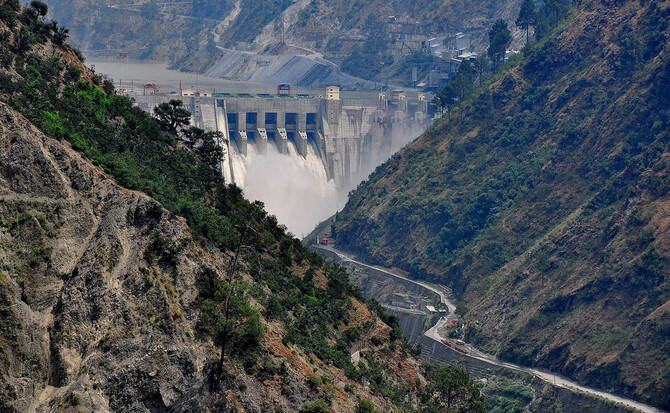
A photo of Kishanganga Hydroelectric Plant, which is part of a run-of-the-river hydroelectric scheme that is designed to divert water from the Kishanganga River (Neelum River in Pakistan) to a power plant in the Jhelum River basin. It will have an installed capacity of 330 MW. (Photo courtesy: ICIMOD)
Short Url
Updated 15 August 2025
Follow

India says international court lacks authority to rule on Pakistan water treaty

  • India does not recognize the Court of Arbitration’s jurisdiction over the Indus Waters Treaty
  • Pakistan has hailed ruling backing its position on Indian hydro-power projects on western rivers

NEW DELHI: The international Court of Arbitration lacks any legal authority to make pronouncements on the Indus Waters Treaty between India and Pakistan as New Delhi has never recognized the legitimacy of the court, India’s foreign ministry said on Thursday.

A ruling from the Court of Arbitration last week backed Pakistan by saying that India must adhere to the Indus Waters Treaty in the design of new hydro-electric power stations on rivers that flow west into Pakistan.

Under the 1960 Indus Waters Treaty, three rivers that flow westwards were awarded to Pakistan, with India getting three eastern flowing rivers. Pakistan fears its neighbor India could choke its main water supply, with 80 percent of the country’s agriculture and hydro-power dependent on those three river flows.

In 2023, Pakistan brought a case to the Hague-based Permanent Court of Arbitration over the design of Indian hydro-power projects on rivers that were awarded to Pakistan under the treaty.

The court, in a ruling on Friday that was posted on its website on Monday, said it had jurisdiction over the dispute and ruled the treaty “does not permit India to generate hydro-electric power on the Western Rivers based on what might be the ideal or best practices approach for engineering” of these projects.

Instead, the design of these projects must adhere “strictly” to the specifications laid down in the treaty, the court said.

Pakistan’s Attorney General, Mansoor Usman, said in an interview on Tuesday that, by and large, the court had accepted Pakistan’s position, especially on the design issue of the new hydropower projects.

“I am sure it is clear now that India cannot construct any of these projects in violation of the court’s decision,” he told Reuters.

Pakistan’s foreign ministry said late Monday that the court ruling said that India had to “let flow” the waters of the three rivers for Pakistan’s unrestricted use.

The court said its findings are final and binding on both countries, according to the foreign office statement.

An Indian official pointed to a June statement by India’s foreign ministry, which said that India has never recognized the existence in law of the Court of Arbitration.

Tensions between the two countries over the Indus Waters Treaty soared when India unilaterally said in April that it would hold the treaty in abeyance in response to the killing of 26 civilians in Indian-controlled Kashmir, an attack it blamed on Islamabad. Pakistan denied involvement. Conflict then erupted in May, the most serious fighting between the two countries in decades, before it ended with a ceasefire announcement by US President Donald Trump.


Pakistan launches crypto testing framework to regulate digital assets

Updated 20 February 2026
Follow

Pakistan launches crypto testing framework to regulate digital assets

  • Regulatory ‘sandbox’ to let firms test crypto products under supervision
  • Move comes amid broader push to formalize Pakistan’s digital asset sector

ISLAMABAD: Pakistan’s Virtual Assets Regulatory Authority (PVARA) on Friday launched a crypto testing framework to regulate digital assets, allowing firms to trial new products and services under official supervision.

The initiative, formally structured as a regulatory “sandbox,” creates a controlled environment where companies can test crypto-related services under the oversight of the regulator before full-scale approval.

According to PVARA, the sandbox will support real-world use cases including tokenization, stablecoins, remittances and on- and off-ramp infrastructure.

Tokenization refers to converting real-world assets into digital tokens on a blockchain, while stablecoins are cryptocurrencies pegged to a fiat currency to maintain a stable value. On- and off-ramp infrastructure allows users to convert between fiat money and digital assets, enabling the practical use of virtual asset products.
“The Pakistan Virtual Assets Regulatory Authority has formally approved and launched its Regulatory Sandbox for virtual assets,” PVARA said in a post on X. “Sandbox Guidelines and the application process will be published shortly on our website.”


The move comes as the government seeks to build a formal regulatory framework for digital assets while attracting investment and strengthening oversight of the sector.

Pakistan has stepped up efforts recently to regulate its digital asset sector and is exploring digital currency initiatives as part of broader measures to reduce cash usage.

In January, Pakistan signed a memorandum of understanding with a company affiliated with World Liberty Financial, a crypto-based finance platform launched in September 2024 and linked to US President Donald Trump’s family to explore the use of a dollar-linked stablecoin for cross-border payments.