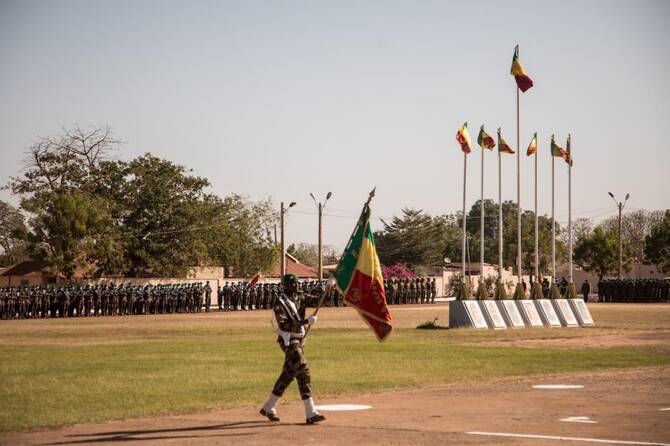
BAMAKO: Mali’s military-led government has arrested two generals and a French national, accusing them of participating in an alleged plot to destabilize the West African nation, according to a government statement and state-owned media.
Mali has endured over a decade of turmoil marked by Islamist insurgencies in its arid north along with political instability that culminated in a series of coups in 2020 and 2021 that brought current president General Assimi Goita to power.
Sources told Reuters earlier this week that more than 30 soldiers and military officials had been taken into custody on suspicion of attempting to destabilize Goita’s government.
Mali’s ministry of territorial administration, in a statement released late on Thursday, said those arrested included Yann Vezilier, a French citizen.
France’s once close relationship with its former colonies in West Africa’s Sahel region has soured in recent years as military officers have overthrown civilian governments in Mali, Burkina Faso and Niger.
Paris has withdrawn French troops involved in an operation to combat Islamist militants there under pressure from the countries’ new leadership. Mali, which cut military ties with France, has meanwhile turned to Russia for support.
The ministry statement accused Vezilier of acting on behalf of French intelligence services to mobilize political and civil society figures and military officers.
A French foreign ministry spokesperson said Friday that it had no official comment on Vezilier’s arrest.
Malian state media showed images of 10 other people detained for involvement in the alleged plot, including General Abass Dembele, who is the former governor of the central Mopti region, and General Nema Sagara, another leading military figure.
The ministry did not specify how many people had been arrested in total but described them as “a group of marginal elements” and said the situation was under control.
Mali’s military authorities have failed to keep their promise to hold elections. Instead, Goita was granted a five-year renewable term in June and political activities were suspended across the country.
While Mali’s military junta cited the civilian authorities’ failure to put down Islamist uprisings in the north among its justifications for seizing power, security woes have persisted under Goita.
The past few months have seen a surge of deadly attacks by Jama’at Nusrat Al-Islam wal-Muslimin, an Al-Qaeda-linked group that also operates in Burkina Faso and Niger.


![]()

Mali arrests generals, French national accused in alleged destabilization plot
Short Url
https://arab.news/b2k3p
Mali arrests generals, French national accused in alleged destabilization plot
- Mali’s ministry of territorial administration, in a statement released late on Thursday, said those arrested included Yann Vezilier, a French citizen


Latest updates


© 2026 SAUDI RESEARCH & PUBLISHING COMPANY, All Rights Reserved And subject to Terms of Use Agreement.