

Water shortages plague Beirut as low rainfall compounds woes

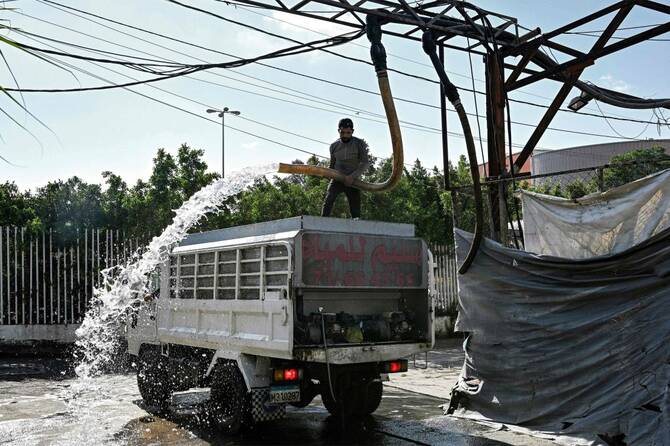
The shortages are felt unevenly across greater Beirut, where tanks clutter rooftops, water trucks clog roads and most people on the ramshackle state grid lack meters. (FILE/AFP)
Short Url
Updated 14 August 2025
Follow

Water shortages plague Beirut as low rainfall compounds woes

  • People are buying water by the truckload in Beirut as the state supply faces its worst shortages in years, with the leaky public sector struggling after record-low rainfall and local wells running dry

BEIRUT: People are buying water by the truckload in Beirut as the state supply faces its worst shortages in years, with the leaky public sector struggling after record-low rainfall and local wells running dry.

“State water used to come every other day, now it’s every three days,” said Rima Al-Sabaa, 50, rinsing dishes carefully in Burj Al-Baranjeh, in Beirut’s southern suburbs.

Even when the state water is flowing, she noted, very little trickles into her family’s holding tank.

Once that runs out, they have to buy trucked-in water — pumped from private springs and wells — but it costs more than $5 for 1,000 liters and lasts just a few days, and its brackishness makes everything rust.

In some areas, the price can be twice as high.

Like many Lebanese people, Sabaa, who works assisting the elderly, relies on bottled water for drinking. But in a country grappling with a yearslong economic crisis and still reeling from a recent war between Israel and Hezbollah, the costs add up.

“Where am I supposed to get the money from?” she asked.

Water shortages have long been the norm for much of Lebanon, which acknowledges only around half the population “has regular and sufficient access to public water services.”

Surface storage options such as dams are inadequate, according to the country’s national water strategy, while half the state supply is considered “non-revenue water” — lost to leakage and illegal connections.

This year, low rainfall has made matters even worse.

Mohamad Kanj from the meteorological department told AFP that rainfall for 2024-2025 “is the worst in the 80 years” on record in Lebanon.

Climate change is set to exacerbate the county’s water stress, according to the national strategy, while a World Bank statement this year said “climate change may halve (Lebanon’s) dry-season water by 2040.”

Energy and Water Minister Joseph Saddi said last week that “the situation is very difficult.”

The shortages are felt unevenly across greater Beirut, where tanks clutter rooftops, water trucks clog roads and most people on the ramshackle state grid lack meters.

Last month, the government launched a campaign encouraging water conservation, showing dried or depleted springs and lakes around the country.

North of the capital, levels were low in parts of the Dbayeh pumping station that should have been gushing with water.

“I’ve been here for 33 years and this is the worst crisis we’ve had for the amount of water we’re receiving and can pump” to Beirut, said the station’s Zouhair Azzi.

Antoine Zoghbi from the Beirut and Mount Lebanon Water Establishment said water rationing in Beirut usually started in October or November, after summer and before the winter rainy season.

But this year it has started months early “because we lack 50 percent of the amount of water” required at some springs, he told AFP last month.

Rationing began at some wells in June, he said, to reduce the risk of overuse and seawater intrusion.

Zoghbi emphasized the need for additional storage, including dams.

In January, the World Bank approved more than $250 million in funding to improve water services for greater Beirut and its surroundings.

In 2020, it canceled a loan for a dam south of the capital after environmentalists said it could destroy a biodiversity-rich valley.

In south Beirut, pensioner Abu Ali Nasreddine, 66, said he had not received state water for many months.

“Where they’re sending it, nobody knows,” he said, lamenting that the cost of trucked-in water had also risen.

His building used to get water from a local well but it dried up, he added, checking his rooftop tank.

Bilal Salhab, 45, who delivers water on a small, rusted truck, said demand had soared, with families placing orders multiple times a week.

“The water crisis is very bad,” he said, adding he was struggling to fill his truck because wells had dried up or become salty.

In some areas of greater Beirut, wells have long supplemented or even supplanted the state network.

But many have become depleted or degraded, wrecking pipes and leaving residents with salty, discolored water.

Nadim Farajalla, chief sustainability officer at the Lebanese American University, said Beirut had ballooned in size and population since the start of the 1975-1990 civil war but water infrastructure had failed to keep up.

Many people drilled wells illegally, including at depths that tap into Lebanon’s strategic groundwater reserves, he said, adding that “nobody really knows how many wells there are.”

“Coastal aquifers are suffering from seawater intrusion, because we are pumping much more than what’s being recharged,” Farajalla told AFP.

As the current shortages bite, rationing and awareness campaigns should have begun earlier, he said, because “we all knew that the surface snow cover and rainfall” were far below average.


Iraq’s dreams of wheat independence dashed by water crisis 

Updated 3 sec ago
Follow

Iraq’s dreams of wheat independence dashed by water crisis 

NAJAF: Iraqi wheat farmer Ma’an Al-Fatlawi has long depended on the nearby Euphrates River to feed his fields near the city of Najaf. But this year, those waters, which made the Fertile Crescent a cradle of ancient civilization 10,000 years ago, are drying up, and he sees few options.
“Drilling wells is not successful in our land, because the water is saline,” Al-Fatlawi said, as he stood by an irrigation canal near his parched fields awaiting the release of his allotted water supply.
A push by Iraq — historically among the Middle East’s biggest wheat importers — to guarantee food security by ensuring wheat production covers the country’s needs has led to three successive annual surpluses of the staple grain.
But those hard-won advances are now under threat as the driest year in modern history and record-low water levels in the Tigris and Euphrates rivers have reduced planting and could slash the harvest by up to 50 percent this season.
“Iraq is facing one of the most severe droughts that has been observed in decades,” the UN Food and Agriculture Organization’s Iraq representative Salah El Hajj Hassan told Reuters.

VULNERABLE TO NATURE AND NEIGHBOURS
The crisis is laying bare Iraq’s vulnerability.
A largely desert nation, Iraq ranks fifth globally for climate risk, according to the UN’s Global Environment Outlook. Average temperatures in Iraq have risen nearly half a degree Celsius per decade since 2000 and could climb by up to 5.6 C by the end of the century compared to the period before industrialization, according to the International Energy Agency. Rainfall is projected to decline.
But Iraq is also at the mercy of its neighbors for 70 percent of its water supply. And Turkiye and Iran have been using upstream dams to take a greater share of the region’s shared resource.
The FAO says the diminishing amount of water that has trickled down to Iraq is the biggest factor behind the current crisis, which has forced Baghdad to introduce rationing.
Iraq’s water reserves have plunged from 60 billion cubic meters in 2020 to less than 4 billion today, said El Hajj Hassan, who expects wheat production this season to drop by 30 percent to 50 percent.
“Rain-fed and irrigated agriculture are directly affected nationwide,” he said.

EFFORTS TO END IMPORT DEPENDENCE UNDER THREAT
To wean the country off its dependence on imports, Iraq’s government has in recent years paid for high-yield seeds and inputs, promoted modern irrigation and desert farming to expand cultivation, and subsidised grain purchases to offer farmers more than double global wheat prices.
It is a plan that, though expensive, has boosted strategic wheat reserves to over 6 million metric tons in some seasons, overwhelming Iraq’s silo capacity. The government, which purchased around 5.1 million tons of the 2025 harvest, said in September that those reserves could meet up to a year of demand.
Others, however, including Harry Istepanian — a water expert and founder of Iraq Climate Change Center — now expect imports to rise again, putting the country at greater risk of higher food prices with knock-on effects for trade and government budgets.
“Iraq’s water and food security crisis is no longer just an environmental problem; it has immediate economic and security spillovers,” Istepanian told Reuters.
A preliminary FAO forecast anticipates wheat import needs for the 2025/26 marketing year to increase to about 2.4 million tons.
Global wheat markets are currently oversupplied, offering cheaper options, but Iraq could once again face price volatility.
Iraq’s trade ministry did not respond to a request for comment on the likelihood of increased imports.
In response to the crisis, the ministry of agriculture capped river-irrigated wheat at 1 million dunams in the 2025/26 season — half last season’s level — and mandated modern irrigation techniques including drip and sprinkler systems to replace flood irrigation through open canals, which loses water through evaporation and seepage.
A dunam is a measurement of area roughly equivalent to a quarter acre.
The ministry is allocating 3.5 million dunams in desert areas using groundwater. That too is contingent on the use of modern irrigation.
“The plan was implemented in two phases,” said Mahdi Dhamad Al-Qaisi, an adviser to the agriculture minister. “Both require modern irrigation.”
Rice cultivation, meanwhile, which is far more water-intensive than wheat, was banned nationwide.

RURAL LIVELIHOODS AT RISK
One ton of wheat production in Iraq requires about 1,100 cubic meters of water, said Ammar Abdul-Khaliq, head of the Wells and Groundwater Authority in southern Iraq. Pivoting to more dependence on wells to replace river water is risky.
“If water extraction continues without scientific study, groundwater reserves will decline,” he said.
Basra aquifers, he said, have already fallen by three to five meters.
Groundwater irrigation systems are also expensive due to the required infrastructure like sprinklers and concrete basins. That presents a further economic challenge to rural Iraqis, who make up around 30 percent of the population.
Some 170,000 people have already been displaced in rural areas due to water scarcity, the FAO’s El Hajj Hassan said.
“This is not a matter of only food security,” he said. “It’s worse when we look at it from the perspective of livelihoods.”
At his farm in Najaf, Al-Fatlawi is now experiencing that first-hand, having cut his wheat acreage to a fifth of its normal level this season and laid off all but two of his 10 workers.
“We rely on river water,” he said.