

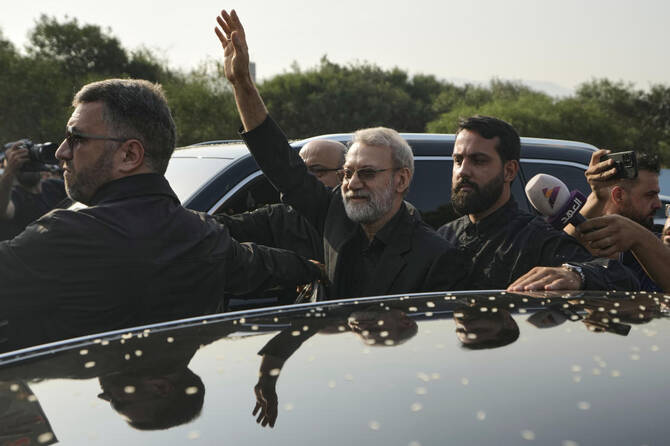


BEIRUT: Ali Larijani, the secretary of Iran’s Supreme National Security Council, affirmed on Wednesday Tehran’s support for the Lebanese government and its decisions, emphasizing that his statement “expresses the official Iranian position toward Lebanon.”
However, he pointed out that “the US is the one that came up with a proposal paper for powerful and independent countries in the region, which do not need to take orders from across the oceans.”
His statements came during his visit to Beirut after diplomatic tensions were stirred by statements by Iranian officials in which they declared their rejection of plans to disarm Hezbollah. The Iran-backed group was severely weakened by the assassination of its leader, Hassan Nasrallah, along with senior officials and the destruction of its military infrastructure during the war with Israel.
Nawaf Salam, prime minister of Lebanon, issued a decision last week to restrict arms to the Lebanese state and to assign to the Lebanese army the task of developing an implementation plan to present to the Cabinet by the end of the month. He called for the decision to be implemented before the end of the year.
Larijani’s visit was met by Lebanese officials who took a high-pitched tone against Iranian interference in Lebanese affairs. Reiterating his country’s rejection of foreign interference, President Joseph Aoun informed the Iranian official that “Lebanon is willing to cooperate with Iran within the limits of sovereignty and friendship based on mutual respect.”
He noted that “the language Lebanon has heard recently from some Iranian officials is unhelpful.”
Aoun told Larijani that the relations between the two countries should not be through one sect or one Lebanese component, but with all Lebanese.
He said that Lebanon is the “ultimate homeland for all its citizens, whether Christians or Muslims, and the Lebanese state, through its constitutional and security institutions, is responsible for protecting all Lebanese components.”
According to a statement from the Lebanese presidency, Aoun said: “We reject any interference in our internal affairs from any party, and we want the Lebanese arena to remain safe and stable in the interest of all Lebanese without discrimination.”
Referring to the decision to disarm Hezbollah, Aoun told the Iranian official: “If, throughout Lebanese history, some sought strength from abroad against others inside, everyone paid a high price. The lesson learned by the Lebanese is that it is not allowed for any party, without exception, to bear arms and use foreign backing as leverage against another Lebanese.”
He said the constitutional institutions are the official representatives of the Lebanese people that safeguard the interests of the state. “If the Islamic Republic of Iran seeks to achieve its major interests, this is natural, but we in Lebanon seek to achieve our own interests.”
The Lebanese president stressed that the unity of the Lebanese people is the best way to overcome any challenges coming from Israel or other parties, which affect all Lebanese, not just one group.
“This is what we are working for, and we hope to receive the necessary cooperation, especially since we will not hesitate to accept any assistance in this regard,” Aoun said.
A political source close to Larijani in Beirut told Arab News that the Iranian official, who arrived in Lebanon following a visit to Iraq, sought to reinforce Tehran’s regional influence.
But faced with resistance, he was compelled to stress in Beirut that Iran now seeks equal relations between states, after years of treating Lebanon as an extension of its regional axis.
According to a statement issued after the meeting with Aoun, Larijani informed the president of Tehran’s desire to assist Lebanon’s postwar reconstruction efforts, proposing the creation of a fund to rebuild areas damaged by Israeli aggression and expressing his country’s willingness to contribute to it.
Aoun welcomed the Iranian offer of assistance but simultaneously emphasized that such support must be channeled through Lebanese state institutions, not directed to any specific party or sect, sources added, in reference to the direct aid Hezbollah has received from Iran.
In a statement after his meeting with Parliament Speaker Nabih Berri, a Hezbollah ally and the party’s key negotiator with the US on the ceasefire implementation mechanism with Israel, Larijani said: “Through friendly, comprehensive, and serious dialogue within Lebanon, the country can reach sound decisions, and through dialogue with the resistance (Hezbollah) it can make the most appropriate decision.
“The resistance has a deep sense and strong strategic thinking, and we do not emphasize orders through which a specific timetable is set. We advise you to preserve the resistance. Israel has become a predatory animal, but Hezbollah stands up to it,” he added.
Larijani’s arrival in Beirut on Wednesday morning was preceded by political discontent, triggering calls for Lebanese officials to refuse to meet with him.
Ali Akbar Velayati, senior adviser to the Iranian supreme leader, said last Saturday that Iran strongly opposes the Lebanese government’s decision to disarm Hezbollah, considering that its fate would be “failure, and the resistance will stand firm in the face of these conspiracies,” Tasnim News Agency reported.
Larijani’s visit included two extensive meetings at the Iranian embassy in Beirut: the first with Lebanese religious and political figures; and the second with Lebanese and Palestinian parliamentary, political, and party figures, according to the Iranian embassy in Beirut.
The meeting between Larijani and Salam took place later in the day, following a Lebanese cabinet session that lasted several hours as ministers worked through a heavy agenda of service and administrative items, before adjourning for a two-week suspension.
Ministers from the Amal Movement and Hezbollah attended the session, indicating that they were not planning to resign, as previously reported, in protest against the government’s arms control decision taken last week. Dozens of Hezbollah supporters waited on the road to Beirut airport for Larijani’s arrival, chanting anti-American slogans and rejecting “humiliation.”


