Pakistan’s central bank sees FY26 growth up to 4.25%, trade gap to widen

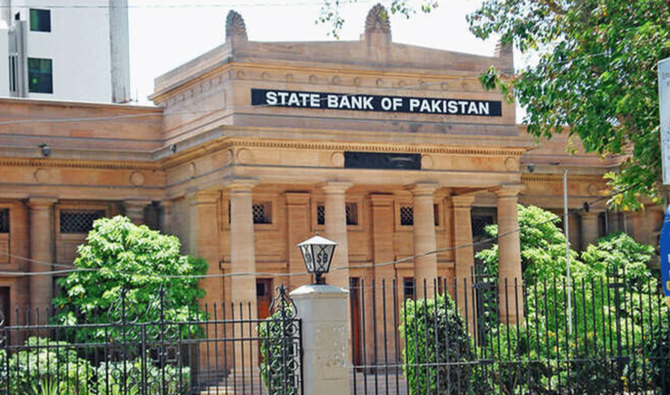
This undated file photo shows premises of the State Bank of Pakistan. (Shutterstock/File)
Short Url
Updated 13 August 2025
Follow

Pakistan’s central bank sees FY26 growth up to 4.25%, trade gap to widen

  • Current account deficit forecast at 0–1% of GDP despite remittance growth
  • Forex reserves projected to reach $15.5 billion by end-December 2025

KARACHI: Pakistan’s central bank on Wednesday projected economic growth of up to 4.25 percent in the current fiscal year but warned the trade deficit would widen, even as reserves are set to climb on the back of steady remittances and foreign inflows.

The forecast comes as Pakistan implements reforms under a $7 billion International Monetary Fund (IMF) program approved in September 2024, which has helped stabilize the currency, ease inflation and restore investor confidence. The IMF deal is tied to fiscal consolidation, energy sector reforms, and measures to boost exports, part of a broader effort to strengthen macroeconomic stability after years of chronic external imbalances.

The economy returned to moderate growth last year, aided by improved agricultural output, lower global commodity prices, and a series of policy rate cuts totaling 1,100 basis points since late 2024. Inflation has eased from record highs, while the rupee has stabilized against the dollar after a crackdown on the illegal currency market.

“With the policy rate kept unchanged at 11 percent in the MPC meetings in June and July, the MPC expects the real policy rate to be adequately positive to stabilize inflation within the medium-term target range,” the State Bank of Pakistan (SBP) said in its Monetary Policy Report (MPR) released on Wednesday. 

“In the external account, the MPR expects the trade deficit to widen further and, notwithstanding continued expected growth in workers’ remittances, result in a current account deficit of 0–1 percent of GDP in FY26,” it added.

The central bank said “projected financial inflows, coupled with continued SBP interbank FX purchases, would support further buildup in SBP’s FX reserves, which are projected to rise to $15.5 billion by end-December 2025.”

Economic activity, it said, was “projected to gain further traction, with the impact of the earlier reductions in the policy rate still unfolding,” and real GDP growth was expected to range between 3.25 percent and 4.25 percent in FY26.

The MPR also flagged “potential external and domestic risks to the baseline macroeconomic outlook” and included analysis of the lag in monetary policy transmission, comparisons with global central bank decisions, and the SBP’s use of alternative data and machine learning to fill gaps in labor market and agriculture statistics.



Pakistan transporters call off five-day strike after successful talks with Punjab government

Updated 12 December 2025
Follow

Pakistan transporters call off five-day strike after successful talks with Punjab government

  • Transporters went on strike against heavy fines, penalties imposed by Punjab over traffic violations
  • Punjab government sets up committee to resolve transporters issues, confirms provincial minister

ISLAMABAD: Pakistani goods transporters called off their five-day-long nationwide strike on Friday after successful talks with the Punjab government, officials and transporters confirmed, as the business community warned of an impending economic crisis if the dispute stayed unresolved. 

Transporters went on a nationwide strike on Dec. 8 against stringent traffic rules and heavy fines imposed by the Punjab government over traffic violations. These penalties were included in the Motor Vehicle Ordinance 2025 last month. 

The ordinance details hefty fines ranging from Rs2000 [$7] to Rs50,000 [$178] and mentions prison sentences going up to six months for various offenses committed by drivers, such as driving on the wrong side of the road or driving in vehicles with tinted windows. 

“Yes, the strike has been called off after our meeting with Senior Minister of Punjab Marriyum Aurangzeb,” Nabeel Tariq, president of the All Pakistan Goods Transport Association (APGTA), told Arab News. 

Tariq said fines ranging from Rs1000 ($3.6) to Rs1500 ($5.4) for traffic violations have been increased to around Rs20,000 ($71.3) as per the new rules. 

He said the APGTA has agreed to accept a 100 percent or even 200 percent hike in fines. However, he said an increase of 2000 percent was not “logical.”

“Our urgent demands have been accepted and a committee has been formed to review the ordinance and come up with recommendations,” Tariq said. 

Speaking to Arab News, Aurangzeb confirmed the strike had been called off after talks with the Punjab government and that a committee has been formed to resolve the transporters’ issues. 

The committee will be headed by Aurangzeb and will include representatives of goods transporters, a statement issued by her office said. 

“The government wants to protect human lives and make things better for all citizens,” the statement said. “We will resolve the issues (with transporters) amicably.” 

‘UNPRECEDENTED CRISIS’

Pakistan’s business and industrial community, meanwhile, warned of an impending crisis if the disputed was not resolved. 

The All Pakistan Textile Mills Association (APTMA) and the Karachi Chamber of Commerce and Industry (KCCI) have both appealed for immediate government intervention.

Imdad Hussain Naqvi, president of the Grand Transport Alliance Pakistan (GTAP), told Arab News that over 400,000 goods carriers had been stranded across Pakistan due to the strike, affecting supplies to millions of consumers.

Earlier, in a letter to Punjab Chief Minister Maryam Nawaz, APTMA Chairman Kamran Arshad said the strike has “critically impacted import and export operations which are backbone of the country’s economy.”

He said hundreds of cargo vehicles remain stranded across Punjab, creating “abnormal delays” in goods movement and triggering heavy demurrage, detention charges, missed vessels and production shutdowns due to the non-availability of raw materials.

Arshad warned the disruption poses “a serious risk of order cancelation of export orders by international buyers, which would have far-reaching consequences for Pakistan’s foreign exchange earnings.”

Meanwhile in Pakistan’s commercial hub Karachi, KCCI President Rehan Hanif issued an even stronger warning, saying the nationwide strike threatens to paralyze Pakistan’s economic lifeline. 

“The complete suspension of cargo movement is pushing Pakistan toward an unprecedented trade and industrial crisis,” Hanif said in a statement. 

He added that import and export consignments are now stranded at the city’s ports, highways and industrial zones.