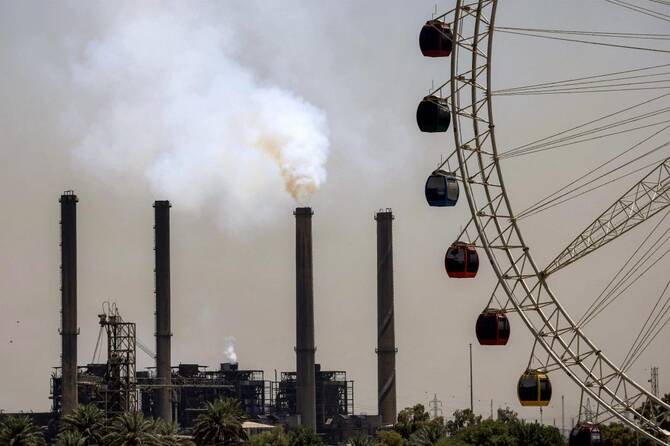
BAGHDAD: Electricity supply returned to all Iraq’s provinces on Tuesday, a government official told AFP, expecting the grid’s full recovery within a day after a nationwide power outage.
Electricity shortages are a frequent complaint in Iraq, suffering from endemic corruption and dilapidated public infrastructure.
Most households rely on private generators, acquired to compensate for daily power cuts to public electricity.
On Monday, the electricity ministry said that “a record rise in temperatures” coupled with a surge in demand resulted in the shutdown of transmission lines, which then led to a total outage.
A senior ministry official, speaking on condition of anonymity, told AFP on Tuesday that “since midnight, all provinces have seen the return” of power supply.
The official cautioned that “it is happening gradually,” with the central province of Karbala, where millions of Shiite Muslim pilgrims were expected for a major religious commemoration, being “the first to recover its electricity.”
In the capital Baghdad, the grid was back to 95 percent of its normal capacity, said the official.
The outage came amid a heatwave that Iraqi meteorological services expect to last more than a week, with temperatures climbing as high as 50C in parts of the country.
While the vast majority of Iraqis rely on private generators, they often cannot power all household appliances, especially air conditioners.
Iraq is sometimes rocked by protests when outages worsen in the hot summer months.
To avoid outages during peak demand, Iraq would need to produce around 55,000 megawatts of electricity.
This month, for the first time, the country’s power plants reached the 28,000-megawatt threshold.
The electricity ministry official said that “the system has returned to normal and is stable,” producing 24,000 megawatts and expected to reach 27,000 once the final malfunctions related to Monday’s outage are resolved.

Iraq electricity gradually back after nationwide outage
Short Url
https://arab.news/cyrvt
Iraq electricity gradually back after nationwide outage
- Most households rely on private generators, acquired to compensate for daily power cuts to public electricity
- In the capital Baghdad, the grid was back to 95 percent of its normal capacity, said the official
Village in southern Lebanon buries a child and father killed in Israeli drone strike
- Hassan Jaber, a police officer, and his 3-year-old son, Ali, were on foot when the strike hit a passing car in Yanouh on Monday
- The car’s driver, Ahmad Salami, was also killed. The Israeli military said Salami was an artillery official with Hezbollah
YANOUH: Mourners in southern Lebanon on Tuesday buried a father and his young son killed in an Israeli drone strike that targeted a Hezbollah member.
Hassan Jaber, a police officer, and his child, Ali, were on foot when the strike on Monday hit a passing car in the center of their town, Yanouh, relatives said. Lebanon’s health ministry said the boy was 3 years old. Both were killed at the scene along with the car driver, Ahmad Salami, who the Israeli military said in a statement was an artillery official with the Lebanese militant group.
It said it was aware of a “claim that uninvolved civilians were killed” and that the case is under review, adding it “makes every effort to reduce the likelihood of harm” to civilians.
Salami, also from Yanouh, was buried in the village Tuesday along with the father and son.
“There are always people here, it’s a crowded area,” with coffee shops and corner stores, a Shiite religious gathering hall, the municipality building and a civil defense center, a cousin of the boy’s father, also named Hassan Jaber, told The Associated Press.
When the boy and his father were struck, he said, they were going to a bakery making Lebanese breakfast flatbread known as manakish to see how it was made. They were standing only about 5 meters (5.5 yards) from the car when it was struck, the cousin said.
“It is not new for the Israeli enemy to carry out such actions,” he said. “There was a car they wanted to hit and they struck it in the middle of this crowded place.”
Jaber said the little boy, Ali, had not yet entered school but “showed signs of unusual intelligence.”
“What did this innocent child do wrong, this angel?” asked Ghazaleh Haider, the wife of the boy’s uncle. “Was he a fighter or a jihadi?”
Attendees at the funeral carried photos of Ali, a striking child with large green eyes and blond hair. Some also carried flags of Hezbollah or Amal, a Shiite party that is allied with but also sometimes a rival of Hezbollah.
Lebanon’s Internal Security Forces, of which the child’s father was a member, said in a statement that the 37-year-old father of three had joined in 2013 and reached the rank of first sergeant.
The strike came as Israel has stepped up its campaign against Hezbollah and its allies in Lebanon.
The night before the strike in Yanouh, Israeli forces launched a rare ground raid in the Lebanese village of Hebbarieh, several kilometers (miles) from the border, in which they seized a local official with the Sunni Islamist group Al-Jamaa Al-Islamiya, or the Islamic Group in English. The group is allied with Hezbollah and the Palestinian militant group Hamas.
The low-level conflict between Lebanon and Israel escalated into full-scale war in September 2024, later reined in but not fully stopped by a US-brokered ceasefire two months later.
Since then, Israel has accused Hezbollah of trying to rebuild and has carried out near-daily strikes in Lebanon that it says target Hezbollah militants and facilities.
Israeli forces also continue to occupy five hilltop points on the Lebanese side of the border. Hezbollah has claimed one strike against Israel since the ceasefire.
Hassan Jaber, a police officer, and his child, Ali, were on foot when the strike on Monday hit a passing car in the center of their town, Yanouh, relatives said. Lebanon’s health ministry said the boy was 3 years old. Both were killed at the scene along with the car driver, Ahmad Salami, who the Israeli military said in a statement was an artillery official with the Lebanese militant group.
It said it was aware of a “claim that uninvolved civilians were killed” and that the case is under review, adding it “makes every effort to reduce the likelihood of harm” to civilians.
Salami, also from Yanouh, was buried in the village Tuesday along with the father and son.
“There are always people here, it’s a crowded area,” with coffee shops and corner stores, a Shiite religious gathering hall, the municipality building and a civil defense center, a cousin of the boy’s father, also named Hassan Jaber, told The Associated Press.
When the boy and his father were struck, he said, they were going to a bakery making Lebanese breakfast flatbread known as manakish to see how it was made. They were standing only about 5 meters (5.5 yards) from the car when it was struck, the cousin said.
“It is not new for the Israeli enemy to carry out such actions,” he said. “There was a car they wanted to hit and they struck it in the middle of this crowded place.”
Jaber said the little boy, Ali, had not yet entered school but “showed signs of unusual intelligence.”
“What did this innocent child do wrong, this angel?” asked Ghazaleh Haider, the wife of the boy’s uncle. “Was he a fighter or a jihadi?”
Attendees at the funeral carried photos of Ali, a striking child with large green eyes and blond hair. Some also carried flags of Hezbollah or Amal, a Shiite party that is allied with but also sometimes a rival of Hezbollah.
Lebanon’s Internal Security Forces, of which the child’s father was a member, said in a statement that the 37-year-old father of three had joined in 2013 and reached the rank of first sergeant.
The strike came as Israel has stepped up its campaign against Hezbollah and its allies in Lebanon.
The night before the strike in Yanouh, Israeli forces launched a rare ground raid in the Lebanese village of Hebbarieh, several kilometers (miles) from the border, in which they seized a local official with the Sunni Islamist group Al-Jamaa Al-Islamiya, or the Islamic Group in English. The group is allied with Hezbollah and the Palestinian militant group Hamas.
The low-level conflict between Lebanon and Israel escalated into full-scale war in September 2024, later reined in but not fully stopped by a US-brokered ceasefire two months later.
Since then, Israel has accused Hezbollah of trying to rebuild and has carried out near-daily strikes in Lebanon that it says target Hezbollah militants and facilities.
Israeli forces also continue to occupy five hilltop points on the Lebanese side of the border. Hezbollah has claimed one strike against Israel since the ceasefire.
© 2026 SAUDI RESEARCH & PUBLISHING COMPANY, All Rights Reserved And subject to Terms of Use Agreement.


