

Colombia presidential hopeful dies after June rally shooting

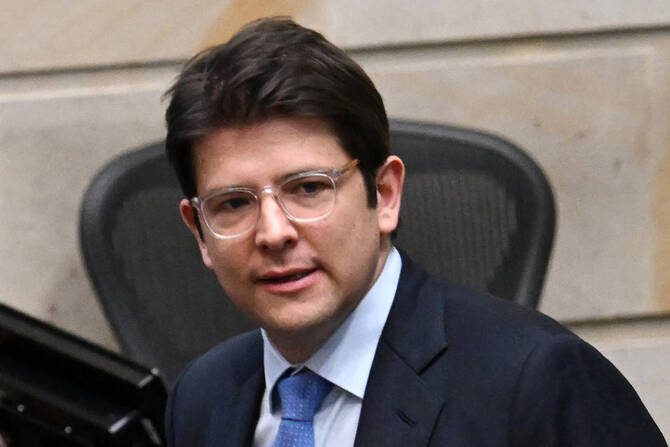
Colombian presidential candidate Miguel Uribe died two months after being shot in the head at a campaign event, his wife announced, Aug. 11, 2025. (File/AFP)
Short Url
Updated 11 August 2025
Follow

Colombia presidential hopeful dies after June rally shooting

  • Miguel Uribe, 39, was a conservative senator and a grandson of former president Julio Cesar Turbay (1978-1982)
  • Authorities have arrested six suspects linked to the attack and the alleged mastermind, Elder Jose Arteaga Hernandez, alias “El Costeno”

BOGOTA: Colombian presidential candidate Miguel Uribe has died two months after being shot at a campaign rally, his family said Monday, as the attack rekindled fears of a return to the nation’s violent past.

The 39-year-old conservative senator, a grandson of former president Julio Cesar Turbay (1978-1982), was shot in the head and leg on June 7 at a rally in the capital Bogota.

Despite signs of progress in recent weeks, his doctors on Saturday announced he had suffered a new brain hemorrhage.

“Rest in peace, love of my life,” his wife Maria Claudia Tarazona wrote Monday morning in a post on Instagram.

“Thank you for a life full of love.”

Authorities have arrested six suspects linked to the attack, including the alleged shooter, a 15-year-old boy captured at the scene by Uribe’s bodyguards.

Following a nationwide manhunt, police announced the arrest of an alleged mastermind behind the attack, Elder Jose Arteaga Hernandez, alias “El Costeno.”

Police have also pointed to a dissident group of the defunct FARC guerrilla group as being behind the assassination.

The attack on Uribe, a leading candidate ahead of the 2026 presidential election, has reopened old wounds in a country wracked by violence.

His own mother, journalist Diana Turbay, was killed in a botched 1991 police operation to free her from cocaine kingpin Pablo Escobar’s Medellin cartel.

Four presidential candidates were assassinated during the worst phase of violence in the 1980s and 1990s under Escobar, who terrorized citizens of Bogota, Medellin and elsewhere with a campaign of bombings.
 

Sad day for Colombia

“Today is a sad day for the country,” Colombian Vice President Francia Marquez said on social media.

“Violence cannot continue to mark our destiny. Democracy is not built with bullets or blood, it is built with respect, with dialogue.”

Uribe has been a strong critic of Colombia’s first left-wing president, Gustavo Petro, who has sought in vain to make peace with the country’s various remaining armed groups.

He announced in October that he would seek to succeed the term-limited Petro in the May 2026 presidential election.

Uribe was elected to Bogota’s city council at age 26, later becoming its youngest-ever chairperson and then the mayor’s right-hand man.

In 2019, he unsuccessfully ran for mayor of Bogota, but three years later, he was elected a senator — receiving the most votes of any candidate in the country.

He took a seat with the conservative Democratic Center party, founded by former president Alvaro Uribe, no relation.

“Evil destroys everything, they killed hope. May Miguel’s struggle be a light that illuminates Colombia’s rightful path,” former president Uribe wrote on X.

In recent months, Petro, a former left-wing guerrilla, has been accused of dialing up the political temperature by labelling his right-wing opponents “Nazis.”

US Secretary of State Marco Rubio, a frequent critic of the leftist Petro government, demanded justice following the announcement of Uribe’s death.

“The United States stands in solidarity with his family, the Colombian people, both in mourning and demanding justice for those responsible,” Rubio said.

Uribe leaves behind a young son and three teenage daughters of his wife, whom he had taken in as his own.


US kills 8 in eastern Pacific strikes on alleged drug boats

Updated 3 sec ago
Follow

US kills 8 in eastern Pacific strikes on alleged drug boats

  • Strikes on three alleged drug-trafficking vessels in the eastern Pacific Ocean killed eight people on Monday, according to the US military
WASHINGTON: Strikes on three alleged drug-trafficking vessels in the eastern Pacific Ocean killed eight people on Monday, according to the US military, the latest in a controversial campaign that has killed dozens of people.
Since early September, the US military under Pentagon chief Pete Hegseth has targeted alleged drug-smuggling boats in the Caribbean Sea and eastern Pacific Ocean, destroying at least 26 vessels and killing at least 95 people.
The US Southern Command announced the latest three strikes on X, saying the eight men killed had been involved in drug trafficking, without providing evidence.
The post included video footage of three separate boats floating in water before they are each hit by strikes.
“Intelligence confirmed that the vessels were transiting along known narco-trafficking routes in the Eastern Pacific and were engaged in narco-trafficking,” it said.
The strikes killed three men in the first vessel, two in the second and another three in the third, the US Southern Command added.
The strikes have drawn intense scrutiny from human rights advocates and Democratic lawmakers, with the United Nations’s human rights chief warning last month they could violate international law.
The US administration has labeled those killed as “unlawful combatants” and said it can legally engage in lethal strikes without judicial review due to a classified Justice Department finding.
US authorities have not provided specific evidence that the boats it has targeted were ferrying drugs.
Senate Minority Leader Chuck Schumer said that there would be an all-senators briefing Tuesday on the “administration’s rogue and reckless actions in the Caribbean,” with Hegseth and US Secretary of State Marco Rubio.
“The American people deserve oversight. We intend to deliver it,” the senior Democratic party lawmaker said in an X post published before the latest strike announcement by the US military.
- Concern over strikes -
The strikes have been accompanied by a massive US military buildup in the Caribbean that includes the world’s largest aircraft carrier and a slew of other warships.
US President Donald Trump has insisted the goal is combating narco-trafficking, while Venezuelan President Nicolas Maduro says he suspects it is a pretext for leadership change in Caracas.
The admiral leading US forces in the Caribbean, Alvin Holsey, stepped down last week, just a year into his tenure and after reportedly expressing concerns about the boat strikes.
Neither he nor Hegseth have publicly provided a reason for his early departure.
“We must always be there for like-minded partners, like-minded nations who share our values — democracy, rule of law and human rights,” Holsey said in a ceremony to mark him relinquishing command.
During one of the first strikes in September, survivors of an initial attack on a boat were killed in a second US strike on the vessel, generating accusations of a possible war crime since media reported details of the incident in November.
Hegseth has maintained he did not order a second strike, instead attributing it to the operational commander Admiral Frank Bradley.
Even before news of the double-strike broke, UN rights chief Volker Turk had urged Washington to investigate the legality of the campaign and warned of “strong indications” of “extrajudicial killings.”