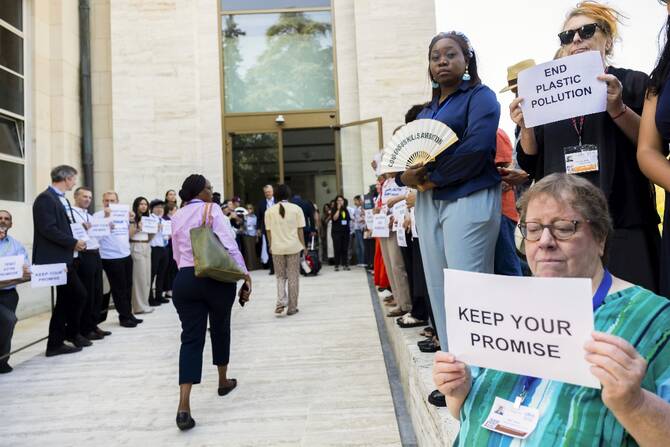

GENEVA: Countries remained at loggerheads Monday over how to tackle plastic pollution, with only four days left to craft a landmark global treaty on reining in the ever-growing scourge.
While plastic has transformed modern life, plastic pollution poses an increasing threat to the environment and the human body — and every day the garbage accumulates on land and in the oceans.
The 184 countries meeting at the United Nations to sculpt a first international accord setting out the way forward return to the negotiating table after a day off Sunday to reflect on their differences.
The first week of talks in Geneva fell behind schedule and failed to produce a clear text, with states still deeply divided at square one: the purpose and scope of the treaty they started negotiating two and a half years ago.
Last week, working groups met on technical topics ranging from the design of plastic to waste management, production, financing for recycling, plastic reuse, and funding waste collection in developing countries.
They also discussed molecules and chemical additives that pose environmental and health risks.
A nebulous cluster of mostly oil-producing states calling themselves the Like-Minded Group want the treaty to focus primarily on waste management.
The United States and India are also close to this club.
At the other end of the spectrum, a growing faction calling themselves the “ambitious” group want radical action written into the treaty, including measures to curb the damage caused by plastic garbage, such as phasing out the most dangerous chemicals.
Plastic pollution is so ubiquitous that microplastics have been found on the highest mountain peaks, in the deepest ocean trench and scattered throughout almost every part of the human body.
The ambitious group wants a clause reining in plastic production, which is set to triple by 2060.
The club brings together the European Union, many African and Latin American countries, Australia, Britain, Switzerland and Canada.
It also includes island micro-nations drowning in plastic trash they did little to produce and have little capacity to deal with.
Palau, speaking for 39 small island developing states (SIDS), said the treaty had to deal with removing the plastic garbage “already choking our oceans.”
“SIDS will not stand by while our future is bartered away in a stalemate,” and “this brinkmanship has a real price: a dying ocean,” the Micronesian archipelago said.
The treaty is set to be settled by universal consensus; but with countries far apart, the lowest-ambition countries are quite comfortable not budging, observers said.
“We risk having a meaningless treaty without any binding global rules like bans and phase-outs. This is unacceptable,” Eirik Lindebjerg, global plastics adviser for the World Wide Fund for Nature, told AFP.
“Expecting any meaningful outcome to this process through consensus is a delusion. With the time remaining, the ambitious governments must come together as a majority to finalize the treaty text and prepare to agree it through a vote.”
Without touching on whether ambitious countries would ultimately abandon consensus and go for a vote, the EU’s environment commissioner Jessika Roswall, due in Geneva on Monday, urged countries to speed up negotiations and not “miss this historic opportunity.”
The draft treaty has ballooned from 22 to 35 pages — with the number of brackets in the text going up near five-fold to almost 1,500 as countries insert a blizzard of conflicting wishes and ideas.
“With four more days to go, we have more square brackets in the text than plastic in the sea. It’s time to get results,” Roswall said.
In total, 70 ministers and around 30 senior government officials are expected in Geneva from Tuesday onwards and could perhaps help break the deadlock.