

In India, Trump’s tariffs spark calls to boycott American goods

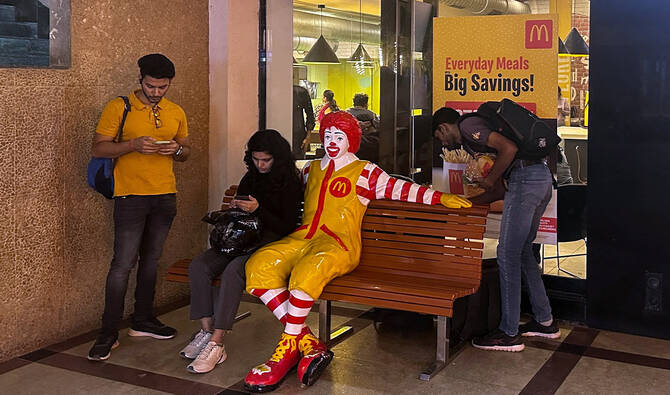
A person sits outside a McDonald’s restaurant in Mumbai, India, on February 26, 2024. (REUTERS/File)
Short Url
Updated 11 August 2025
Follow

In India, Trump’s tariffs spark calls to boycott American goods

  • Trump recently imposed a 50 percent tariff on goods from India, rattling exporters and damaging ties with New Delhi
  • India is a key market for American brands that have rapidly expanded to target growing base of affluent consumers

NEW DELHI: From McDonald’s and Coca-Cola to Amazon and Apple, US-based multinationals are facing calls for a boycott in India as business executives and Prime Minister Narendra Modi’s supporters stoke anti-American sentiment to protest against US tariffs.

India, the world’s most populous nation, is a key market for American brands that have rapidly expanded to target a growing base of affluent consumers, many of whom remain infatuated with international labels seen as symbols of moving up in life. India, for example, is the biggest market by users for Meta’s WhatsApp and Domino’s has more restaurants than any other brand in the country.

Beverages like Pepsi and Coca-Cola often dominate store shelves, and people still queue up when a new Apple store opens or a Starbucks cafe doles out discounts. Although there was no immediate indication of sales being hit, there’s a growing chorus both on social media and offline to buy local and ditch American products after Donald Trump imposed a 50 percent tariff on goods from India, rattling exporters and damaging ties between New Delhi and Washington.

McDonald’s, Coca-Cola, Amazon and Apple did not immediately respond to Reuters queries.

Manish Chowdhary, co-founder of India’s Wow Skin Science, took to LinkedIn with a video message urging support for farmers and startups to make “Made in India” a “global obsession,” and to learn from South Korea whose food and beauty products are famous worldwide.

“We have lined up for products from thousands of miles away. We have proudly spent on brands that we don’t own, while our own makers fight for attention in their own country,” he said.

Rahm Shastry, CEO of India’s DriveU, which provides a car driver on call service, wrote on LinkedIn: “India should have its own home-grown Twitter/Google/YouTube/WhatsApp/FB — like China has.”

To be fair, Indian retail companies give foreign brands like Starbucks stiff competition in the domestic market, but going global has been a challenge. Indian IT services firms, however, have become deeply entrenched in the global economy, with the likes of TCS and Infosys providing software solutions to clients world over.

On Sunday, Modi made a “special appeal” for becoming self-reliant, telling a gathering in Bengaluru that Indian technology companies made products for the world but “now is the time for us to give more priority to India’s needs.”

He did not name any company.

DON’T DRAG MY MCPUFF INTO IT

Even as anti-American protests simmer, Tesla launched its second showroom in India in New Delhi, with Monday’s opening attended by Indian commerce ministry officials and US embassy officials.

The Swadeshi Jagran Manch group, which is linked to Modi’s Bharatiya Janata Party, took out small public rallies across India on Sunday, urging people to boycott American brands.

“People are now looking at Indian products. It will take some time to fructify,” Ashwani MaHajjan, the group’s co-convenor, told Reuters. “This is a call for nationalism, patriotism.”
He also shared with Reuters a table his group is circulating on WhatsApp, listing Indian brands of bath soaps, toothpaste and cold drinks that people could choose over foreign ones.

On social media, one of the group’s campaigns is a graphic titled “Boycott foreign food chains,” with logos of McDonald’s and many other restaurant brands.
In Uttar Pradesh, Rajat Gupta, 37, who was dining at a McDonald’s in Lucknow on Monday, said he wasn’t concerned about the tariff protests and simply enjoyed the 49-rupee ($0.55) coffee he considered good value for money.

“Tariffs are a matter of diplomacy and my McPuff, coffee should not be dragged into it,” he said. 


Trump sues the BBC for defamation over editing of January 6 speech, seeks up to $10 billion in damages

Updated 59 min 28 sec ago
Follow

Trump sues the BBC for defamation over editing of January 6 speech, seeks up to $10 billion in damages

  • A BBC spokesperson told Reuters earlier on Monday that it had “no further contact from President Trump’s lawyers at this point
  • The BBC is funded through a mandatory license fee on all TV viewers, which UK lawyers say could make any payout to Trump politically fraught

WASHING: President Donald Trump sued the BBC on Monday for defamation over edited clips of a speech that made it appear he directed supporters to storm the US Capitol, opening an international front in his fight against media coverage he deems untrue or unfair. Trump accused Britain’s publicly owned broadcaster of defaming him by splicing together parts of a January 6, 2021 speech, including one section where he told supporters to march on the Capitol and another where he said “fight like hell.” It omitted a section in which he called for peaceful protest.
Trump’s lawsuit alleges the BBC defamed him and violated a Florida law that bars deceptive and unfair trade practices. He is seeking $5 billion in damages for each of the lawsuit’s two counts. The BBC has apologized to Trump, admitted an error of judgment and acknowledged that the edit gave the mistaken impression that he had made a direct call for violent action. But it has said there is no legal basis to sue.
Trump, in his lawsuit filed Monday in Miami federal court, said the BBC despite its apology “has made no showing of actual remorse for its wrongdoing nor meaningful institutional changes to prevent future journalistic abuses.”
The BBC is funded through a mandatory license fee on all TV viewers, which UK lawyers say could make any payout to Trump politically fraught.
A spokesman for Trump’s legal team said in a statement the BBC “has a long pattern of deceiving its audience in coverage of President Trump, all in service of its own leftist political agenda.”
A BBC spokesperson told Reuters earlier on Monday that it had “no further contact from President Trump’s lawyers at this point. Our position remains the same.” The broadcaster did not immediately respond to a request for comment after the lawsuit was filed.

CRISIS LED TO RESIGNATIONS
Facing one of the biggest crises in its 103-year history, the BBC has said it has no plans to rebroadcast the documentary on any of its platforms.
The dispute over the clip, featured on the BBC’s “Panorama” documentary show shortly before the 2024 presidential election, sparked a public relations crisis for the broadcaster, leading to the resignations of its two most senior officials.
Trump’s lawyers say the BBC caused him overwhelming reputational and financial harm.
The documentary drew scrutiny after the leak of a BBC memo by an external standards adviser that raised concerns about how it was edited, part of a wider investigation of political bias at the publicly funded broadcaster.
The documentary was not broadcast in the United States.
Trump may have sued in the US because defamation claims in Britain must be brought within a year of publication, a window that has closed for the “Panorama” episode.
To overcome the US Constitution’s legal protections for free speech and the press, Trump will need to prove not only that the edit was false and defamatory but also that the BBC knowingly misled viewers or acted recklessly.
The broadcaster could argue that the documentary was substantially true and its editing decisions did not create a false impression, legal experts said. It could also claim the program did not damage Trump’s reputation.
Other media have settled with Trump, including CBS and ABC when Trump sued them following his comeback win in the November 2024 election.
Trump has filed lawsuits against the New York Times, the Wall Street Journal and a newspaper in Iowa, all three of which have denied wrongdoing. The attack on the US Capitol in January 2021 was aimed at blocking Congress from certifying Joe Biden’s presidential win over Trump in the 2020 US election.