



ISLAMABAD: In the foothills of Azad Kashmir, where receding springs once signaled environmental collapse and families quietly planned their migration, a schoolteacher is proving that climate action doesn’t have to come from the top.
Usman Abbasi, 46, began his environmental journey a decade ago in his hometown of Kotli, where he watched rising temperatures, erratic rainfall and deforestation chip away at the valley’s ecological balance. A teacher at the time, Abbasi started modestly, planting trees and installing dustbins around his community, but the impact of Pakistan’s climate crisis soon compelled him to take his mission further.
Fast forward to 2025, and Abbasi is leading a quiet but powerful grassroots movement centered on rainwater harvesting wells and ponds. His efforts, now expanding into the Pakistani capital of Islamabad, have helped communities save millions of rupees, restored groundwater in parched regions and convinced entire families to abandon their plans to leave.
“This solution is not expensive,” Abbasi told Arab News during a visit to the Institute of Islamic Sciences in Islamabad, one of the many institutions transformed by his approach. “If someone can afford to install a Rs600,000 ($2,117) borewell at home, they can add this [electric motor] system for just Rs150,000 ($529).”
Abbasi first visited the seminary during a 2024 plantation drive and discovered that the campus, home to over 1,200 students, had little access to piped water. The school was spending Rs30,000 ($105) per day on tankers.
Months later, he returned with a solution: a Rs180,000 ($635) rainwater harvesting well, which now channels monsoon runoff from rooftops into an underground system filled with natural filtration materials.
“It’s drilled like a borewell and filled with charcoal, gravel, sand, broken bricks or stones, and wrapped in a geofabric cloth to prevent dirt from entering,” he explained. “Rainwater from rooftops and the surrounding ground is channeled into this well through pipes visible in the two manholes.”

Usman Abbasi (right) watching the level of water in his underground well in Islamabad, Pakistan on August 3, 2025. (AN Photo)
The result was immediate. Two dry boreholes were revived, and today, a single motor runs for six hours a day, providing water for drinking, washing, and daily use, saving the seminary nearly Rs900,000 ($3,175) each month.
“In our area, groundwater has dropped drastically,” said Abrar Ahmed, deputy general secretary of the institute.
“Borewells that once worked at 70–80 feet now have to go 500 feet deep, and even then, it is hard to find water. We’re hopeful that by implementing the same method for our other borewells, not only will the institution’s water crisis be resolved, but the surrounding area’s needs can also be fulfilled.”
“RAINWATER HARVESTING”
Pakistan, a country of over 240 million people, relies heavily on groundwater for both agriculture and domestic use. According to the World Bank, 90 percent of rural households and over 50 percent of agriculture depend on underground water. Yet despite this reliance, the country lacks a coordinated groundwater management system, and aquifers are being rapidly depleted due to over-extraction, poor infrastructure, and climate change.
Abbasi’s model is being noticed. Aamir Mehmood Mirza, Secretary of Environment, Wildlife and Fisheries, praised his work and its impact on community awareness.
“He should also seek technical guidance and expert assistance to yield better results, and we are developing a model soon with our experts to gather scientific data on such efforts to expand them on a larger scale,” he said.
In recent years, Pakistan has introduced measures to encourage rainwater harvesting.
In 2025, the federal cabinet approved a Green Building Code mandating such systems in all new construction. In Punjab province, the Environmental Protection Agency has required rainwater harvesting across 23 industrial sectors. In Rawalpindi, the Water and Sanitation Agency (WASA), in collaboration with UN-HABITAT, is installing systems in 30 public buildings.
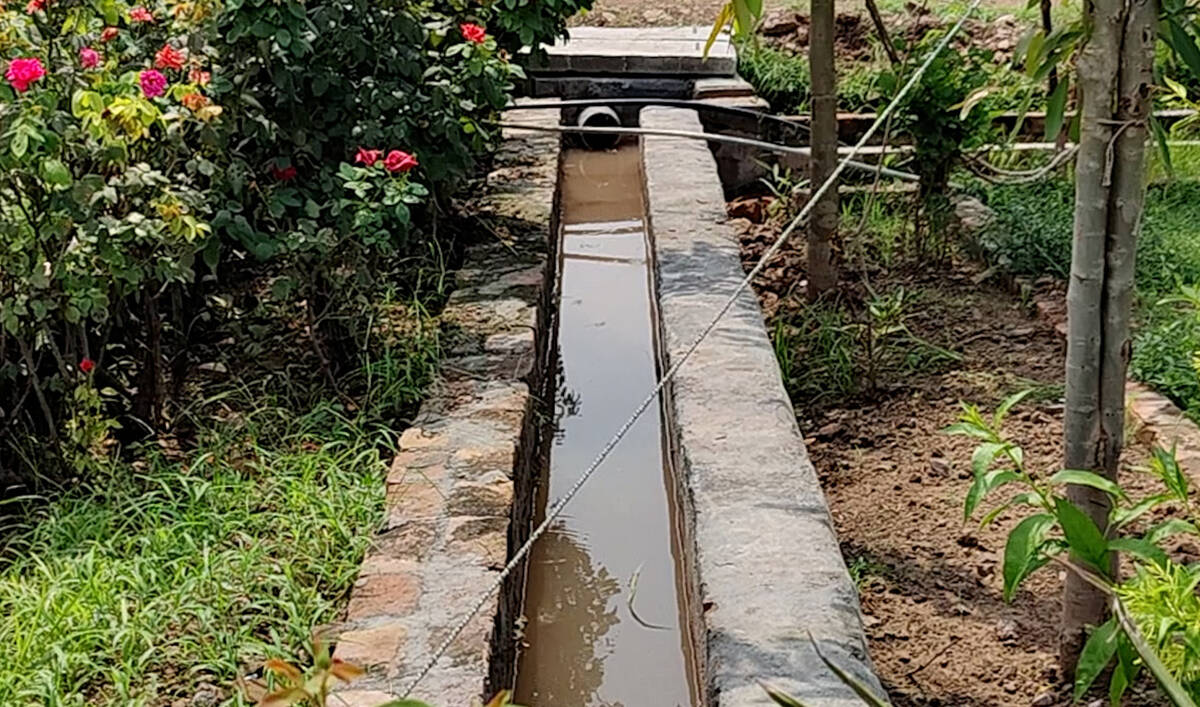
A canal designed to collect rainwater and divert it into an underground well is visible in this picture taken in Islamabad, Pakistan, on August 3, 2025. (AN Photo)
But Abbasi’s work extends far beyond formal policy. In the rugged hills of northern Pakistan, he has built hundreds of rainwater ponds that have brought back natural springs, revived livestock farming, and allowed residents to stay on ancestral land.
His influence is growing online, too. Using platforms like TikTok, YouTube, and Facebook, Abbasi has amassed more than 600,000 followers.
“This is the real use of social media,” he said. “Through my social media, I have created a following of like-minded people and together we can drive this social change.”
In the summer of 2024, Abbasi along with the local community members, planted nearly 80,000 trees across Azad Kashmir. His work has earned him a presidential nomination by the Azad Kashmir government.
“This [environmental conservation] is something that we all must absolutely do, not to earn something from it but for our country and our future generations,” Abbasi said. “If a collective action to preserve the environment is not taken, then in a few years, there will be no water, there will be mountains of trash everywhere and a concrete jungle.”


