

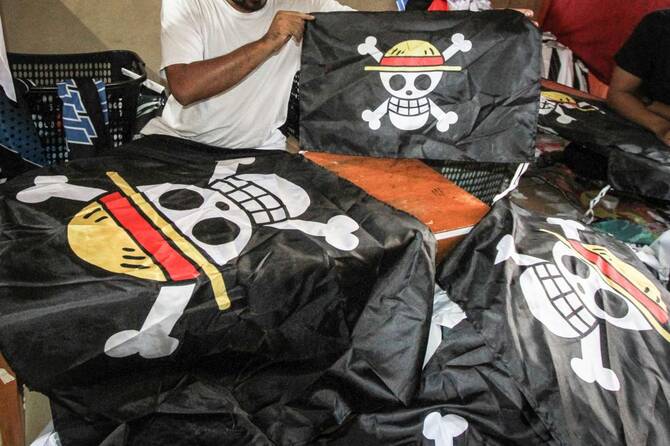
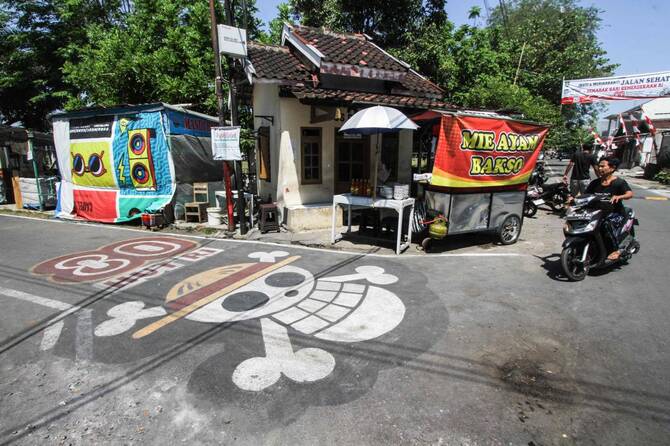

JAKARTA: Indonesia is cracking down on a viral pirate flag that is spreading as a symbol of political protest ahead of independence day.
The Jolly Roger skull and bones with a straw hat – from Japanese anime series “One Piece” – has been fluttering from a rising number of trucks, cars and homes.
Officials warn the “provocation” – seen by many as a protest against President Prabowo Subianto’s policies – should not fly alongside the country’s red-and-white flag.
The pirate banner was taken up by disgruntled truck drivers earlier this summer, but has recently snowballed into an online and real-life movement.
“I personally raised the One Piece flag because the red and white flag is too sacred to be raised in this corrupt country,” Khariq Anhar, a 24-year-old university student in Sumatra’s Riau province, said.
“I believe freedom of speech in Indonesia exists, but it is very limited. Voicing your opinion is getting more dangerous.”
Government officials say the flag’s use is an attempt to divide the nation.
They warn it may be banned from flying next to Indonesia’s colors, or being raised on August 17 – the 80th independence anniversary after Japan’s surrender at the end of World War II.
“It is imperative we refrain from creating provocation with symbols that are not relevant to this country’s struggle,” chief security minister Budi Gunawan said in a statement last week.
Ministers have cited a law that prohibits flying a symbol higher than the national flag as the basis for any punishment.
Under that law, intent to desecrate, insult or degrade the flag carries a maximum prison sentence of five years or a fine of nearly $31,000.
State Secretary Minister Prasetyo Hadi on Tuesday said Prabowo had no issue with the “expression of creativity,” but the two flags “should not be placed side by side in a way that invites comparison,” local media reported.
A presidency spokesman did not respond to an AFP question about its position on the pirate flag, which was put two days earlier.
Experts say unhappy Indonesians are using the flag as a way to express anti-government feeling indirectly, with some of Prabowo’s economic and defense policies causing concern about democratic backsliding.
“Symbols like the pirate flag let people channel frustration without spelling it out,” said Dedi Dinarto, lead Indonesia analyst at advisory firm Global Counsel.
“It reflects a public sentiment that parts of the country have been ‘hijacked’.”
Others, like food seller Andri Saputra, who has flown the pirate ensign below an Indonesian flag at his home for a week, say they want to be able to decide what symbols they display.
“I want to be free to express my opinion and express myself,” the 38-year-old said in Boyolali regency in Central Java.
“This is just a cartoon flag from Japan.”
Online culture has been a popular channel for Indonesian dissatisfaction against perceived government corruption and nepotism.
Japanese anime is popular in Indonesia, and in the best-selling ‘One Piece’ manga series created in 1997, the flag represents opposition to an authoritarian world government.
In February, protests known as ‘Dark Indonesia’ began against Prabowo’s widespread budget cuts, sparked by a logo posted on social media showing a black Indonesian mythical Garuda bird alongside the words ‘Emergency Warning’.
Other rallies in 2016 and 2019 were also sparked online, and Dedi says the government may be worried that “this follows the same digital playbook.”
There is also a generational divide, with older locals viewing the Indonesian flag as hard-won after centuries of colonial rule, while younger Indonesians see the new movement as an expression of disappointment.
“They just want Indonesia to get better, but... they can only express it through the ‘One Piece’ flag,” said Ismail Fahmi, founder of Indonesian social media monitor Drone Emprit.
Police in Banten Province neighboring capital Jakarta and West Java Province, Indonesia’s most populous, have threatened action if the flag is flown next to the nation’s colors.
One printing business owner in Central Java said on condition of anonymity that his facility was raided by plain-clothes police on Wednesday evening to halt its production of the pirate emblem.
Rights groups have called the response excessive and say Indonesians are allowed to wave the flag by law.
“Raising the ‘One Piece’ flag as a critic is a part of the freedom of speech and it is guaranteed by the constitution,” said Amnesty International Indonesia executive director Usman Hamid.
Despite the government’s threats, some young Indonesians are still willing to risk walking the plank of protest.
“Last night my friend and I went around the town while raising a One Piece flag,” said Khariq on Wednesday.
“If the government has no fear of repressing its own people, we shouldn’t be scared to fight bad policies.”


