SEOUL: South Korea and the United States will launch their annual large-scale military exercise this month to bolster readiness against North Korean threats, the allies said Thursday, in a move likely to irritate Pyongyang amid a prolonged stalemate in diplomacy.
The exercise also comes against the backdrop of concerns in Seoul that the Trump administration could shake up the decades-old alliance by demanding higher payments for the US troop presence in South Korea and possibly move to reduce it as Washington puts more focus on China.
Ulchi Freedom Shield, the second of two large-scale exercises held annually in South Korea, following another set of drills in March, typically involves thousands of troops in computer-simulated command post training and combined field exercises.
The Aug. 18-28 exercise may trigger an angry reaction from North Korea, which calls the joint drills invasion rehearsals and often uses them as a pretext to dial up military demonstrations and weapons tests aimed at advancing its nuclear program.
Doubling down on its nuclear ambitions, North Korea has repeatedly rejected Washington and Seoul’s calls to resume diplomacy aimed at winding down its weapons program, which derailed in 2019. The North has now made Russia the priority of its foreign policy, sending thousands of troops and large amounts of military equipment to support Moscow’s war in Ukraine.
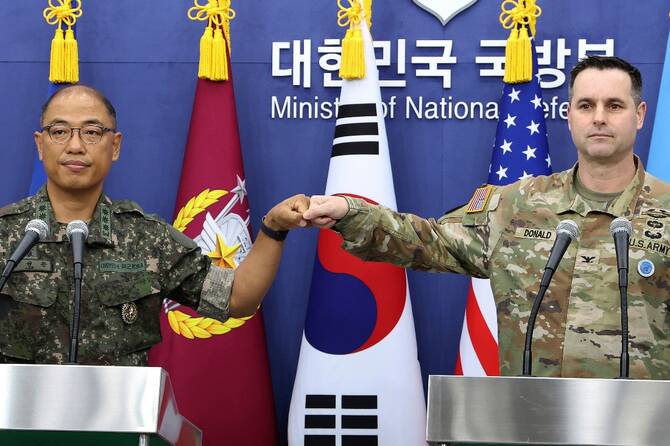
About 18,000 South Korean troops will take part in this year’s Ulchi Freedom Shield exercise, South Korea’s Joint Chiefs of Staff spokesperson, Col. Lee Sung Joon, said during a joint briefing with US Forces Korea, which did not disclose the number of participating US troops.
Both Lee and US Forces Korea public affairs director Col. Ryan Donald downplayed speculation that South Korea’s new liberal government, led by President Lee Jae Myung, sought to downsize the exercise to create momentum for dialogue with Pyongyang, saying its scale is similar to previous years. However, Col. Lee said about half of the exercise’s originally planned 40 field training programs were postponed to September due to heat concerns.
The threat from North Korea’s advancing nuclear and missile programs will be a key focus of the exercise, which will include training to deter North Korean nuclear use and respond to its missile attacks, Lee said.
The exercise will also incorporate lessons from recent conflicts, including Russia’s war in Ukraine and the clash between Israel and Iran, and address threats from drones, GPS jamming and cyberattacks, Lee and Donald said.
“We look across the globe at the challenges we may face on the battlefield and incorporate that so we can challenge the participants in the exercise,” Donald said. “We are focused on ensuring the alliance is sustainable and credibly deters aggression from the DPRK and addresses the broader regional security challenges,” he said, using the initials of North Korea’s formal name, the Democratic People’s Republic of Korea.
The announcement of the exercise came a week after the powerful sister of North Korean leader Kim Jong Un rebuffed overtures by Lee Jae Myung’s government, saying that Seoul’s “blind trust” in its alliance with Washington and hostility toward Pyongyang make it no different from its hard-line conservative predecessor.
Kim Yo Jong later issued a separate statement dismissing the Trump administration’s intent to resume diplomacy on North Korea’s denuclearization, suggesting that Pyongyang — now focused on expanding ties with Russia — sees little urgency in resuming talks with Seoul or Washington.
On the other side of Seoul’s security concerns is whether its alliance with Washington will see dramatic shifts during the second term of President Donald Trump, who has rattled allies and partners with tariff hikes and demands that they reduce their reliance on the US and spend more for their own defense.
Dating back to his first term, Trump has regularly called for South Korea to pay more for the 28,500 American troops stationed on its soil. Recent comments by key Trump administration officials, including Undersecretary of Defense Elbridge Colby, have also suggested a desire to restructure the alliance, which some experts say could potentially affect the size and roles of US forces in South Korea.
Under this approach, South Korea would take a greater role in countering North Korean threats while US forces focus more on China, possibly leaving Seoul to face reduced benefits but increased costs and risks, experts say. During Thursday’s news conference, Donald did not provide a specific answer when asked whether US and South Korean troops during their combined exercise will train for any possible realignment of US troops to face broader regional threats.
The future of the alliance will possibly be a topic in a summit between Trump and South Korean President Lee, which is expected this month. In a recent interview with the Washington Post, Lee’s foreign minister, Cho Hyun, downplayed the possibility of significant changes to the US military presence in South Korea.
“We are talking with the United States, but there is no concern about the US forces in Korea. We believe that they will remain as such and their role will remain as of today,” he said.


![]()

South Korea, US militaries will stage large-scale drills this month to address North Korean threats
Short Url
https://arab.news/bhrrx
South Korea, US militaries will stage large-scale drills this month to address North Korean threats
- The announcement of the exercise came a week after the powerful sister of North Korean leader Kim Jong Un rebuffed overtures by Lee Jae Myung’s government


Latest updates





© 2026 SAUDI RESEARCH & PUBLISHING COMPANY, All Rights Reserved And subject to Terms of Use Agreement.